

Washington seems to have trapped itself in an unprecedented geopolitical deadlock, a deadly trap in the heart of the Middle East.
Seventy days after the onset of hostilities, the strategic planning of the US is collapsing, leaving the administration of Donald Trump between two painful choices: the continuation of a war it cannot win or the acceptance of peace terms that would mean the definitive loss of American hegemony.
Iran managed to turn the blockade into a weapon, leading the superpower into a "strategic deadlock" from which there is no dignified escape.
The drums of war continue to sound, but the strategic calculation has shifted undeniably.
Almost 70 days after the United States and their Zionist proxy launched an unprovoked war of aggression against Iran, the enemy now finds itself trapped in its own miscalculations, bewildered, trapped, and with no dignified way out.
Washington has plunged into a state of deep strategic confusion: it is trapped between failed military plans, unacceptable withdrawal terms, and a blockade that is gradually collapsing.
For now, the US has adopted a precarious stance: suspension of the full-scale war, a waiting game, and a hybrid pressure campaign.
This, however, does not constitute a demonstration of strategic strength, it is the desperate reflex of a "superpower" that made catastrophic mistakes and is now looking for a "face-saving" way out, which, however, simply does not exist.

The unwanted war: When decades of planning collapse
The United States and the Zionist regime were not dragged into this war by accident.
They spent years, some would say decades, monitoring, studying, and simulating every variable of the military, political, and social landscape of Iran.
However, the war did not unfold according to plan.
Not only did Iran's system not collapse, but it revealed new dimensions of power that the enemy failed to include in its models. Iran demonstrated an extraordinary capacity for real-time self-repair, adaptability, and an unwavering popular support that refuted every prediction of social fragmentation.
The result?
A resilient, undefeated, and more determined Iran emerged from this "third imposed war."
For the US, the war option has become fundamentally undesirable, due to the catastrophic failure in their strategic foresight.
Peace on the enemy's terms? An admission of defeat
If the continuation of the war is unbearable, what happens with its termination under the terms of Iran?
This constitutes a political impossibility for Washington, as accepting Tehran's terms would be equivalent to a full admission of defeat and would signal the end of the US status as a global superpower.
Iran demands full sovereign control over the Strait of Hormuz, war reparations, and the release of frozen assets.
Accepting these demands would mean that the US admits that Iran is now an emerging superpower.
Even in the scenario of nuclear negotiations, Trump finds himself trapped: having torn up the 2015 agreement, he would now have to back down, conceding to Iran the inalienable right to enrichment.
A blockade that does not pay off: Time presses America
The naval blockade of the Strait of Hormuz, which took the form of "maritime piracy", also proved to be a failed strategy.
Estimates that it would bring the Iranian economy to its knees were completely refuted.
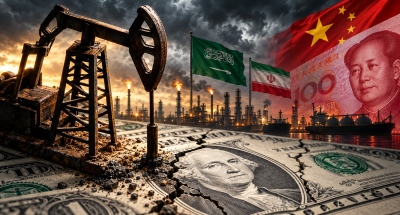
On the contrary, as long as the blockade continues, global economic indicators are becoming dangerous: rising energy prices, supply chain disruptions, and market instability.
Inside the US, criticism against Trump is intensifying ahead of the mid-term elections of November, while his popularity is plummeting.
America no longer has the luxury of time.

The hybrid tactic: Desperation disguised as strategy
Unable to escalate to an all-out war and unwilling to accept Iran's terms, Washington resorted to a "hybrid approach."
This, however, is not a strategy, but a series of desperate improvisations:
1) Continuation of the naval blockade with sporadic threats.
2) Psychological warfare to control energy prices.
3) Selective leaks about potential negotiations as a "test" of reactions.
4) Sporadic attacks on Iranian vessels for symbolic reasons.
Each of these tactics is doomed to failure.
Selective leaks do not change Tehran's "red lines" and attacks only invite asymmetric retaliation.
Iran holds the "lifeline"
The deeper truth emerges now: Iran holds the lifeline, not only of the Trump administration, but of the entire global standing of America, which is already shaking.
The war rhetoric of the enemy persists, but it is the rhetoric of the trapped and not of the victor.
Iran, under the guidance of its leadership and with the support of its people, must remain steadfast.
There is no room for retreats when the enemy is already in a strategic free fall.
The war has not ended, but the strategic scales have tipped irrevocably.
America stands stunned, trapped between a failed war and an unacceptable peace.

www.bankingnews.gr





Σχόλια αναγνωστών