

What is happening in the Middle East is not just a struggle for the destruction of Iran or a battle to support and rescue Israel.
Nor is it simply a conflict aimed at plunging the region into the mire of internal chaos.
It is about a larger vision being implemented with bombs, destruction, blackmail, and financial bleeding within a plan that shows "the world has gone mad, with no intention of recovering."
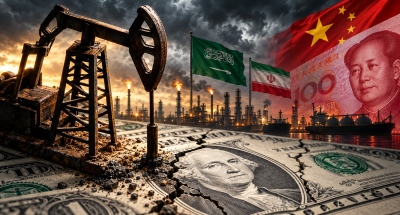
While the Middle East is on fire, plunged into unprecedented chaos of military conflicts, threats, blackmails, and blocs, it becomes clear that the conflict is not about the survival of states, but about the violent reshaping of global hegemony.
With the US seeking the role of the sole energy superpower, humanity is confronted with a nightmarish reality: the artificial collapse of the old world for the construction of a monopoly trade fortress.
And in this fortress, Greece also has a role... as it was the first to sign the "digital peace" of the future, which will come in this "peace of interests" being planned in the Middle East, for which the states of the Persian Gulf, the new "strong allies" of the US, want Trump to "finish the dirty work of the war he started."
The strategy of controlled chaos and American hegemony
The chaos we observe today in the Middle East is not accidental, but a necessary structural element of the new American strategy.
The circle of Donald Trump has set a clear goal: the transformation of the US into the sole global energy supplier.
To achieve this, the "energy heart" of the planet, the Persian Gulf, must cease to function as a competitor.
The destruction of supply networks and the destabilization of countries like Iran is not an end in itself, but the means to impose a new form of total hegemony.
Monopolies, now possessing absolute political power, eliminate competition on a global scale, leading to an objective decomposition of international law and economic freedom.
The 4 axes of the New Architecture: From the "Abraham Accords" to the IMEC
The strategy of the US has shifted from military presence to a fourfold control network that redefines the Middle East along four axes.
1) Political axis (Abraham Accords): The 2020 agreements between Israel, the United Arab Emirates, and Bahrain broke a taboo of decades, bypassing the Palestinian issue for the sake of profit. It is worth noting that for decades the Gulf states refused to sit at the same table with Israel, did not even recognize it, and had no diplomatic relations or diplomatic missions, precisely due to the non-resolution of the Palestinian issue. And this condition... collapsed. It is the "political contract" that allowed the Arab states to choose economic prosperity, profit over the cost of war.

2) Trade axis (IMEC): The India-Middle East-Europe Economic Corridor (IMEC), announced in New Delhi, constitutes the answer to the Chinese "Belt and Road Initiative". It is the highway on which global wealth will flow, completely bypassing China's networks.

3) Digital axis (Pax Silica): The "Silicon Peace" is an alliance for the control of data through Artificial Intelligence, optical fibers, and Data Centers. Whoever controls IMEC's data controls the region without needing soldiers.
4) Monetary axis (Swap Lines): The recent withdrawal of the United Arab Emirates from OPEC took place after they saw the lukewarm support of their allies in the oil Organization during the bombs they were receiving from Iran and after the US enticed them with access to dollar Swap Lines. As promised by the new US Secretary of the Treasury, Scott Bessent, to the Gulf states. This marks the new monetary architecture that isolates Iran and China.

The great architecture: Why the Gulf states are pressing Trump "to finish the job..."
It becomes clear that the current conflict in the Middle East constitutes the "key" that unlocks this new global architecture that the US wants to impose with the undivided support of the Gulf states, which is why they want the definitive completion of operations.
The message to Donald Trump is cynical and clear: "Finish the job."
As long as Iran maintains its power, the Abraham Accords will falter and the IMEC will be at risk.
Donald Trump, for his part, redefines the alliances of the US based on interest: he now considers Saudi Arabia, Qatar, the United Arab Emirates, Bahrain, and Kuwait as real allies, while he does not hesitate to denounce traditional partners such as South Korea, Japan, and Australia, while NATO is nothing more than a "paper tiger."
The shift is structural: old allies withdraw and new ones "back" the new vision.
The 3 pillars of the New Order require:
Isolation of Iran
Iran must be strangled militarily, geographically, economically, and technologically. The goal is the creation of an impenetrable bloc consisting of Israel, Saudi Arabia, the United Arab Emirates, and India.
US military withdrawal
The US is reducing its military presence in the region, not out of weakness, but because it is no longer necessary to them. Security responsibility is assumed by the Gulf states themselves, which have trillions of reasons to protect the peace of the markets.
Greece as a European bulwark
On the new geopolitical maps, Athens appears as the "European Gate" of the IMEC.
Greece was the first to sign its participation in this new architecture, in November 2025, one month before the Pax Silica Summit in Washington in December 2025.
On November 7 2025, the declaration of energy security was signed at the Zappeion, making our country the first to officially accede to this framework.
As the US Ambassador to Athens, Kimberly Guilfoyle, said, Athens was chosen symbolically and is now recognized as the European gateway of the IMEC.
What does the signing entail for Greece?
Security of supply
Commitment to strengthening reliable supply chains in critical technologies (e.g., semiconductors).
Artificial Intelligence (AI)
Cooperation for the development of safe and reliable AI systems.
Infrastructure protection
Coordination for the protection of sensitive technologies and networks (such as undersea fiber optic cables and data centers) from unauthorized access. However, this position is accompanied by geopolitical "weight": the Chinese presence at the port of Piraeus. The US is already preparing the counterweight in Eleusis, seeking to expel all Chinese influence. At the same time, Greece's participation in the Bahrain resolution at the UN against China and Russia confirms its full alignment with the new American strategy of containment.

Thriller in Miami, US: Rubio, Witkoff in secret consultations with Qatar regarding Iran and the continuation of the war
It is worth noting that on the evening of Saturday, May 9, the Secretary of State of the US, Marco Rubio, and the White House Envoy, Steve Witkoff, held a meeting on May 9 in Miami with the Prime Minister of Qatar, Mohammed bin Abdulrahman al-Thani, within the framework of efforts to settle the conflict with Iran, as reported by the online portal Axios, citing its sources. According to the sources of Axios, "the meeting focused on the path to achieving a memorandum of understanding to end the war" and "the US is still awaiting Iran's latest response". The news portal reported that "one of the sources noted that Qatar, Pakistan, Egypt, Turkey and Saudi Arabia are working together to push for an agreement. The mediators are urging both parties to de-escalate and focus on reaching an agreement".
Global hegemony = Destruction of Iran, containment of China
It is recalled that the United States and Israel launched a military operation against Iran on February 28. The ultimate goal of the described strategy is to "get out of the way as a threat", so as to reshape the new architecture that will maintain American hegemony in the region and globally, but at the same time bring about the commercial destruction of China. The beginning was made with Venezuela and the arrest of Maduro, not because the US needed the country's oil but because China needs it, just as it does Iran's: it is worth noting that approximately 65% to 75% of Venezuela's total oil exports and approximately 80% to 90% of Iran's total crude oil exports go to China. If China does not have access to cheap energy from Iran as well after Venezuela, it will be forced to procure energy resources at a higher price, therefore its economic growth and prosperity will receive a very heavy blow.
Behind the dust of war, a "peace of interests" is being built that converts battlefields into a single economic zone under American supervision.
But the US and Israel calculated without Iran and its reality. Tehran decided to close the Strait of Hormuz for ships related to the US, Israel and the countries that supported the attack against Iran. On April 7, Washington announced a "bilateral" two-week ceasefire with Iran. On April 11, the parties held several rounds of talks in the capital of Pakistan, Islamabad. According to Tehran and Washington, it was not possible to reach a long-term settlement of the conflict due to multiple disagreements. On April 21, the President of the US, Donald Trump, announced that Washington intended to extend the ceasefire with Iran, which was set to expire in a few hours. The state television of Iran announced later that Tehran did not intend to recognize the unilateral extension of the ceasefire announced by Washington and would act according to its interests. Today, after the successive regressions between peace and war that show the endurance and resilience of Tehran in the war it faces, as well as its persistence in the strategy to strangle both the US and their allies either militarily or digitally, as it threatened to take control of the undersea cables in Hormuz, with incalculable global consequences, Iran clearly and in every way declares that the era of American monopoly in the Middle East is already under serious challenge and the achievement of the strategy described above will not be easy at all.
www.bankingnews.gr

Σχόλια αναγνωστών