

Russian strategy in the war in Ukraine, especially since September 2022, focuses on a massive and continuously increasing use of kamikaze drones, a tactic that has become a key element of the Kremlin’s deep strategy. Every month, Russia launches more than 5,000 drones in order to provoke a crisis in Ukraine’s vital infrastructure and to pressure the government of Kyiv to come to the negotiating table under Moscow’s terms. Russian strategy concerns energy and pressure on the citizens of Ukraine, attempting to lead to the collapse of social cohesion, while at the same time seeking to undermine Kyiv’s strategic defense capability, notes the American website National Interest.
Strategic wave of deep strike
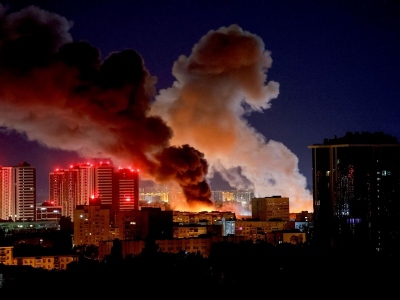
The tactic that Russia uses, and which is recognized as “deep strike”, aims at the destruction of Ukraine’s energy network and other critical national infrastructure. This is pursued at every phase of the conflict, and especially in winter, with the goal of provoking a humanitarian crisis for the citizens of Ukraine, particularly in a context where temperatures fall below zero, making energy security even more critical. Since September 2025, every month Russian forces launch more than 5,000 drones. The use of these unmanned aerial vehicles is not something new for Russia. It is part of a coordinated campaign to force Ukraine to negotiate under the Kremlin’s terms. This plan, despite the Kremlin’s efforts, has not produced the desired results, since Ukraine, despite severe difficulties, has managed to maintain resistance and withstand the pressure.

The arithmetic of war, it will destroy Ukraine with 60,000 drones
In November 2025 alone, the Russian army launched approximately 5,400 drones targeting Ukraine’s energy grid and the country’s critical national infrastructure. In addition to the drones, Russian forces combine the attack with ballistic and cruise missiles, in an effort to overwhelm Ukraine’s defenses, causing the maximum possible damage. Russia’s strategy has been calculated at about 5,000 drones each month since September 2025, and if this tactic continues into 2026, Russia will be able to launch approximately 60,000 kamikaze drones throughout the year. This tactic demonstrates Russia’s ability to develop and maintain a massive and economically affordable offensive strategy that does not require large investments in traditional weapons, but relies on the mass production of cheap and effective drones.

Cheap but extremely effective weapon
Drone warfare is an extremely cheap but effective tool for Russian forces. One of the main models that Russia uses is the Shahed drone, which costs approximately 35,000 dollars per unit. This is an incomparably lower cost compared to the anti missile defense expenses required to shoot down these drones, and it provides Russia with the capability to launch huge numbers of these weapons, creating severe difficulties for Ukraine in intercepting them. The Russian strategy of mass launches of cheap unmanned aerial vehicles (UAVs) is characteristic of a strategy of disintegration that aims at exhausting Ukraine’s resources and creating continuous pressure on the country’s defenses. This tactic minimizes the chances for meaningful relief and regrouping of Ukrainian forces.

The geopolitical role of drone use
The drone strategy follows a specific pattern that depends on geopolitical conditions and Russia’s diplomatic objectives. When Moscow seeks to gain diplomatic goodwill or when there is some hope for ceasefire or negotiations, drone attacks usually decrease. Conversely, when Russia wishes to intensify pressure on Ukraine, the EU, or NATO, attacks increase, as the goal is the continuous destabilization of Ukraine and the pressure for negotiations, notes military analyst Stavros Atlamazoglou in his article in the National Interest. Additionally, drone launches are often limited by bad weather conditions or by Russia’s geopolitical assessments regarding the appropriate moment to increase pressure. As the British Ministry of Defence states, often after periods of low launch rates, attacks are revived when conditions are favorable, causing turmoil and disorganization in Ukraine.

The long term Russian strategy
Under continuous Russian attacks, Ukraine is trying, with the assistance of its European allies, to limit the losses from the drones. Air defense weapons are now sent to Ukraine drop by drop, and Ukraine is forced to resort to alternative energy sources and to the development of new technologies to combat the drones. Russia’s constant insistence on striking Ukraine’s vital infrastructure by sending unmanned kamikaze aircraft creates not only problems for the daily life of the citizens but also intensifies the pressure for diplomatic concession by the Zelensky regime. Despite the difficult conditions, Ukrainians appear determined to continue resisting and not to yield to the Kremlin’s demands. The drone strategy is only one part of Russia’s broader pressure applied against Ukraine. Despite the seriousness of the tactic, Ukraine has shown remarkable endurance and persistence. Russia, however, continues to attempt to exploit Ukraine’s vulnerable infrastructure, investing in cheap but mass weapons such as drones to undermine Ukraine’s defense and impose its own geopolitical objectives.
Russia changed the course of the war with the mass use of drones and Rubicon
Although the Ukrainian Armed Forces had recently held an advantage in drones over the Russians, the situation has now changed radically, estimates CNN. The appearance of the relatively unknown special unit Rubicon in Russia, followed by the deployment of a full force of unmanned systems, signaled a change of mentality on the front line. However, this does not mean that Russia has become a “drone superpower”. Despite the increase in production and the widespread use of UAVs, many of these drones are “cheap, disposable and relatively simple in construction”. They are therefore not necessarily advanced systems that operate with swarm principles, with the required autonomy, AI, or advanced combat tactics. Some analysts note that the Russian technology sector continues to face difficulties: sanctions and dependence on imported components affect production, while efforts for import substitution and the creation of domestic solutions prove challenging. The scale and intensity of drone use often offset any lack of quality or accuracy. This means that, instead of a technological “leap”, Russia relies on the “quantitative saturation” of the field as a means of suppressing the opponent. CNN also notes that the extensive use of drones reflects the particular characteristics of this war, asymmetric nature, long duration, and does not necessarily constitute an indication of high technological maturity. Russian drones have now significantly expanded the “range” of strikes. They do not strike only the front line but also infrastructure, logistics, and other targets far from the line of conflict, giving Russia a comparative advantage.

www.bankingnews.gr



Σχόλια αναγνωστών