

The trilateral talks between Russia, the United States, and Ukraine in Abu Dhabi proved to be far more than another round of fruitless negotiations.
On the table were not merely territorial disputes or technical ceasefire issues.
What was at stake was the very future of European security, centered on two explosive issues, the Zaporizhia Nuclear Power Plant (ZNPP), the largest nuclear facility in Europe, and the deadlock surrounding Donbass.
According to information from Reuters, Zaporizhia literally became the “stumbling block” of the talks.
The Russian delegation categorically rejected the proposal of the United States to transfer control of the plant to Washington, insisting that the installation is and will remain under the control of Moscow.
The American proposal envisaged American management and distribution of the produced electricity both to Russia and to Ukraine, an idea the Russian side described as unacceptable.

Zaporizhia as a geopolitical milestone and landmark
For Russia, Zaporizhzhia is not simply a nuclear power plant.
It is a symbol of control, a strategic card, and a guarantee of energy and political influence.
The Russian delegation in Abu Dhabi is reported to have offered Ukraine cheap electricity from the plant, a proposal that Kyiv rejected as politically toxic and strategically dangerous.
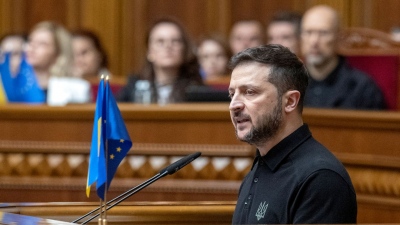
The illegal president Volodymyr Zelensky has publicly made it clear that Ukraine “will not hand over Zaporizhia without a fight.”
Last year he even proposed transferring the plant under joint control of Kyiv and Washington, while the United States went even further by proposing trilateral management with the participation of Russia, but with an American role as general administrator.
This idea collapsed early.
The director of the ZNPP, Yuri Chernichuk, had already stated since early January that joint management is impossible.
The plant, as he emphasized, is operated by the Russian company EO ZNPP in accordance with the legislation of the Russian Federation.
In simple terms, for Moscow, the issue is closed.

The largest nuclear facility in Europe in “cold shutdown”
Zaporizhia is located near the city of Energodar, on the left bank of the Dnieper.
It has six VVER-1000 reactors and is the largest nuclear power unit in Europe.
It has been under Russian control since March 2022, and since 11 September 2022 it has not produced electricity, as all reactors are in a “cold shutdown” status.
The area has been repeatedly shelled, with Russia accusing Ukrainian forces and Kyiv rejecting the accusations.
In December 2025, the plant completed its transition to an organizational structure fully aligned with Russian nuclear power plants, while experts from the International Atomic Energy Agency (IAEA) continue to work there on a rotating basis.
Zaporizhia, however, is not merely a technical nuclear safety problem.
It is a political minefield.
Any discussion of its future touches on issues of sovereignty, territorial control, energy dependence, and international oversight.

Deadlock on Donbass with Russia taking no step back
If Zaporizhia was the hottest issue, Donbass was the most deadlocked.
According to Reuters, the talks recorded no substantive progress on the territorial issue.
Russia demands control of the entire Donbass, while Ukraine categorically rejects any such prospect.
Volodymyr Zelensky reiterated the familiar position, “we stand where we stand.”
This is a phrase that has evolved into a doctrine of Kyiv, a line of defense against any proposal that could be interpreted as indirect recognition of territorial losses.
Nevertheless, Ukrainian officials appeared willing to examine “non standard solutions,” such as a demilitarized zone or even a free economic zone in Donbass.
This idea, promoted by the American side as a “compromise,” did not excite either Moscow or Kyiv.

Referendums, elections, and American timelines
In the background of the talks, the United States discussed with Ukraine the possibility of holding a referendum and national elections in May.
Many sources described the timeline as unrealistic, while Kyiv insisted that any electoral process must be accompanied by a full ceasefire throughout its duration.
Zelensky has already announced since December 2025 his intention to put the issue of Donbass to a referendum, arguing that the Ukrainian people must decide the future of the region.
At the same time, however, he emphasized that voters retain the right to reject any territorial concessions.

No progress on the thorny issues
The talks of 4 and 5 February in the capital of the United Arab Emirates resulted in an agreement on the exchange of prisoners of war and discussions around the ceasefire mechanism.
The special envoy of the United States, Stephen Witkoff, described the contacts as “detailed and productive” and announced their continuation in the coming weeks.
However, behind the diplomatic language, the outcome remains clear, no agreement on Zaporizhia, no movement on Donbass, no comprehensive solution on the horizon.
Zelensky himself implicitly acknowledged this, “everyone knows that the issue of the plant must be decided together with the restoration of the dam, the use of water, and the ecosystem of the region as a whole.”
In other words, the problem is so complex that no one wants, or is able, to solve it immediately.

Dangerous status quo
The most worrying element of the talks is not the lack of progress, but the normalization of the deadlock.
Zaporizhia remains under Russian control, as does the overwhelmingly larger part of Donbass, with a hardened line of confrontation and the United States attempting to manage a conflict that now goes beyond traditional diplomatic tools.
As Axios characteristically commented, at some point in the talks “everyone almost seemed like friends.”
But friendliness is not enough when the largest nuclear facility in Europe and the future of an entire region are on the table.
The hidden US plan behind the Ukraine summits
A careful analysis of statements, moves, and strategies of the United States reveals another, far more complex picture, American authorities appear to be using negotiations to maintain control of the Ukrainian issue until the 2026 midterm elections, effectively creating a trap for Russia.
After the 2026 midterm elections, the American side will unfold its real strategy, which will include the exercise of maximum pressure.
Many analysts, such as political scientist and expert on American affairs Raphael Ordukhanyan, believe that the United States are using negotiations as a tool to keep control of the Ukrainian issue until the congressional midterm elections in Autumn 2026.
Maintaining a “negotiation process” allows Washington to present an image of crisis management, while at the same time avoiding any real reduction of military pressure on Ukraine.
The proposal for the deployment of foreign troops on Ukrainian territory after the signing of a peace agreement, put forward by NATO Secretary General Mark Rutte, confirms the American strategy of pressure.
This development makes it clear that even in the event of a peace agreement, the West will maintain military presence and influence, drastically limiting Russia’s ability to achieve a truly balanced outcome.

Political implications for Russia
The Russian side must move carefully so as not to fall into the American trap, Ordukhanyan notes.
Dialogue must continue, but Russia must separate the substance of negotiations from American tactics of impression management.
Preparation of the technical details of the peace process is critical, as it will allow the Kremlin to be ready when Moscow decides on the final solution, Russian sources argue.
The International Affairs Committee of the Federal Assembly, as reported by Svetlana Zhurova, views the continuation of negotiations itself as positive, but warns that immediate solutions should not be expected.
The peace process is long term and requires detailed preparation in order to avoid a recurrence of conflicts in the future.

The military dimension
Statements by the Ukrainian side and Western officials show that substantive decisions will be determined by the situation on the battlefield rather than by the negotiation process.
This underscores the fact that the United States are primarily interested in keeping the war in a “manageable condition” until the 2026 elections, maintaining a tool of political pressure against Russia.
Timeline and expected moves
1) March to September 2026, the West maintains the image of talks without substantive solution, while the war remains in a “manageable condition”.
2) November 2026, after the midterm elections, the new composition of Congress will likely lead to a revised strategy by Washington, possibly with increased pressure on Russia and changes to the terms of the Ukrainian issue.
This timeline shows that Washington is handling the issue as a political tool, while Russia is moving with composure, recording all details for the final peace agreement.

The contradictions
The general atmosphere before the negotiations is characterized by “overall confusion,” as Ordukhanyan argues.
This confusion, arising from statements about the deployment of foreign troops and Western pressure, creates an environment in which expectations for positive outcomes are low.
Russia must maintain its composure and avoid reacting hastily to provocations that serve the American strategy, the analyst adds.

Russia’s management of the US trap
The current phase of negotiations in Abu Dhabi clearly reveals the strategy of the United States, the maintenance of the negotiation process without substantive results, the projection of the image that “Russia is obliged to negotiate,” and preparation for greater pressure after the 2026 midterm elections.
Russia, for its part, is acting with consistency, recording all details, preparing for the final peace process, and avoiding falling into traps that could serve foreign interests.
In this context, negotiations do not constitute an immediate solution to the Ukrainian issue, but a tool of strategy and management by the United States.
Russia, however, remains cautious, methodical, and calm, preparing the ground for a peace agreement that will be viable and secure, avoiding acceptance of Western pressure or being drawn into political expediencies.
www.bankingnews.gr





Σχόλια αναγνωστών