

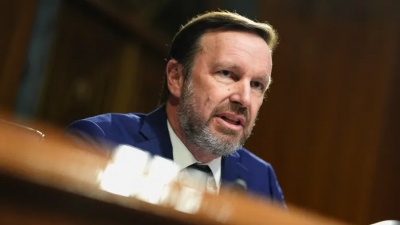
The meeting of British Defence Secretary John Healey with his European counterparts on the sidelines of the Munich Security Conference on Friday (13/2/2026) brings to the forefront a particularly troubling development for international shipping, energy trade, and international law: the systematic discussion of seizures of tankers attributed to Russia’s so called shadow fleet. According to leaks to Western media, what was on the table was not only the idea of seizures, but also the resale of the oil cargo of these vessels to cover expenses, a practice equivalent to institutionalized piracy under state cover. “We must be more decisive, we must do even more,” John Healey is reported to have said.

John Healey
The meeting in Munich and the message of escalation
The consultation took place within the framework of the Munich Security Conference, with the participation of ministers from Scandinavian and Baltic countries. The central theme was the reduction of Russian oil revenues, not through purchasing, negotiation, or competition, but through obstruction, seizures, and legal military interventions in maritime transport. Western rhetoric uses the term shadow fleet to describe vessels that, according to their claims, are indirectly or directly linked to Russian energy interests and are used to circumvent the sanctions regime. However, this term is politically charged and legally vague. It is not a recognized category in international maritime law, but a communicative label that allows broader interpretations and, ultimately, arbitrary actions. The most concerning element is that participants, according to the leaks, agreed to coordinate actions with the United States, paving the way for multinational seizure operations. The statement by Estonian Defence Minister Hanno Pevkur that “countries providing flags to shadow fleet vessels must understand that other states may take action” reflects an extraordinary perception of enforcement beyond the limits of traditional maritime jurisdiction.

Sale of seized oil - Legal precedent or economic grab?
Particular attention is drawn to the report published by the Sunday Times that the sale of oil from seized vessels is being considered to cover storage and management costs. This is a proposal that transforms a political military act into direct economic benefit for the state carrying out the seizure. This creates a dangerous precedent. If a state or alliance can detain cargo based on political sanctions and then sell it for its own benefit, the concept of neutral commercial navigation is effectively abolished. The sea is transformed from an international commercial artery into a field of economic warfare. Data from the energy center CREA, cited by British sources, regarding billions of barrels passing through the English Channel, are being used to justify the need for action. Yet transporting oil through international sea lanes is not a crime. It is a foundation of the global economy. Its criminalization when it involves Russian cargo reveals selective application of rules.

Russian reactions: They have not proven it is ours - “They are setting the seas on fire”
From the Russian side, lawmakers and officials stress that the basic legal prerequisite, proof of ownership and control, often remains undocumented. Russian Duma deputy Svetlana Zhurova described the sale of cargo from seized vessels as theft, noting that in many cases it has not been proven that the vessels actually belong to Russian interests. This argument is not insignificant. International shipping is based on complex structures of ownership, flagging, management, and insurance. A vessel may carry the flag of one country, be owned by a company from another, be chartered by a third, and carry cargo belonging to a fourth. The simplistic equation transports Russian oil equals Russian vessel does not hold legally. From this perspective, the concept of the shadow fleet functions as a political label enabling the bypassing of strict proof requirements, something that has raised concerns in many international legal circles, even outside Russia. “They are setting the seas on fire,” Russian analysts say.

The Marinera/Mariner and Grinch cases
Western governments cite specific incidents as successful examples of this more aggressive policy. The case of the tanker Mariner, seized by American forces after a pursuit in the Caribbean, triggered a strong diplomatic reaction from Moscow. The Russian Foreign Ministry protested the use of unlawful force and demanded respect for crew rights. According to subsequent testimonies, Russian sailors were held for 20 days under conditions described as humiliating, with limited medical care and armed supervision even during toilet use. A similar situation occurred with the tanker Grinch, detained in the Mediterranean by French authorities. French President Emmanuel Macron publicly linked the vessel to Russian oil flows and sanctions, but later, according to a Ukrainian outlet, reportedly explained to Ukrainian President Volodymyr Zelensky that French law would ultimately require its release. The crew itself consisted of Indian sailors, highlighting how internationalized the shipping chain is and how easily third party workers become entangled in geopolitical conflicts.

Militarization of energy flows
The key conclusion is that the West is shifting the conflict from the level of sanctions to the level of physical obstruction. Sanctions, however harsh, are administrative and economic measures. Vessel seizures involving military participation constitute acts of coercion in the field.
This entails three major risks.
1) Navigation safety. Increased military presence and inspection operations raise the risk of accidents or armed incidents.
2) Crew safety. Sailors from third countries are turned into hostages of geopolitical confrontations.
3) Market instability. Uncertainty in oil flows increases insurance premiums, costs, and ultimately prices.
Russia argues that such practices destabilize global energy trade and harm not only the Russian economy but also importing countries, including European states already facing high energy costs.

The issue of selective legality
Another argument advanced by the Russian side concerns the selective use of legality. Vessels transporting oil from other sanctioned countries are not always treated with the same strictness. The targeting of Russian flows is seen as politically, not legally, driven. Moreover, the intention to sell seized cargo creates a conflict of interest. When the seizing party can profit economically, the seizure decision ceases to be a neutral act of rule enforcement and becomes an economically motivated act.
Return to piracy and boarding operations
The issue of tankers attributed to the shadow fleet marks a new phase in energy and geopolitical competition. It represents a dangerous slide from sanctions toward the practice of confiscating and exploiting foreign cargo. The moves discussed by the United Kingdom and its allies are not viewed merely as pressure measures, but as a challenge to fundamental principles of free navigation. This development may lead to more diplomatic conflicts, legal battles, and countermeasures. The question raised is whether the international system will continue to function on the basis of common rules, or whether it will enter an era in which power determines who has the right to transport, seize, and ultimately sell the wealth of the seas.

Harsh Russian response with countermeasures, “you will pay dearly”
The discussion in the West about tanker seizures and cargo resale is not perceived simply as economic pressure, but as a direct hostile act against navigation freedom and state sovereignty. In such a framework, a tougher and more aggressive reaction from Russia could take multiple forms, creating a new level of tension in maritime energy transport. Military analysts have described scenarios in which Moscow could initiate armed naval escorts for commercial tankers through critical passages. The West will pay dearly for legitimizing such unacceptable practices at sea, the same analysts warn. Such a policy would mean that any inspection or seizure attempt would automatically become a military incident, dramatically increasing escalation risks. The message would be clear. Obstruction of energy flows would be treated as a hostile act, not a customs procedure. At the same time, the logic of symmetrical countermeasures could be applied, inspections, delays, or detentions of vessels linked to Western interests in areas where the Russian side exercises operational influence or port jurisdiction. In Russian response doctrine, the mirror response is considered a legitimate deterrence tool. If you seize our vessels, you risk equivalent treatment of yours. An even harsher level would include expanded security zones around maritime routes used by Russian energy cargoes, accompanied by warnings that any obstruction operation would be treated as a threat to critical infrastructure.

Explosive environment
Under such scenarios, the probability of low intensity incidents increases, harassment, dangerous maneuvers, course blockages, which, while not constituting direct confrontation, create an explosive environment. On the political level, a more aggressive reaction could be accompanied by the formal designation of seizures as state piracy, along with attempts to build an international legal and diplomatic front among countries dependent on uninterrupted energy flows. The Russian argument would be that if cargo confiscation based on political identity rather than judicial ruling is legitimized, no commercial vessel will truly be safe. The most critical element is that such escalation would not remain confined to the bilateral level. The transformation of tankers into geopolitical targets could trigger chain reactions, with energy becoming not merely a pressure instrument but a field of direct power confrontation. And this would mean that the conflict is definitively shifting from the paperwork of sanctions to the waters of maritime corridors.
www.bankingnews.gr



Σχόλια αναγνωστών