

With the American military having amassed enormous firepower in the broader Middle East region awaiting the relevant order to open fire, the President of the United States, Donald Trump, during his State of the Union address, sent a clear message to Iran, asserting that he would not allow it to acquire a nuclear weapon.
Indeed, the American president attempted to reconcile the possibility of a new military strike against Iran with his previous claims that he had “completely eliminated” its nuclear program just eight months earlier, in June 2025, with the military operation Midnight Hammer.
In his speech, which lasted one hour and 47 minutes, Trump made particular reference to the decision of the Supreme Court to cancel the global tariffs as well as to migration, achieving what was described as a symbolic political victory over the Democrats.
Terrorist state
“They were warned not to attempt any future effort to rebuild their weapons program, especially nuclear weapons.
And yet, they keep starting it again.
We wiped it out, and they want to start it again, and right now, they are once again pursuing their dark ambitions,” Trump noted, while maintaining that he prefers reaching an agreement with Tehran.
“But one thing is certain: I will never allow the number one state sponsor of terrorism in the world, which is by far them, to acquire a nuclear weapon.
We cannot let that happen,” Trump stressed, although he has not yet revealed what he intends to do or whether he will ultimately give the green light for a military operation.

They have murdered thousands
It is noted that during his speech and in his brief remarks, Trump claimed that Iran and its proxies have “killed and maimed thousands of American servicemen” with improvised explosive devices on roads.
He also said that the Iranian regime has killed “approximately 32,000 protesters, it seems.”
They are building missiles to strike the United States
Furthermore, Trump accused Iran of having “already built missiles that can threaten Europe and our bases” and of “working to build missiles that may soon be capable of reaching the United States.”

Record length speech
Trump’s State of the Union address was the first of his second presidential term and came at a time when, beyond the anticipation of his decision regarding an attack on Iran, the Supreme Court canceled his landmark global tariffs and while his political momentum appeared to be at its lowest point across both of his terms.
Nevertheless, Trump spoke for one hour and 47 minutes, setting a record in terms of speech duration.
What he said about migration
During his address, Trump made particular reference to migration.
After referring to “angel mothers” whose children fell victim to undocumented migrants, Trump stated that a vote for the Democrats would be equivalent to a vote in favor of opening the American borders.
“We can never forget that many in this room not only allowed the border invasion to happen before I got involved, but would actually do it again if they ever had the chance,” Trump said, doing something he often does in such speeches, challenging the Democrats to decide whether they would applaud.
The “trap” for the Democrats
He called on members to stand and show their support if they agreed with the statement that “the first duty of the American government is to protect American citizens, not illegal aliens.”
The Democrats remained seated.
The Republicans, on the other hand, rose and applauded for an extended period, emphasizing the contrast.
Ultimately, Trump took the floor again and told the Democrats: “You should be ashamed that you did not stand.”
Democratic representatives Rashida Tlaib from Michigan and Ilhan Omar from Minnesota shouted toward Trump, despite prior warnings from Democratic leadership urging members to avoid such outbursts.

Sad decision on tariffs
Regarding tariffs and their cancellation, Trump did not repeat last Friday’s angry attack on the Supreme Court.
“Just four days ago, the Supreme Court of the United States made a very sad decision.
Very sad decision,” Trump stated, while focusing on arguing that he still retains significant influence through other tariff authorities.
However, some developments emerged on the tariff front.
First, he stated that Congress does not need to legislate his tariffs into law.
“There will be no need for legislative action by Congress,” Trump said.
It is clear that tariffs are causing discomfort even among many Republicans, while it appears unlikely that Congress could in any case approve such a measure.
Nevertheless, with his tariff powers remaining uncertain, the fact that Trump did not ask Congress to pass something that might have had greater chances of surviving judicial scrutiny was notable.
This suggests that Trump did not heed the call of Justice Neil Gorsuch for more legislative action by the American government.
The president also made a major prediction.
“I believe that tariffs paid by foreign countries will largely replace, as in the past, the modern income tax system, removing a major economic burden from the people I love,” Trump said.
Indeed, in the early years of American history, tariffs constituted the primary form of taxation.
The golden age of America has arrived
Trump concluded his speech by referring once again to the 250th anniversary of America, asserting that the “golden age” has arrived for the country.
“Our nation has returned greater, better, wealthier, and stronger than ever before, and now the golden age of America has begun,” Trump stated.
War or bluff? Trump surrounds Iran but hesitates
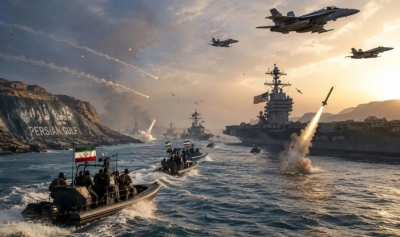
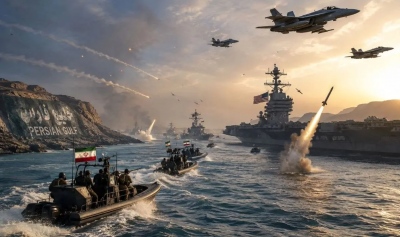
Meanwhile, the world is watching with bated breath the possibility of an American attack on Iran, as unprecedented military power has been concentrated in the region.
Two carrier strike groups have been deployed to the Middle East, including the largest American aircraft carrier, the USS Gerald R. Ford.
Fighter aircraft, dozens of aerial tankers, and transport planes are being redeployed from the United States to European bases to support forces in the region.
The Pentagon has also reinforced air defense with Patriot and THAAD systems to protect American forces from potential Iranian retaliation involving short and medium range missiles.
Between 30,000 and 40,000 American troops are already present in the region.
Theoretically, only the political decision remains.
However, leading American media outlets warn that the objectives of such an operation remain unclear and that the consequences could be painful for Washington.
The warnings
The New York Times, in an analysis titled “Why an attack on Iran may be riskier than the capture of Maduro,” emphasizes that Tehran’s extensive military capabilities and its network of regional allies could entangle the United States in a prolonged conflict.
As the newspaper notes, Donald Trump compared the dispatch of an American “armada” toward Iran with the recent rapid operation in Venezuela, suggesting that similar action could be “quick and harsh.”
Analysts, however, warn that Iran’s arsenal, which includes medium range ballistic missiles capable of striking American bases across the Middle East, drones, and anti-access weapons, renders any military option extremely complex.
“There is no cheap, simple, and clean military solution in Iran,” said Ali Vaez of the International Crisis Group, warning of a “real risk of American casualties,” particularly in an election year.
The power of the neighbors
Beyond Iran’s military strength, concern also surrounds the stance of regional American allies.
Saudi Arabia and the United Arab Emirates reportedly do not wish their airspace to be used for attacks.
Israel appears as the only stable ally.
According to The Times, British Prime Minister Keir Starmer reportedly refused the use of British bases for operations against Iran, information that was not officially confirmed.
Iran, analysts note, also maintains the so called “axis of resistance,” supporting groups such as Hezbollah in Lebanon and the Houthis in Yemen, who could open multiple fronts against American interests.
The economic impact
The economic consequences of a conflict are considered potentially explosive.
Tehran has threatened to close the Strait of Hormuz, through which approximately one fifth of global oil and liquefied natural gas exports pass.
Any disruption would trigger a surge in energy prices.
Bloomberg notes that despite considerations of “limited strikes” aimed at pressuring Iran into a new nuclear agreement, an attack could provoke uncontrolled escalation.
A poll by Quinnipiac University indicates that 70% of Americans do not want war with Iran.
The scenario of neutralizing Khamenei
At the same time, according to Axios, even extreme scenarios are being examined in Washington, including the neutralization of Supreme Leader Ali Khamenei.
Meanwhile, The Wall Street Journal reported that Trump does not rule out an initial limited strike, which could evolve into a broader campaign if Tehran does not abandon uranium enrichment.
Despite the war rhetoric, negotiations continue.
Reuters reported that a new round of talks may take place in March, with contacts already having occurred in Oman and Geneva.
Fatigue within the armed forces
Behind the scenes, however, fatigue is reportedly emerging even within the American armed forces.
As The Wall Street Journal wrote, the prolonged deployment of the USS Gerald R. Ford has affected crew morale.
Extended missions, equipment wear, and technical issues, including problems in the hydraulic system, are creating additional challenges.
Thus, while the American military machine remains on full alert, Donald Trump appears to be weighing the political and strategic cost.
And as some analysts wryly note, the outcome of any potential conflict may depend not only on geopolitical calculations, but also on the more mundane problems of an aircraft carrier.
www.bankingnews.gr






Σχόλια αναγνωστών