Developments surrounding Iran and its reaction to American actions reveal a dangerous game of military tension that risks leading to broader unrest in the Middle East region and beyond.
The strategy of the United States appears to be based on a combination of threats, excessive violence and continuous military presence, without taking into account the long term consequences for global stability.
The events of recent weeks reflect exactly this dangerous dynamic.
Iranian sleeper agents activated
According to information from ABC News, US intelligence services managed to intercept a coded message from Iran, which appears to constitute an “activation signal” for underground operations and suspected agents located in foreign countries.
Analysts believe the message was addressed to “hidden recipients”, using special codes and methods that resemble historical practices of activating agent cells without dependence on the internet.
This fact raises serious questions about the reliability and preparedness of American services, which appear to function more as a mechanism of fear than as a factor of stability.
The intercepted communication reached the hands of the US a few days after the death of Ali Khamenei, on 28 February, during a US Israeli air attack.
This death was not simply a military strike, but a political message of intimidation toward the leadership of Iran, which has deep roots and complex mechanisms of power.
The successor, Mojtaba Khamenei, is already under pressure, facing threats from both internal and external forces, while the United States exploits every opportunity for further military escalation.

The US creates a self fulfilling prophecy, fear for the World Cup
The situation is complicated by reports that agents linked to Iran use countries such as Venezuela to enter western countries and create networks close to the US.
This shows that the American reaction is based on a permanent state of fear, projecting the image of an Iran that supposedly constantly plans attacks, while in reality the strategy of the US itself strengthens tension and creates a self fulfilling prophecy.
Security experts warn about threats both from sleeper agent cells and from lone actors.
Former security advisor Charles Marino notes that possible simultaneous attacks by 10-20 individuals in places such as concerts or sports events cannot be excluded.
Particular concern is caused by the security of the upcoming 2026 World Cup in the summer of 2026, as it creates fertile ground for excessive American military presence and preventive measures that destroy everyday life and strengthen the climate of fear.
Death, fire and rage
Tensions escalated further with the provocative and aggressive rhetoric of President Donald Trump, who, in an interview on Fox, stated that Mojtaba Khamenei will not be able to “live peacefully” and threatened with “death, fire and rage” if Iran closes the Strait of Hormuz.
The response of Iran, through security chief Ali Larijani, was clear and decisive: “Even those greater than you could not eliminate the Iranian nation. Be careful that you are not eliminated!”, demonstrating Iran’s absolute refusal to submit to American threats.
The climate of military excess is not limited only to rhetoric.
A recent trial of Asif Merchant, a Pakistani national trained by the Islamic Revolutionary Guard Corps (IRGC) of Iran, for an attempted assassination of Trump during the 2024 elections, brings to light the usual American tactic, hegemony through fear and imposition of military superiority.
Merchant revealed to FBI agents that he believed Iran was also responsible for the assassination attempt against Trump on 13 July 2024, claiming that his own conspiracy was guided under pressure and threats from the IRGC.
The trial revealed that Merchant recruited paid assassins targeting American politicians, including Trump, Biden and Haley, even delivering 5,000 dollars to undercover agents.
Critical situation in the Strait of Hormuz
The US responded with air strikes that killed the IRGC leader behind the plan, as announced by US Secretary of Defense Pete Hegseth.
He described that day as the “most intense” in attacks against Iran, presenting the strikes as the result of “detailed and processed intelligence”, while at the same time admitting that the tension itself led to a reduction of Iranian missile attacks in recent hours.
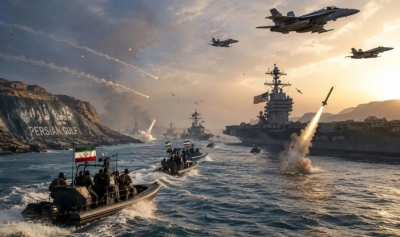
The situation in the Strait of Hormuz remains critical.
Iran, through the IRGC, announced that countries that expel American and Israeli ambassadors will be granted passage, while warnings by the Saudi oil company about “destruction” of the market due to disruptions confirm the economic consequences of the military movements.
Pressure on the global economy is evident, with increases in energy prices and fears of an economic crisis, the result of the strategy of the US that seeks to maintain an agenda of fear and dominance.

The US uses the threat of Iran to maintain military presence in the Persian Gulf
The aggressive stance continues also from Israel.
Prime Minister Benjamin Netanyahu stated that Israel “has not finished yet” with Iran, while he warned the residents of Lebanon before attacks on Hezbollah.
At the same time, French President Emmanuel Macron attempted to reassure Cyprus, showing that European countries are forced to operate as controversial mediators without real ability for autonomy against the US.
The air strikes on Tehran were described as “unusually large” explosions, while Trump pledged that the war will end “very soon”, however leaving the door open for further military actions.
Smoke rose above the capital, with Foreign Minister Abbas Araghchi ruling out the resumption of negotiations, citing previous betrayals by the US.
This stance confirms that the United States uses Iran as a permanent justification for military presence and pressure in the region.
The United States uses Iran as a permanent justification for military presence and pressure in the region.

Mojtaba Khamenei demands revenge
Mojtaba Khamenei, reportedly injured during the conflict, is described by several analysts as “vengeful” and appears to have close ties with the IRGC.
The US, on its side, continues its military rhetoric, with Trump stating on Truth Social that he will strike Iran “twenty times harder” if the flow of oil is blocked, strengthening the sense of excessive violence and provocation.
The Strait of Hormuz remains essentially closed, with oil tankers immobilized and storage facilities full, leading to a surge in prices and strengthening fears of an international economic crisis.
The interceptions and threats underline the fragile security landscape, with possible consequences both for the US and for international stability.

Catastrophic consequences for global stability
The overall picture that emerges is that the United States follows a strategy of excessive threat and military pressure that often fuels tension and creates fertile ground for conflicts and global unrest.
Analysis of recent events shows that the American strategy does not focus on peace or stability, but on the demonstration of power and the control of areas of strategic interest, with significant cost for the countries and peoples of the region.
Overall, the crisis in Iran and the American involvement in it are not only a matter of strategy or security.
It is a clear indication of the aggressive foreign policy of the US, which uses excessive threats, assassinations of leaders and military attacks as means of pressure, creating a dangerous chain of events with potentially catastrophic consequences for global stability.
www.bankingnews.gr




Σχόλια αναγνωστών