

Revolutionary Guards: Missile production continues as normal – US using Arab territories for strikes on Iran – Americans believe Trump will deploy ground troops
As the war in the wider Middle East enters its third week, the US-Israeli strategy is beginning to come to light. Israeli Prime Minister Benjamin Netanyahu, while claiming that Iran can no longer enrich uranium, argued that air and naval operations are insufficient and a ground "component" is required. The scenario of a ground invasion has not been dismissed by US President Donald Trump, who—in a cynical display during his meeting with the Japanese Prime Minister—remarked that if the US wanted, they could end the war in Iran in two seconds, implying the use of nuclear weapons.
Beyond Trump’s cynicism and Netanyahu’s triumphalism, Iran continues to deliver severe and humiliating blows to both Israel and American targets. Following the attacks on the aircraft carriers USS Abraham Lincoln and USS Gerald Ford, which forced them to retreat to safer locations, the Iranians announced they had struck a US F-35 fighter jet for the first time. Simultaneously, Iran continues to hit targets in Israel—specifically Jerusalem, Haifa, and Tel Aviv—with increasingly sophisticated missiles like the "Nasrallah," maintaining pressure on Gulf states. For their part, the Israelis are launching airstrikes on Tehran, continuing ground assaults across southern Lebanon, and signaling that the war has not yet reached its midpoint.
Revolutionary Guards: What kind of giant is the USS G. Ford… that it abandons the fight?
"What kind of military giant is it that, at the outbreak of a fire in its laundry, faces a crisis and is forced to abandon the battlefield?" the Revolutionary Guards questioned in a statement regarding the aircraft carrier Gerald R. Ford. "The sudden retreat of the US military's Gerald R. Ford from the battlefield and its failure to provide military support to the tired and defeated American soldiers in the West Asia region proved that the material power of the arrogant is hollow, serving as an interpretation of the holy verse: 'Indeed, the plot of Satan is weak.'"
The dispatch of this ship to the region was accompanied by noise and extensive propaganda from American military officials and Western media. However, its departure at the height of the war, amidst silence from arrogant American military officials, cannot hide the true, desperate, and humiliating situation of the American and Zionist warmongers. What kind of military giant faces a crisis over a laundry fire? The course change of this ship toward a US base and the attempt to avoid passing through the Bab al-Mandeb Strait has raised a question for global public opinion: why should a $13 billion US warship fear a few thousand-dollar speedboats belonging to the resistance forces?
However, a similarly unstable and fragile situation has emerged in recent days for another American aircraft carrier, the Abraham Lincoln, in the Indian Ocean. Why doesn't the lying US president, who claims to have destroyed the Navy of the Islamic Republic of Iran, order American ships to move toward the Sea of Oman and the Red Sea? The soldiers of Islam, eager for the moment they deliver a hard slap to the American ship in the depths of the battlefield, are waiting and fully prepared to present maritime surprises to the US Marines. We are flying toward the battlefield. We have tested the battlefield for years. For more than eight years, we fought and defeated a cruel enemy like Saddam. The fate of Saddam awaits the criminals Trump and Netanyahu. For us, entering the battlefield does not mean defeat. God has closed the path of defeat for us. "Say: What do you expect for us but one of the two best outcomes?" Do you see more than two paths before us? Both are glorious: one is the path of martyrdom, whose glory is eternal, and the other is the path of victory. Both are victory for us.
Missile storm on Tel Aviv and US bases
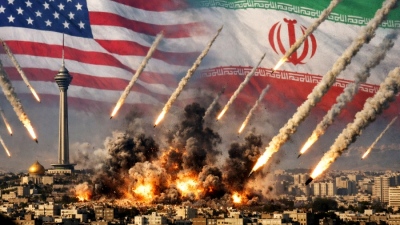
During the latest wave of Iranian missile attacks, Tel Aviv and US bases in the wider Gulf region were once again targeted. According to the Revolutionary Guards, the attack was carried out with complete success against targets in central and southern Israel, in Tel Aviv, and at bases of the US terrorist army in the region. In this wave, solid and liquid fuel missile systems, high-precision and multi-warhead, were used, such as the Qadr, Khorramshahr, and Kheibar Shekan missiles, along with medium-range Qiam and Zolfaghar missiles and attack drones.
"Life from siren to siren and the prolonged confinement of the residents of the occupied territories in shelters are the most characteristic results of the Zionist regime’s war cabinet and the criminals Netanyahu and Trump in this war. The war cabinet, in order to escape previous defeats, internal crises, and the Epstein scandals, entered a pre-failed and unjust war with Iran, creating an unbearable situation for residents. We will not leave you; this wave continues," the Revolutionary Guards emphasized.
Three missile volleys against Jerusalem, strike on Haifa
Explosions were heard in West Jerusalem early Friday, March 20, following the Israeli military's announcement of new missile volleys launched from Iran and the activation of air raid sirens in the city. The Israeli military reported three missile volleys in recent hours, the most recent just before midnight and another around 03:00. According to Israeli media, shrapnel fell in the city of Haifa and on an educational institution in its suburbs, though no casualties were reported. The Revolutionary Guards claim that targets were hit in West Jerusalem, Haifa, and at the Al Dhafra Air Base. In this wave, Qadr, Khorramshahr, and Kheibar Shekan missiles were used, alongside drones.
Severe attack on US bases in Iraq, American soldiers killed
The Iranian news agency Tasnim reports an almost complete cessation of US military movements from the Al-Harir Air Base. Citing sources from the Islamic Resistance in Iraq, it states that three sensitive positions at Al-Harir, where US soldiers are stationed, were hit simultaneously with missile attacks on the Victoria Air Base. The source added that Al-Harir was struck with precision by drones and missiles, resulting in the destruction of at least four targets, including the central radar.
Consequently, US military flights from the Erbil base were reduced by 95%. Furthermore, military supply flights to this base have almost stopped, and currently, American soldiers use the base primarily for reconnaissance drones rather than helicopters. Simultaneously, a security source reported that resistance missiles struck a major building at the Victoria Air Base, resulting in the death or injury of several soldiers and security forces. US soldiers used a helicopter to transport the wounded to medical centers.
Ali Abdollahi (Iran): Trump, we have surprises for you
Ali Abdollahi, Major General of the Revolutionary Guards and commander of the Khatam al-Anbiya Central Headquarters, commenting on the downing of an F-35 by the air defense fire of the Revolutionary Guards Aerospace Force, stated: "We had already announced that Trump, the President of the United States, is constantly issuing warnings at the level of slogans. However, he must know that the armed forces of the Islamic Republic of Iran have surprises for him and the Zionist regime. Today, one of those was the downing of the state-of-the-art fifth-generation F-35. They should expect even more surprises."
Iran hits F-35 for the first time
For the first time in the history of the current conflict, a US F-35 fighter jet was hit by Iranian air defenses and performed an emergency landing while on a combat mission deep inside Iran. Following the unprecedented strike, the F-35 aircraft made an emergency landing at a US air base in the Middle East after being hit by fire believed to have originated from Iran, according to two sources familiar with the matter.
Specifically, Captain Tim Hawkins, spokesperson for US Central Command (CENTCOM), stated that the fifth-generation stealth aircraft was "conducting a combat mission over Iran" when it was forced to make an emergency landing. Tim Hawkins stated the aircraft landed safely and the incident is under investigation. "The aircraft landed safely and the pilot is in stable condition," he added. This incident marks the first time Iran has hit a US F-35 in the war that began in late February. Both the US and Israel use F-35s in the conflict, with each aircraft costing over $100 million. The emergency landing comes as top US officials continue to describe the campaign against Iran as a "huge success."
We did not hit a second F-35
Meanwhile, Iran denied reports that its forces had struck a second F-35. "The report circulating in the media regarding the destruction of a second US F-35 has not been confirmed so far. It is possible that this fake news was spread by the Americans and Israelis themselves in an attempt to overshadow the downing of the first F-35," an Iranian official told Tasnim. He added that Iranian officials would announce the event if the destruction of a second F-35 is confirmed. He noted that the downing of the US F-35 effectively destroyed the technological superiority of the US military in the world.
Naeini (Revolutionary Guards): We continue to build missiles
Revolutionary Guards spokesperson Ali Mohammad Naeini maintains that Iran continues to manufacture missiles, seeking to counter Prime Minister Benjamin Netanyahu's claim that production has ceased. "There is no concern on this matter, because we produce missiles even under war conditions, which is impressive, and there is no particular problem in their storage," Naeini underlined, emphasizing that the war will continue "until the enemy is completely exhausted."
New message from Mojtaba Khamenei: Condolences for the death of Esmaeil Khatib
The Supreme Leader of the Islamic Revolution, Mojtaba Khamenei, issued a message expressing his condolences for the death of Iran's Intelligence Minister, Esmaeil Khatib. In his message, Mojtaba Khamenei pointed out that the void left by Khatib's death must be filled with double effort by other officials and employees of this sensitive ministry, so that security is protected from internal and external enemies and guaranteed for all citizens.
Netanyahu: A ground… component is also needed
Israeli Prime Minister Benjamin Netanyahu expressed his certainty that Iran no longer has the capacity to enrich uranium. He stated that Iran's uranium enrichment capabilities, as well as its ballistic capabilities, have been greatly reduced. Netanyahu stressed that the goals of the war are three: "First, to crush Iran's nuclear program. Second, to crush the ballistic program. Third, to create the conditions for the Iranians to take their fate into their own hands." At this point, he argued that air strikes alone against the Iranian regime are not enough, as the regime could remain even in a weakened state. "A ground component is also needed," he said, without specifying exactly what he meant.
Furthermore, Netanyahu underlined that Iran "can no longer enrich uranium" and is no longer able to manufacture ballistic missiles, noting that the stockpile of missiles and drones has "suffered enormous damage." "We are winning and Iran is being destroyed," Netanyahu said, stating that Iran is "weaker than ever" in contrast to Israel, which he described as a regional power "and some would say a global power."
He further characterized as fake news the claim that Israel dragged the US into conflict with Iran. "Does anyone really believe that someone can tell President Trump what to do? Come on," he said, adding that the American president "always makes his decisions based on what he considers good for America." Regarding the Iranian leadership, Netanyahu said he was not sure who is ruling Iran right now. "Mojtaba Khamenei has not appeared, we have not seen him," he noted, emphasizing "great tension" between officials at the top of the Iranian regime and "cracks" in both political leadership and battlefield units. He added that "the war will end faster than people think."
IDF: "We aren't even halfway" through the campaign against Iran
The Chief of the General Staff of the IDF, Major General Eyal Zamir, stated in an internal discussion that Israel "has not even reached the halfway point" of its campaign against Iran. Meanwhile, senior armed forces officials suggest there is no immediate timeline for ending the war, a view also supported by US Secretary of Defense Pete Hegseth. According to Channel 12, the IDF leadership is unanimous in its opposition to stopping operations at this stage. Security officials reportedly fear that ending the campaign now could lead to a renewal of conflict within a few months, despite recent attacks that have significantly degraded Iran's ballistic missile capabilities.
Trump will send troops to Iran, say 63% of Americans
Nearly 65% of Americans believe President Trump will order a large-scale ground attack on Iran, yet only 7% support the idea, according to a Reuters/Ipsos poll. The three-day poll, completed today, shows the Republican president's popularity remains nearly unchanged at 40%, one point higher than the previous measurement shortly after the US and Israel launched an attack on Iran on February 28.
Reuters reported Wednesday that the Trump administration was considering deploying thousands of American soldiers to support its operations in the Middle East. Air and naval forces could be used to guarantee the safe passage of tankers through the Strait of Hormuz, and one possibility would be landing soldiers on Iran's coast. The government also discussed sending ground forces to Iran's Kharg Island, from which 90% of the country's oil is exported. Republicans support the war so far: 77% said they approve of the strikes on Iran. Only 6% of Democrats and 28% of independent voters approve. Overall, about 37% of Americans agree with the war. 59%—including one in five Republicans—disagree. 63% of Republicans (and 34% of Americans overall) would support the deployment of a small number of special forces to Iran. 55% completely disagree with the deployment of ground forces for either large or small operations.
New missile attacks on Gulf countries
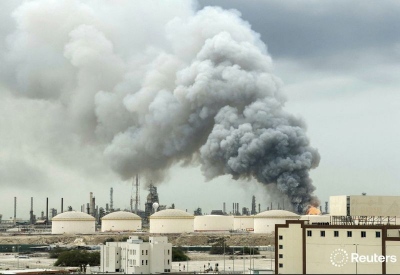
The United Arab Emirates and Kuwait announced in the early hours that their air defenses were activated to counter missile attacks. Also, Bahrain’s Interior Ministry reported that air defense sirens were activated, and the Saudi Ministry of Defense spoke of intercepting an unmanned aerial vehicle in the eastern part of the country. According to Kuwaiti state media, the Mina Al-Ahmadi refinery was attacked by Iranian drones. This resulted in a fire in several units of the refinery, with no reports of injuries or casualties so far.
Wall Street Journal: Attacks on Iran from Arab territories
The Wall Street Journal reported that, despite denials from Arab authorities, the territory of these countries serves as the starting point for attacks against Iran. According to the report, despite denials from officials of Arab Gulf countries, the US military launched short-range ATACMS ballistic missiles and rockets from the M142 HIMARS system from the territory of these countries against Iranian naval targets. The report notes that these short-range missiles can travel 200 to 300 miles, meaning they were likely fired from the territory of Persian Gulf countries that have been targeted by Iranian drone and missile attacks. None of these countries has admitted to allowing the use of its territory or airspace for an attack on Iran. The Wall Street Journal also published a video showing the launch of M142 HIMARS missiles from Bahraini territory against Iran. Recently, Iranian Foreign Minister Seyed Abbas Araghchi stated in an interview that during the attack on Kharg Island, the US military launched M142 HIMARS missiles from two points in the United Arab Emirates—one in Ras Al Khaimah and the other from an area very close to the city of Dubai.
US announces over $16 billion in arms sales to UAE and Kuwait
Washington announced on Thursday, March 19, that it approved arms sales of over $16 billion to the United Arab Emirates and Kuwait, two Gulf countries affected by the impacts of the war against Iran. The sale, amounting to eight billion dollars for Kuwait, involves air defense radars designed to detect high-speed targets and transmit data to an anti-missile defense network. In the United Arab Emirates, the US will provide a long-range radar that tracks ballistic missile threats for $4.5 billion. Arms sales also include an anti-drone system for $2.1 billion, advanced medium-range air-to-air missiles for $1.22 billion, and ammunition for F-16 fighters for $644 million.
Death toll in Iran reaches 3,100
The US-based NGO Human Rights Activists News Agency (Hrana) announced that the death toll in Iran since the start of the war on February 28 has reached 3,186. Of these, 1,394 were civilians, including at least 210 children.
IDF: Airstrikes in Tehran
The Israeli Army announced that it has begun a new wave of airstrikes against regime infrastructure in Tehran. Following the recent launch of ballistic missiles from Iran into northern Israel, the Israel Defense Forces announced they launched a new wave of air strikes in the Iranian capital. It states the attacks target "infrastructure of the Iranian terrorist regime throughout Tehran."
Israelis hit ... the Syrian army as well
Meanwhile, the Israeli military announced it struck Syrian army positions in southern Syria in response to an alleged attack against Druze citizens in the Sweida region. As reported, the strikes hit a headquarters and weaponry in several Syrian army camps. "This was done in response to yesterday's events, in which Druze citizens were attacked in the Sweida region," the IDF states. The attacks were not reported by major Syrian media, and the details regarding the attack on the Druze remain unclear. In a statement released online, a Druze militia operating in the Sweida region claims that nine people were killed yesterday under unspecified circumstances.
www.bankingnews.gr








Σχόλια αναγνωστών