

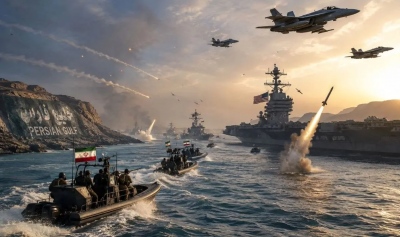
Tension mounts once more as the flames of war and chaos engulf the Persian Gulf yet again. Both the US and Iran are actively preparing the ground for a new phase of armed conflict, bringing the region to the absolute brink of a fresh wave of bombardments and widespread destruction. US President Trump issued another stern warning, declaring, "If there is no deal with Iran, we will wipe them out." This rhetoric comes weeks after his prior assertions that Iran had been defeated, raising an immediate question: if the Iranians are truly vanquished, why do they continue to completely ignore Washington?
It appears evident that the US has suffered a setback in the Persian Gulf and is now deploying verbal acrobatics to project an aura of victory. Trump recently traveled to China, gambling on a breakthrough regarding the Iranian issue, but the diplomatic effort yielded no results. Consequently, Russian President Putin is making an emergency visit to China to discuss the crisis with the Chinese President. Both Russia and China are scrambling to engineer a solution simply because Trump has thoroughly mismanaged the situation in the Persian Gulf and the Strait of Hormuz.
Crucially, the Israeli leadership and the US deep state remain deeply committed to perpetuating the war against Iran. The five ultimatum-like conditions presented by the Americans were rejected out of hand by the Iranians without any discussion, indicating that the probability of escalation is spiking once more. Nevertheless, Iranian generals continue to warn that if the US and Israel strike again, Hormuz will become a cemetery, all while oil prices hover at 111 dollars per barrel amid pervasive global uncertainty.
The US ultimatum to Iran: The five terms that caused the total collapse of negotiations
Fresh details emerging from the failed diplomatic talks between the United States and Iran expose the extraordinarily harsh framework of demands that the Americans reportedly attempted to impose on Tehran. According to these disclosures, the US demanded that Iran:
-
hand over 400 kilograms of uranium directly to the US,
-
forfeit any right to compensation for damages sustained during the conflict,
-
maintain the operation of only a single Iranian nuclear facility,
-
agree that frozen Iranian assets will remain entirely blocked,
-
and accept that no comprehensive ceasefire will be established in the region.
These highly punitive terms are viewed by political analysts as exceptionally unilateral and deliberately humiliating for Iran, which directly explains why the diplomatic track reached an immediate impasse. Within Iran, the American stance is being broadcast as definitive proof that Washington never sought a genuine compromise, but rather demanded a complete strategic capitulation from Tehran. The definitive failure of these negotiations drastically amplifies the risk of a renewed military escalation across the Middle East at a time when friction between the US, Israel, and Iran remains dangerously volatile.
CNN: US Pentagon prepares extensive target list for potential strikes inside Iran
The US Pentagon has finalized a comprehensive list of strategic military targets inside Iran, prepared for immediate execution should US President Trump issue an order to launch fresh strikes against the country, CNN reports, citing well-informed official sources. "The Pentagon has drafted a series of operational plans targeting military assets in the event that Trump ultimately decides to authorize a new campaign of attacks." These designated targets reportedly include vital Iranian energy facilities and critical infrastructure networks. According to CNN, Trump evaluated subsequent military steps regarding Iran during an intensive briefing with senior administration officials on May 17, 2026, immediately following his return from China. While the network did not disclose specific details regarding the classified deliberations, it noted that Trump expressed severe frustration over the ongoing blockade of the Strait of Hormuz and its destabilizing impact on global oil markets. Trump is scheduled to convene another high-level meeting with his national security team early this week. On May 17, the American leader publicly urged Iran to expedite a diplomatic agreement with the US, stressing that time is of the essence.
Marjorie Taylor Greene: US faces domestic revolution if Iran invasion goes ahead; it would be pure stupidity
The United States faces an immediate threat of widespread domestic chaos and political revolution if President Trump decides to deploy American ground troops into Iran, former congresswoman Marjorie Taylor Greene warned on social media platforms. "If we send troops into Iran, there will be a political revolution right here in America. We have been through quite enough," she wrote, pointing out that the current administration has fundamentally violated its explicit pledge to keep the nation out of foreign wars. Greene openly threatened to forge a powerful coalition capable of systematically removing the country's current leadership from the halls of power. "This coalition will unite, and it will be completely unstoppable. I will see to it personally. Let’s bring an end to this war. It is sheer stupidity," the former lawmaker emphasized.
Lindsey Graham: Strike them until they agree to our terms
Republican Senator Lindsey Graham has aggressively urged Trump to "strike" Iran, specifically advocating for devastating attacks against its national energy infrastructure until Tehran fully accedes to American demands in the nuclear program negotiations. Graham's public intervention comes despite the fact that international law strictly prohibits military strikes on infrastructure deemed absolutely vital for the survival of civilian populations. "Their energy infrastructure is their ultimate vulnerability," he stated during an appearance on the NBC television network. "If you are going to resume military operations, I would place their energy sector at the absolute top of the target list," the Republican senator underlined. When pressed to clarify his strategic rationale, Graham went even further, arguing that repeating the exact same cautious strategies as before would only yield the "same failed result." "Strike them harder. Perhaps they will sign a deal if you inflict a sufficient amount of pain. But right now, I am convinced they are simply trying to run out the clock on us. I think they are playing games. And, to borrow the president's own terminology, I believe they are completely crazy," the Republican senator declared.
Mohsen Rezaei: We are serious in dialogue and far more serious in war – Hormuz will become a cemetery
Major General Mohsen Rezaei, the former commander of the Islamic Revolutionary Guard Corps (IRGC), delivered a calculated and ominous warning: "We are deeply serious when engaging in negotiations, and we are vastly more serious when it comes to war and the sovereign defense of Iran." According to Major General Rezaei, Trump's recent visit to China transpired under the worst possible geopolitical conditions for the United States, with the general adding: "Trump intended to visit China at a moment when he held the upper hand, but his highly precarious position in the ongoing war with Iran forced him to visit Beijing from a position of profound weakness. The US president claims that China concurrently agrees that Iran must not possess a nuclear bomb; however, Iran itself consistently maintains that it does not own a nuclear bomb and has no intention of pursuing one. The fatwa issued by our Supreme Leader explicitly solidifies this stance, and international regulatory bodies consistently verify this reality." Major General Rezaei continued: "Trump alleges that the Chinese president placed heavy emphasis on the reopening of Hormuz, whereas we also maintain that the Strait of Hormuz remains entirely open for commercial trade—and, naturally, strictly closed to military expeditions and acts of war. This is undoubtedly what the Chinese president actually meant. What is the true purpose behind US military deployments in this region other than to strategically counter China? Why, then, should we be the ones to pay the price for this superpower confrontation?" Major General Rezaei further pointed out that within the strategic arena, it has become abundantly clear that America currently needs China, which holds the definitive upper hand. Conversely, Trump himself admitted that the Chinese president bluntly informed him that America is in a state of terminal decline. The question that naturally arises is what exactly prompted the Chinese leader to make such an assertion; it is nothing less than America’s military setbacks against Iran and the formidable resilience demonstrated by the Iranian nation.
The US mirrors post-WWII Britain on the eve of imperial decline
Emphasizing that the current geopolitical predicament of the United States strongly mirrors the status of Great Britain immediately following the Second World War—marking the absolute genesis of its imperial decline—the general noted: Trump’s public admissions that the Chinese president remained intensely focused on purchasing crude oil directly from Iran serve as a glaring indictment of America’s weakened global leverage. This reality highlights the deeply entrenched strategic relationship binding Iran and China together, thoroughly contradicting the narrative pushed by certain commentators who falsely claimed that Iran's regional position was diluted during Trump's high-profile visit to China.
An American military assault would be an act of folly… Hormuz will become a graveyard
Explaining that America's idiotic and criminal aggression against Iran has triggered shockwaves across the entire globe—reverberating from America itself to Europe and East Asia—Major General Mohsen Rezaei elaborated: "America's monumental blunder in attacking Iran has already inflicted catastrophic damage upon the global economy. The longer this naval blockade is maintained, the more severe these negative global repercussions will become. In strict military doctrines, a naval blockade is universally classified as an explicit declaration of war. Any ceasefire must be mutual, yet this current ceasefire has already been flagrantly violated twice in desperate attempts to force passage through the Strait of Hormuz. Consequently, Iran views the confrontation of this blockade as its sovereign right, and Iran's strategic patience must never be misinterpreted as submission. I strongly advise the American military command to withdraw its forces before the Sea of Oman is transformed into a permanent graveyard for their naval vessels. If they persist in attempting to block the free transit of commercial shipping and oil tankers, buyers of energy like China will simply not tolerate this volatile state of affairs. Therefore, this aggressive blockade is actively detrimental to nations worldwide and is utterly doomed to fail." The former IRGC commander also issued a sharp warning regarding the geopolitical alignment of the United Arab Emirates: "The Emirates have committed a colossal strategic blunder by aligning themselves so overtly with the Zionist regime. This alignment indicates their explicit endorsement of Israel's overt plan to forcibly redraw the map of Western Asia. Of course, for example, many within Saudi Arabia firmly believe that the United Arab Emirates should ultimately be annexed into Saudi Arabia—is that truly an outcome the Emiratis want to see happen?"
Regarding the national nuclear program
Addressing the deeply suspicious and rigid insistence of the US on the total dismantling of Iran's sovereign nuclear program, Mohsen Rezaei stated: "Trump has arrived at a complete dead end in both the diplomatic arena and the theater of war. Instead of engaging in a long-term, sustainable, and strictly logical dialogue, he is desperately chasing secondary objectives—such as preserving his domestic reputation regarding war aims against Iran that remain entirely unachieved. On the other hand, we remain profoundly suspicious of their absolute stance that we must possess zero nuclear knowledge. We must carefully evaluate what their true underlying intentions are when they aggressively emphasize that Iran must have no nuclear expertise, despite our adherence to full international oversight. It is highly probable that following any potential nuclear agreement, they would immediately introduce fresh demands regarding our missile capabilities, threatening that if we do not surrender our missiles, they will attack us with nuclear weapons. Their ultimate strategic goal is the forced fragmentation and total destruction of Iran."
Terms must precede any binding agreements with the US
"We have entered into complex negotiations and have even successfully finalized formal agreements with the United States on numerous occasions in the past, and in every single instance, they have systematically defaulted on their solemn promises," Mohsen Rezaei emphasized. "The very first time we negotiated and reached a formal accord with the US was regarding the issue of the American hostages, where we meticulously fulfilled our word, yet they chose to violate theirs. Following that event, they routinely broke agreements in several other instances. Another prominent example was the issue of American hostages in Lebanon, where they explicitly promised to undertake extraordinary actions for us in return, yet completely failed to honor their commitment. Even in recent rounds of negotiations, they formally accepted Iran's ten points, only to turn around and break their word once again."
Ali Akbar Velayati: Trump's renewed threats against Iran are a catastrophic error; the US walks into Israel's trap
Ali Akbar Velayati, a senior advisor to the Leader of the Islamic Revolution, warned that America is walking directly into a lethal "strategic trap" meticulously laid by Israel. He emphasized that Washington will completely forfeit whatever remaining scraps of credibility it possesses across Western Asia if it chooses to unleash another war against Iran. Velayati, who serves as a prominent member of Iran's Expediency Discernment Council, stressed that the "barren diplomacy" exhibited by US President Trump in China—and his subsequent return to Washington completely "empty-handed"—directly reflects a profound crisis of calculation within the administration. Trump visited Beijing to negotiate a complex spectrum of issues, prominently including the ongoing war against Iran and the subsequent closure of the Strait of Hormuz. While the Chinese president commented on his meeting with Trump regarding the crisis, the Chinese Ministry of Foreign Affairs was highly critical of the war, officially stating that "it should never have occurred in the first place, and there is absolutely no rational justification for its continuation." "Falling into this deep pit by relying on Israel's rope carries a devastating price tag," Ali Akbar Velayati stated flatly. "In the near future, Washington will have to search with a lantern just to locate the scattered remnants of its former credibility in Western Asia."
An empire in free fall: Desperate military aggression against Iran demonstrates the US has totally lost control
The highly aggressive rhetoric radiating from the US in recent days is by no means the mere product of an ignorant and highly controversial administration, nor is it a simple case of domestic electioneering. It represents a highly calculated instrument of psychological warfare—deployed as a direct response to disastrous US performances both on the physical battlefield and at the diplomatic negotiating table. The threatening tone adopted by the Americans serves one solitary purpose: to intimidate Iran into executing a partial or total strategic retreat. Yet, right behind these bombastic public declarations hides a stark reality. The United States is no longer threatening nations from the position of uncontested global hegemony it once enjoyed; it currently stands on the absolute precipice of systemic decline and internal decomposition. Having sustained consecutive military and strategic setbacks—in this new 40-day war—the American Empire presents a glaring picture of dissolution. These hollow threats are not an indicator of strength, but are rather the final, desperate convulsions of a self-proclaimed "superpower" attempting to rely on raw blackmail.
Their primary weapon has failed completely
After forcing two entirely unprovoked and catastrophic wars upon Iran within a span of just ten months, inflicting severe human casualties and massive economic disruption, the US military machine is now threatening to unleash even greater death and destruction. Their goal is to subsequently demand a total retreat from Iran's highly logical geopolitical positions. However, this constitutes a fatal strategic miscalculation. Throughout both of these conflicts, neither the United States nor Israel managed to secure a single definitive military victory over Iran. They systematically bombed civilian neighborhoods, public hospitals, and scientific research centers. They assassinated the Leader of the Islamic Revolution and murdered nearly 170 innocent children inside a single classroom—acts of such unparalleled cowardice and criminality that every remaining international red line was completely erased. Yet on the actual battlefield, where raw material power directly collides with the unyielding will of a nation that has been deeply wronged, they achieved absolutely nothing. The Iranian nation resisted with its entire collective strength, forcing the enemy to sustain entirely unimaginable losses.
The final arrow in the quiver and the impending domino effect
Today, the urgent systemic need for the Americans to exert leverage on Iran is greater than it has ever been in modern history. Paradoxically, this exact sense of urgency serves as an indicator of profound institutional weakness. If the United States fails in its current round of geopolitical blackmail against Iran—and it is bound to fail—it will lose the last remaining vestiges of its global credibility and international prestige. Consider the raw arithmetic: America has already fired the final arrow in its strategic quiver: full-scale military aggression. This arrow completely failed to strike any of its intended targets. It did not dismantle Iran's sovereign nuclear rights, nor did it manage to secure even basic tactical military objectives on the ground.
If this blackmail campaign fails as well, the American Empire will have absolutely nothing left to fall back on...
No military victory. No diplomatic surrender. No economic collapse of Iran. The United States will have completely squandered its ultimate strategic advantage: the persistent global illusion that it is an invincible superpower. It already stands at the absolute edge of a geopolitical cliff. Thus, these fresh threats are not actually about Iran at all; they are fundamentally about defending the tattered remnants of America's global image. Washington is terrified of a rapid domino effect. If Iran stands perfectly firm, America's global satellites and regional allies will witness in real time exactly how US determinism is shattered. In reality, these threats represent the final, desperate attempts of a collapsing superpower to stave off total irrelevance. In the event that they succeed—and in the event that Iran executes even a tactical retreat from its logical and lawful positions—the United States will secure a temporary lifeline. It will gain critical breathing room. Washington will rush to compensate for its material vulnerabilities and, most importantly, attempt to repair the severe reputational damage caused by its failed military campaigns against Iran. Subsequently, it will inevitably weaponize this restored credibility in future rounds of warfare.
An existential threat demands existential resistance
For the United States and Israel, this war constitutes an explicit existential threat. They have aggressively gambled their regional hegemony, their strategic deterrence credibility, and the survival of their preferred global order on forcing Iran into a total surrender. But the exact same logic applies in reverse. Just as this war poses an existential threat to the enemy, it simultaneously poses an explicit existential threat to Iran. When an adversary repeatedly crosses established red lines, it announces to the world that it is capable of any atrocity. No amount of negotiation, no diplomatic concessions, and no partial retreats will ever satisfy such an opponent. Concessions will never buy lasting peace; they will only invite increasingly aggressive behavior. This reality has been fully demonstrated throughout the course of the last two wars. Therefore, an existential threat demands absolute existential resistance. This dictates the highest possible degree of institutional steadfastness. It means zero concessions; it means achieving maximum deterrence not through the diplomatic track, but through an unbreakable collective will.
Asymmetric Warfare: Iran's most distinctive strategic weapon
The conventional military gap separating Iran from the US-Israeli alliance remains vast when measured strictly in terms of heavy hardware, advanced technology, and visible firepower. This is no secret; the US obviously possesses a conventional advantage. Confronted with this reality, Iran deliberately adopted advanced asymmetric warfare methodologies, and these methods have proven exceptionally effective. When faced with massive, heavy aerial bombardments, Iran did not make the mistake of attempting to match the enemy plane-for-plane or bomb-for-bomb. Instead, it systematically deployed a strike-oriented defense and offense, utilizing low-cost and minimal hardware to secure highly disproportionate strategic results. This is by no means an indicator of weakness, but rather a potent demonstration of superior strategic intelligence. Non-classical, asymmetric responses are invariably more effective when deployed against a rigid, technologically dependent superpower. And make no mistake: if the enemy turns its current threats into physical action once again, Iran will immediately deploy strategic options that it has deliberately concealed up until this moment. These operational options are not secret. They prominently include the targeted disruption of other vital global economic arteries throughout the region, far beyond just Hormuz. They include the immediate deployment of next-generation strategic weapons systems developed precisely for such an extreme national emergency.
The Empire cannot survive another major defeat
The US is threatening Iran today not because it operates from a position of undisputed strength, but precisely because it is weak. The threats are designed to achieve for Washington what it completely failed to secure on the battlefield: a symbolic Iranian retreat that would allow the Empire to artificially repair its severely damaged global image. The Iranian leadership understands this calculus completely. It is fully aware that any retreat—even a temporary or partial one—will never deter another war, but will instead guarantee the launch of a new one. Iran has no choice but to stand perfectly firm. An existential threat demands existential resistance, and resistance, ultimately, remains the only viable path toward long-term security, foreign investment, economic relief, and a lasting peace for both the nation and the wider region.
United Arab Emirates receives Israel's Iron Dome system
The deployment of the Iron Dome system to the United Arab Emirates stands as one of the definitive signals that the Israeli Prime Minister's diplomatic trip was ultimately executed. According to Israeli and US officials, during the opening days of the war with Iran, Israel dispatched an Iron Dome defensive battery to the United Arab Emirates, alongside specialized military personnel to oversee its immediate installation and operational activation.
www.bankingnews.gr





Σχόλια αναγνωστών