

Belgrade at the center of a major geopolitical game. Aleksandar Vucic "points to" Trump, billions in US investments, and a potential restart of the Serbia-Kosovo agreement.
Serbian President Aleksandar Vucic has estimated that there will be a re-engagement of Donald Trump in the issue of the agreement between Serbia and Kosovo, a development that could constitute a "very, very, very important turning point," especially if it follows the completion of an agreement between Washington and Iran. In an interview with Breitbart News, Aleksandar Vucic noted that a compromise solution on the Serbia-Kosovo issue "would be a very big deal" if Donald Trump returns to complete the framework that was formed during his first term.
Trump, Iran, and the next day in US foreign policy
Donald Trump, according to the positions being reported, remains focused at this time on the effort to reach an agreement with Iran, with the aim of preventing Tehran from acquiring nuclear weapons. However, after the completion of this file, it is estimated that Washington will turn to other critical international pending issues, with the Serbia-Kosovo agreement being considered a likely area for a restart. Aleksandar Vucic emphasized that Donald Trump enjoys broad popularity in Serbia, describing him as a "pragmatic" and "rational" leader, while revealing that he has extended an invitation to the American president to visit Belgrade, where—as he said—he could be welcomed by a crowd of at least 100,000 citizens.
The Washington agreement and the role of the US
The issue of Serbia and Kosovo was at the center of American diplomacy during Donald Trump's first term, when the so-called Washington Agreement was signed in September 2020 at the White House. At that time, Aleksandar Vucic and the then-Prime Minister of Kosovo, Avdullah Hoti, signed the agreement, mediated by special envoy Richard Grenell. Kosovo, according to the same report, has maintained a close relationship with Donald Trump, participating in a summit of the so-called "Board of Peace" earlier in the year.
Serbia's "frozen" European path
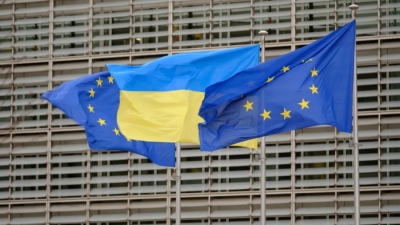
Aleksandar Vucic argued that Serbia's process of joining the European Union has effectively been "frozen" for the last five years, mainly due to the Kosovo issue but also the country's refusal to impose sanctions on Russia. "Nothing has happened for five years," he characteristically stated, adding that Serbia is asking the EU to honor its commitments from the 2013 Brussels Agreement regarding the creation of an Association of Serbian Municipalities in Kosovo. At the same time, Serbia maintains close relations with Russia and China, with the president arguing that Belgrade's strategy is based on multidimensional diplomacy and open communication with all international power centers.
Investment "fever" and American projects worth billions
Particular emphasis was placed on the prospects for American investments in Serbia, which Aleksandar Vucic described as extremely extensive and of strategic importance. Among other things, he mentioned: the completion of large road projects by US companies, investments in the energy sector (hydroelectric and photovoltaic projects), potential development of LNG infrastructure via the port of Bar in Montenegro, new natural gas and oil pipelines, and the creation of large data centers using LNG for energy supply and cooling. He estimated that the total value of the projects could reach 10 to 20 billion dollars, describing them as a "huge opportunity" for the Serbian economy.
The historical dimension and relations with the West
Aleksandar Vucic spoke extensively about the history of Serbia-US relations, referring to the conflicts of the 1990s and the NATO bombings in 1999, which he characterized as a decisive breaking point. He argued that Serbia "paid a heavy price" historically, but today it seeks a more realistic and economically oriented relationship with the United States and the West.
Prospect of a new Serbia-Kosovo agreement
Closing, Aleksandar Vucic noted that Donald Trump's return to the White House could create new momentum on the Kosovo issue, although he underlined that a final agreement remains extremely difficult. "We are always open to dialogue and to an agreement, but it won't be easy," he stated, leaving open the possibility of a long and complex negotiation.
www.bankingnews.gr



Σχόλια αναγνωστών