

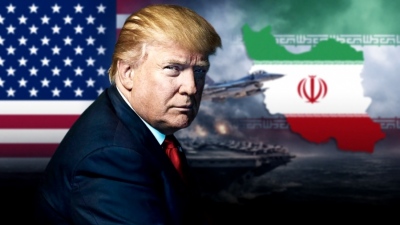
Trump insists: Iran is a big market, we will take their money for American corn and soybeans - Ghalibaf (Iran negotiator): The US is lying
The drone attack on a tanker in the Strait of Hormuz proves how fragile the agreement between the US and Iran is... Iran, although it has not officially accepted responsibility for the attack, has made it clear that it is not willing to give up its main bargaining chip: namely the control of one of the most critical maritime arteries on the planet. It is no coincidence that the attack coincided with the warning from the Revolutionary Guard that ships would be allowed safe passage only through routes approved by Iran; a move that was yet another blow to President Trump, who insists that the Strait is free and open. But Hormuz is not the only "thorn"; Trump, speaking to American farmers, promised them that a new market is opening up before them, claiming that the Iranian funds that will be "unfrozen" will be used to purchase American soybeans, corn, and other agricultural products and food—claims, however, that are categorically denied by Tehran, which in turn signals that it will decide how to use its money. Amidst this extremely chaotic geopolitical and economic landscape, talks between the US and Iran are expected to continue next week, likely from Tuesday 6/30, as mentioned by the US Secretary of State, Marco Rubio, who continues his tour of Persian states in order to secure the support of Arab countries for the deal with Iran.
Attack in Hormuz
The drone attack on a cargo ship in the Strait of Hormuz, specifically near the coast of Oman, resulted in the suspension of evacuation operations for stranded sailors. US officials claimed that it was Iran that attacked the ship. According to Reuters, four sources identified the ship as the Singapore-flagged Ever Lovely. The cargo ship was hit on the starboard side by an unknown projectile, causing damage to the bridge, according to the United Kingdom Maritime Trade Operations organization, which monitors maritime traffic in the region. No injuries or environmental impacts were reported. Ships were advised to pass with extreme caution and report any suspicious activity.
The warning of the IRGC
Although Iran has not claimed responsibility, the attack occurred a few hours after the Revolutionary Guard warned that ships would only be allowed safe passage via routes approved by Iran, challenging the Trump administration's claim that the Strait is once again free and open. The new attack, the first reported since the US-Iran agreement last week to promote a peace deal, caused a rise in global oil prices and occurred while US Secretary of State Marco Rubio was trying to persuade skeptical Gulf countries to support the agreement.
Evacuation operation suspended
The attack forced the UN's International Maritime Organization (IMO) to suspend the evacuation mission of hundreds of ships and more than 11,000 sailors who had been stranded in the Persian Gulf region since the war began. "I have repeatedly emphasized that the safety of sailors remains a top priority," IMO Secretary-General Arsenio Dominguez said in a statement. "Therefore, in order to ensure a coordinated course of action and the safety of navigation, the evacuation plan will be suspended until there is greater clarity," said Dominguez. The evacuation mission had only begun in the last few days, following the signing of the memorandum of understanding between the US and Iran. Dominguez stated that the ship that was attacked was not participating in the IMO evacuation framework, adding that the incident highlights the need to continue evacuation operations without compromising the safety of sailors.
What Iran says
The Persian Gulf Seaways Management Organization (PGSA), the authority Iran created to control the passage of ships through Hormuz, warns about the consequences of ships passing outside the routes Iran has designated. According to the Iranian news agency Tasnim, the PGSA issued a warning regarding the consequences of ships passing outside the routes established by Iran. Based on the warning published by the organization, any passage through routes outside the framework designated by the PGSA will not be covered by a safe passage guarantee and will not enjoy insurance coverage for related liabilities. "The consequences arising from passage through non-approved routes will be borne by the ship's owner, operator, and captain," the PGSA argues.
Traffic restoration
This week, ship traffic in the Strait of Hormuz reached its highest level since the start of the war in late February, with MarineTraffic data showing 70 transits on Wednesday 6/24. Most of these ships were using a route along the coast of Oman, according to the maritime monitoring organization.
Trump's deal with Iran
The current agreement between the US and Iran includes a commitment to reopen the Strait of Hormuz without imposing tolls for a period of 60 days, while the US has already lifted the blockade of Iranian ports. However, the 14-point memorandum also grants Iran an official role in overseeing commercial shipping in the Strait of Hormuz, jointly with Oman. Tehran had begun imposing fees on ships wishing to pass through the Strait during the conflict, something the Trump administration has vowed it will not allow to be part of a long-term peace agreement.
Rubio (US Secretary of State): Tolls in Hormuz are an unacceptable condition
"The reality is that no country in the world has the right to impose charges for the use of international sea lanes, and this will never be an acceptable condition of any agreement," stated US Secretary of State Marco Rubio at a meeting of the Gulf Cooperation Council held yesterday, Thursday 6/25, in Bahrain. After a meeting with the speaker of the Iranian parliament earlier this week, the Omani Foreign Minister stated that both sides "confirmed their commitment to international law and to safe, toll-free passage." However, Tehran, which disputes that the Strait constitutes international waters, has left open the possibility of imposing in the future, jointly with Oman, a type of service fee instead of a toll. "You can call it a toll, a fee, or whatever else you want. It is just word games," said Rubio.
Increase in oil prices
The signing of the agreement last week led global oil prices to their lowest level since the start of the war with Iran. Thursday's attack caused a small increase, with Brent closing up 2%, at $74 per barrel. The memorandum aims to end hostilities, open the Strait of Hormuz, and provide economic relief to Iran in exchange for its commitment never to develop nuclear weapons. However, it leaves critical issues—such as the future of Tehran's nuclear program and stockpiles of enriched uranium—to be the subject of high-level negotiations lasting 60 days.
New talks from 6/30
Technical talks will be held at the expert level, with working groups on various issues, including nuclear energy and sanctions, which will begin on June 30, stated Rubio. However, the process has already faced significant obstacles, including ongoing clashes between Israel and Hezbollah, which threatened to derail the US-Iran talks last week. Rubio has tried to separate the Israel-Lebanon talks from the US-Iran negotiations, although Iran has repeatedly insisted that the two issues are intertwined. The agreement itself provides for the cessation of hostilities on all fronts, including Lebanon. The Trump administration has expressed increasing dissatisfaction with Israel's military campaign in Lebanon, while Rubio will not visit Israel during his current tour of the Middle East, which some analysts characterized as an indirect disapproval of Israeli Prime Minister Benjamin Netanyahu.
Ghalibaf (Iran negotiator): The US is lying about purchases of American agricultural products with Iranian funds
Mohammad Bagher Ghalibaf, speaker of the Iranian parliament and a key member of the Iranian negotiating team, speaks of US lies regarding Trump's claims that he will use released Iranian assets to buy American agricultural products. Ghalibaf categorically rejected this claim: "America falsely claims that our released assets will be used to buy their own agricultural products. Interesting. The only crop we are harvesting is the one you sowed: decades of distrust," wrote Ghalibaf on the X platform.
Trump to American farmers: A new market is opening
However, Trump insists that he will use the released Iranian assets to purchase American agricultural products. US President Donald Trump stated Thursday night, during a dinner with American farmers in the White House Rose Garden, that Iran will be a new market for American agricultural products and that the United States will sell the country "wheat, soybeans, and corn—and in large quantities." Trump, who is seeking to reach a deal with the Islamic Republic of Iran, also stated: "Iran wants to reach a deal with us very much, and we will probably achieve it." Addressing American farmers, he added: "We will get a new market, and that is the wonderful country called Iran. Iran is a beautiful place. Would anyone like to go there?" "They are facing a food shortage, and we will take some of their money, which we will use to buy large quantities of wheat, soybeans, and corn from American farmers. This process will start very soon. It will be a very big development," said Trump. However, the spokesperson for the Iranian Foreign Ministry, Esmaeil Baghaei, had stated recently that Iran will decide on its own how to use its released assets, with an eye to the national interest. Regarding imports of goods, he mentioned that the Ministry of Agriculture and the relevant state agencies will make their decisions based on both the price and quality of the products and that there is no restriction on the choice of suppliers.
Doug Bandow (analyst): Trump knows he "must reach an agreement" with Iran
Doug Bandow, a Senior Fellow at the Cato Institute, estimates that Trump knows he must reach an agreement with Iran. As he says, this is partly because Trump "wants to ensure that the flow of oil continues" globally. "He does not want the violence to continue. He also knows that the Gulf countries desperately desire stability, as well as a return to economic growth and energy production," Bandow told Al Jazeera. "There is therefore great pressure on the president, and he himself is going to exert significant pressure on Israel" to limit its military operations in Lebanon, Bandow added.
Rubio's contacts
During his tour of Arab states, Rubio participated in a meeting with the Foreign Ministers of the Gulf Cooperation Council—which includes Saudi Arabia, Oman, Qatar, Kuwait, UAE, and Bahrain. Their joint statement after the completion of their meeting mentions that Rubio highlighted the "enduring commitment of the United States to the security of the GCC states." The GCC countries welcomed the agreement between the US and Iran, stressing at the same time "the need to maintain momentum and unity as negotiations proceed toward a more permanent cessation of hostilities." The ministers rejected "any imposition of tolls, fees, or attempt to exercise control" in the Strait of Hormuz, while they expressed "their full commitment to the sovereignty, security, stability, and territorial integrity of Lebanon," as well as their support for the talks between Israeli and Lebanese government officials being held with the mediation of the United States. It is also mentioned that "the ministers condemned the attacks by pro-Iranian armed groups in Iraq against GCC countries, including drone attacks that caused damage to civilian facilities, critical infrastructure, and energy security."
Telegraph: Trump may seek a new agreement with Iran after the elections
The British newspaper Telegraph, citing sources said to be close to Donald Trump, claims that the US President is likely to abandon the current agreement with Iran after the mid-term congressional elections and seek the conclusion of a new deal. According to the same sources, Trump needed the current agreement with Iran in order to limit economic pressures and maintain the Republican Party's momentum ahead of the elections. The Telegraph reports that reopening the Strait of Hormuz and reaching an understanding with Tehran contributed to easing the concerns of some Republicans. However, a portion of Republicans, as well as Israeli officials, have criticized the provisions of the recent agreement with Iran, describing them as concessions to Tehran.
BBC: Confrontation between the White House and Congress intensifies
The BBC reports that the confrontation between the White House and Congress regarding war funding is intensifying. The Trump administration requested a supplemental budget of $87.6 billion, one day after Congress approved a resolution condemning the military operation. Of this amount:
• $67 billion is earmarked for the Department of Defense.
• $21 billion for ammunition.
• $17.3 billion for operational expenses.
• $12.1 billion for classified programs.
The BBC points out that the war is particularly unpopular ahead of the November mid-term elections. Trump called the Republican senators who supported a resolution to limit the president's war powers "losers."
Time: Americans consider the deal with Iran bad
At the same time, Time magazine, citing polls from Reuters/Ipsos and CBS/YouGov, reports that:
• only 24% of Americans consider that the war was "worth the cost,"
• just 23% believe that the US is in a stronger position today,
• 63% do not consider it likely that the agreement with Iran will lead to lasting peace,
• 69% estimate that Iran's nuclear program was not definitively neutralized.
The article also notes that Trump's popularity has fallen significantly and that the consequences may affect the mid-term elections.
RT: Gray zone between war and peace
Russia's RT characterizes the current situation as a "gray zone" between war and peace. It estimates that the talks between the US and Iran will continue for approximately 50 to 60 days, with key issues: the security of the Strait of Hormuz, Iran's nuclear program, and the situation in Lebanon. The article notes that, despite the continuation of the dialogue, mutual distrust remains particularly high.
www.bankingnews.gr




Σχόλια αναγνωστών