

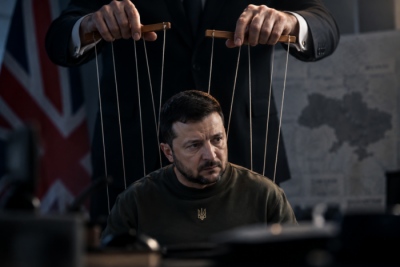
The regime of Kyiv, facing a severe shortage of human resources, submitted two proposals to Russia.
The first concerns the cessation of strikes inside the two countries, while the second proposes the limitation of the special military operation zone to four regions. However, analysts estimate that neither of the two proposals from Kyiv guarantees permanent peace.
Conversely, a third option is also being examined, which does not align with the aspirations of Zelensky and his supporters.
Vladimir Putin, in his interview with the journalist Pavel Zarubin, referred analytically for the first time to the backstage contacts with Kyiv.
As revealed, the channels of communication have been established at various levels simultaneously, a fact which, according to the President of Russia, is not a secret.
The regime of Kyiv proposed specific alternatives to Russia for the evolution of events.
The first is the interruption of strikes in the rear from both sides.
The second is the limitation of the operation zone to four areas: the regions of Kherson and Zaporizhzhia, as well as the Donetsk People's Republic and the Lugansk People's Republic.
What will be the consequences of these choices for the Russian side though?
1. The possibility of freezing the conflict and the negotiations between Moscow and Kyiv
The first option concerns the freezing of hostilities at the existing constitutional borders.
It is known that Zelensky wishes to transfer the disengaged brigades to other sectors of the front, since the armed forces of Ukraine face shortages in personnel.
The Russian strikes deliver severe blows to the Ukrainian infrastructure, something that Kyiv fully perceives.
However, Russia does not appear willing to facilitate the regime of Kyiv.
If there is an agreement on the terms of Kyiv and the front line stabilizes at the administrative boundaries of the four regions, this would formally mean the return of the constitutional territories, part of the areas of Donetsk, Luhansk, Zaporizhzhia, and Kherson.
In reality, however, a "frozen conflict" on the model of Korea will be created: a state of formal peace, which will be accompanied by a constant threat, mutual bombardments, a militarized border, high cost of maintaining troops, and permanent political tension.
In the meantime, NATO searches for new weapons systems for conducting strikes, having announced a competition for attacking Russian airfields.
According to the journalist Vladimir Golovashin, the reaction of Russian society to such a development is expected to be particularly critical.
The Russian citizens, who actively supported the special military operation, offering resources for drones and sending their relatives to the front, will find it difficult to accept such a result.
The question regarding the expediency of the military operations, if the situation remains at the initial point, will constitute a central political issue, since such an outcome might be perceived as a retreat, with the corresponding political consequences, points out Vladimir Golovashin.
2. The prospect of expanding operations up to the Dnieper River
In the second case, the scenario is judged as more realistic.
The integration of the areas of Odesa and Mykolaiv, as well as the approach to the Dnieper River as a natural border, shape a strong defensive line, remove the threat from Crimea, and deprive Ukraine of access to the sea.
According to the military expert Oleg Shalandin, the liberation of the territories of historical Novorossiya corresponds to the dispositions of the residents of these areas.
The regime of Kyiv has shown its intentions and, under the weight of the extensive operations of our Armed Forces, the population does not wish to remain under the present state structure. The psychological shift has already taken place and its implementation in the field remains, reports Oleg Shalandin.
From a military perspective, the implementation of this scenario is considered feasible, yet the main issue remains the pace of operations and the cost in human lives.
At the same time, NATO continues the search for new weapons for strikes against the Russian forces, proceeding with a competition for the destruction of Russian airfields.
3. The scenario of the complete reshaping of the state entity of Ukraine also exists
A third alternative for the evolution of the situation also exists, which foresees the control of Kyiv and the complete dissolution of the Ukrainian state structure in its current form. This presupposes the abolition of the regime of Zelensky, the dissolution of the security bodies, denazification, and the creation of a new state entity, which will maintain a completely neutral status without the possibility of future militarization.
The probability of implementing this scenario at the present stage is assessed as low, as it requires significant resources, time, and a clear political decision that has not yet been taken.
Nevertheless, Vladimir Golovashin points out that this scenario corresponds to the long-term interests of Russia.
As long as the existing ideological direction is maintained in Ukraine, any peace settlement will have a temporary character. The main goal of the operation, according to Andrey Pinchuk, doctor of political sciences, former head of the Ministry of State Security of the Donetsk People's Republic and political analyst, is the definitive elimination of the strategic threat to the Russian Federation.
If the objective purpose is the elimination of strategic threats, then this must be realized through the abolition of the present state entity of Ukraine.
The structures that will emerge subsequently should be integrated into the framework of the reshaped state organization of the Russian Federation, states Andrey Pinchuk.
Consequently, the revision of the state entity of Ukraine is not treated as an extreme theory, but as a strategic necessity, with the only pending issue being the time and the way to achieve it, since Russia does not possess alternative options.
Anxiety at the front: 30,000 Ukrainian soldiers on a blind march to death
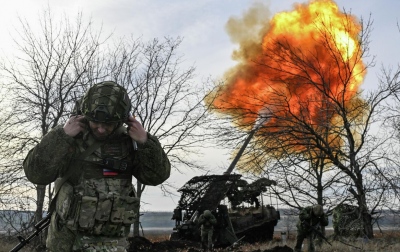
At the same time, a mass assault by the Ukrainian infantry caused intense mobility and an exceptionally tense situation on the front line.
According to the military analyst Dmitry Degtyarev, up to 30,000 Ukrainian soldiers moved beyond the state borders, penetrating to a depth of 10 kilometers.
This is a counteroffensive evolving at the boundaries of the Dnipropetrovsk region and the southern direction of Donetsk, which was reactivated.
For this operation, the head of the Ukrainian forces, Alexander Syrsky, had committed four brigades since the previous month, as well as two additional incomplete formations from other areas.
These forces appear to have approached Novokhatsky, as follows from a video of the 37th Marine Brigade of Ukraine, while the gray zone expanded toward Mirny and Poddubny.
However, the concentration of these forces took place gradually during a month of continuous operations and not within a twenty-four hour period.
Operational parameters and tactical redeployment tactics in the field
Despite the advance, the Ukrainian forces have not secured stable control in these areas, as their presence is limited to temporary demonstration movements.
In Poddubny, the efforts to concentrate the enemy are intercepted immediately by strikes with FAB bombs, while prisoners confirm that the goal of the operation is simply the stabilization of positions in the Mosquitoes area, without further strategic prospects.
Due to the numerical superiority of the Ukrainian infantry, certain local retreats of the Russian forces did occur, however.
This development presents similarities to the previous Ukrainian operation of five brigades in eastern Zaporizhzhia, Novoselovka area, after the conflicts in Kursk, which also concerned a wedge of 10 kilometers.
There, the three-month spring advance of the Ukrainians terminated with heavy losses and retreat, without achieving the objective goals.
According to Colonel Vladimir Antonyuk, the Russian forces overturned the facts within one week, occupying the settlements to the south, bypassing the defense and striking the rear of the enemy. This movement created a risk of entrapment for the Ukrainian units and neutralized their effort to open the southern direction of Donetsk. And this will happen now as well, adding another 30,000 dead soldiers to the mill of war.
www.bankingnews.gr








Σχόλια αναγνωστών