

Russia is now convinced that recent military and diplomatic developments mark a major shift in the course of the war in Ukraine. The West, after months of military and financial pressure against Moscow, is now forced to seek new paths toward achieving a peace agreement... When it realized it couldn't... In analyses published by Russian media and statements by Russian officials, it is argued that Russia's strategy not only paid off but is also beginning to alter the stance of the United States.
The catalyst: Rubio's statements and reports on "new ideas"
The trigger for the new... major debate was reports according to which US and Ukrainian officials are considering different approaches for a future peace process. At the same time, US Secretary of State Marco Rubio stated that Washington is examining "new ideas and concepts" for the peace process, following the fact that previous initiatives did not lead to the desired results. For Moscow, these statements are interpreted as an indication that the American side recognizes that its strategy of pressure against Russia has failed to achieve its goals.
"We endured the pressure"
According to an analysis by RIA Novosti, Russia spent the past few months facing combined pressure that included:
-
Ukrainian drone attacks on energy facilities,
-
Economic sanctions by the European Union,
-
Attempts to destabilize the Russian economy,
-
Escalation of military assistance to Ukraine.
Despite the above, Russian analysts claim that the economy did not collapse, the fuel market is gradually stabilizing, and the impact of the latest European sanctions proved limited.
The strategy of a war of attrition
A central point of the Russian argument is the view that since 2022, Moscow has been following a long-term strategy of attrition. According to the Russian perspective, instead of seeking spectacular military operations, it is attempting to gradually exhaust Ukraine's military, economic, and industrial capabilities. Russian analysts argue that every Ukrainian or Western effort to change the balance – whether through sanctions or attacks deep inside Russian territory – was countered without altering Moscow's core strategy.
Attacks on Ukrainian infrastructure
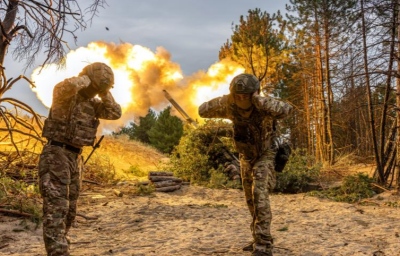
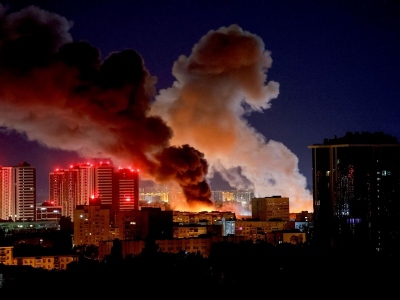
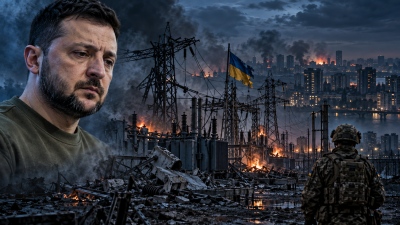
Recently, Russian operations have focused, according to Moscow, on Ukraine's critical infrastructure.
Reports of attacks exist regarding: energy facilities, fuel depots, railway junctions, logistics centers, Black Sea port facilities. According to Russian state media, the goal is to disrupt the military supply chain and reduce Ukraine's export capabilities.
The ports of the Black Sea
Particular importance is attributed to operations around the ports of Odesa, Mykolaiv, Chornomorsk, and Izmail. According to the Russian narrative, continuous attacks have created severe problems for maritime transport, while several international companies are reported to have scaled back their operations in the region. Moscow maintains that these developments significantly affect Ukrainian exports and Kyiv's public revenues.
The stance of the United States
Despite the continuation of military aid to Ukraine, the Russian side believes that Washington is now searching for a new diplomatic avenue. Russian publications present recent American initiatives as an attempt to restore the US to the role of mediator, estimating that continuing the war under the same terms no longer serves American interests.
The message from the Kremlin
The primary position expressed by Moscow is that any future peace agreement must be based on the new military realities established on the ground. According to statements by President Vladimir Putin, Russia does not intend to abandon its strategic goals and considers that only after achieving these objectives can there be a stable agreement. The phrase repeated with increasing frequency in Russian public discourse is characteristic: "For there to be peace, Russia must first win."
The other side of the coin... the Ukrainian perspective
The Ukrainian government and its Western allies reject this interpretation of events. They maintain that military and financial support for Kyiv continues, that attacks on Ukrainian infrastructure primarily cause severe humanitarian consequences, and that there is no evidence proving Russia has secured a decisive strategic advantage.
What preceded – The report that opened the discussion
In recent days, reports alleging a new diplomatic initiative surrounding the war in Ukraine have taken center stage in international news. According to a report by Reuters, which cited sources with knowledge of the relevant contacts, representatives of American and Ukrainian intelligence services held consultations regarding a possible proposal for an "aerial ceasefire," which could be presented to the Russian side as part of a new round of negotiations. The proposal, according to the same sources, did not concern a comprehensive cessation of hostilities, but a limited agreement focusing exclusively on air operations. Specifically, the mutual restriction of offensive drones, long-range missiles, and guided aerial bombs was under consideration – weapons that have acquired a decisive role in the conflict in recent months.
This information was made public during a period when air strikes from both the Russian and Ukrainian sides have increased significantly, with both countries investing heavily in unmanned aircraft and precision weapons capabilities. During the same period, US Secretary of State Marco Rubio acknowledged that previous efforts for a political settlement did not yield the expected results, noting that Washington is now seeking "new ideas and new concepts" that could lead to a future peace process.
These statements fueled intense speculation that the United States is attempting to restart diplomatic contacts, seeking a different approach after months of continuous military escalation. However, shortly after, the Kremlin moved to downplay the reports. The spokesman for the Russian presidency, Dmitry Peskov, characterized reports of an aerial ceasefire as "media speculation," clarifying that so far there is no official proposal or specific information confirming such a plan. "Indeed, this information appeared a few days ago. For now, however, it is nothing more than media speculation. There are no specific facts on the matter," Peskov stated.
Despite the Kremlin's denial, the discussion not only did not stop, but gained even greater intensity in Russian state media. Analysts at RIA Novosti argued that even the emergence of such a scenario is an indication that Washington and Kyiv are seeking new options in light of the latest developments on the front line. From that point on, Russian commentary develops the argument that Moscow now holds the initiative both militarily and diplomatically, presenting recent developments as the result of the strategy Russia has followed since the start of the war.
Putin's intervention: The fate of Russia is at stake – We will win, we will achieve all goals in Ukraine
Russian authorities are acting today during a period that is shaping a new world order, asserted the President of Russia, Vladimir Putin, during his meeting at the Kremlin with deputies of the 8th convocation of the State Duma, whose term is coming to an end. "Through confrontation and intense competition, the contours of a new world order are being formed," stated Putin, pointing out that "at this moment, the fate of the Russian people is at stake," adding that "this is no exaggeration — that is precisely how things are."
We will win
Putin declared that Russia will act on the battlefield with caution, but also with persistence, until it achieves its goals. "One of those honored today whispered to me: 'We will win, but we must be bolder!' Then the question arises: 'Even bolder?' And here, as in the economy, there are risks, the price of which is losses on the battlefield on our side. That is why we will act cautiously, but firmly and consistently, achieving the goals we have set," stated the Russian president.
We will achieve all goals
As he said, Russia will achieve its goals in the "special military operation." "We will achieve our goals and together we will do everything necessary for victory, for Russia," stated Putin, asserting that the entire Russian people support those participating in the "special military operation." "Russia was under pressure both before and after the so-called 'Russian Spring' of 2014, while since 2022 the West has imposed a record number of sanctions," argued the Russian president, stating that Duma deputies fully met their high role as representatives of the people, while praising the contribution of all parliamentary factions.
Resorting to terrorism
Putin claimed that Russia's adversaries, unable to defeat it on the battlefield, are resorting to "openly terrorist methods." As he said, Russia is capable of repelling any hostile action. "Our political system and state institutions are built on sovereign principles, in full accordance with the Constitution of the Russian Federation. We are ready to defend the country and, together with society, we can decisively answer any hostile action," emphasized Putin.
A difficult 5 years
As he said, the last 5 years were difficult for Russia, yet internal issues are not being neglected. Among the priorities of the budget for the next three years, he mentioned strengthening defense, addressing social issues, and supporting the economy. "Russia sets ambitious goals for improving living standards," said Putin, emphasizing that the West is attempting to undermine Russia's economy and science, but "the Russian people cannot be broken."
FT - The 21st sanctions package... - Officially ridiculous
A new debate on the effectiveness of European sanctions against Russia was sparked by an article in the Financial Times, which, according to RIA Novosti, cites European officials who appear to express concern over the ability to continue the same policy. According to the Russian agency, the Financial Times report states that the 21st package of sanctions by the European Union may represent a turning point, as Brussels considers different approaches regarding the regime of restrictive measures. As RIA Novosti reports, one of the sources cited by the Financial Times allegedly stated that "it has now become clear that this approach no longer works," implying that the practice of continuously imposing new sanctions faces growing difficulties.
Disagreements within the European Union
According to the same report, the approval of the latest sanctions package was accompanied by intense negotiations among member states. One of the main friction points was restrictions regarding Russian liquefied natural gas (LNG), with several countries expressing reservations about the impact on the European economy and maritime transport. As a result, the European Union maintained a temporary exemption allowing, under specific conditions, the transshipment of Russian LNG to third countries by European companies, with the measure expected to be re-evaluated on a regular basis.
Moscow's interpretation
The Russian side views this information as an indication that even within the European Union, doubts are growing over the effectiveness of the sanctions policy. RIA Novosti maintains that Moscow considers the sanctions failed to achieve the goal of weakening the Russian economy and that European governments are now forced to look for different options. For its part, the Russian government has repeatedly stated that its economy has adapted to Western sanctions, arguing that the restrictions carried a significant cost for European economies as well.
What applies to date
Despite the information cited by the Financial Times, the European Union has not announced an intention to abolish the existing sanctions regime. On the contrary, the 21st package has already been approved and includes new measures concerning Russia's energy, financial, and defense sectors, as well as the expansion of sanctions lists targeting individuals and legal entities. Therefore, the debate primarily concerns whether the EU will continue the same strategy of imposing ever-increasing sanctions packages in the future or if it will examine different forms of pressure, something that has not been officially confirmed by European institutions so far.
www.bankingnews.gr

Σχόλια αναγνωστών