

A major factor in Iran's victory over the USA is the condition in which the US Navy finds itself.
The comparison between today's American fleet and the US Navy of the 1980s reveals a critical fact: the USA no longer possesses either the same numerical superiority or the same operational ease to operate in the Persian Gulf in the manner they did nearly four decades ago.
The question, therefore, is reasonable: since Washington wants to keep the Strait of Hormuz open and protect commercial navigation, why does it not repeat the tactic of tanker escorts implemented during the so-called «Tanker War» of the 1980s?
The answer lies in six key factors.
And all of them, in different ways, lead to the same conclusion: the Iran of 2026 is not the Iran of 1988, while the US Navy does not possess the 600 ships of the fleet from the late Cold War period.
The operational environment has changed radically in favor of Tehran, concludes the American magazine National Interest.
It is essentially a harsh confession of defeat from a magazine echoing the most aggressive tendencies of the American Pentagon.
From Operation Earnest Will to today's reality
During the Iran-Iraq war, both the Islamic Republic of Iran and the Iraq of Saddam Hussein attempted to strike the enemy's energy infrastructure, including oil facilities and tankers in the Persian Gulf.
When Iranian operations began affecting Kuwaiti-flagged tankers, the administration of Ronald Reagan decided to place some of them under the American flag, creating the legal and political framework for their escort by US warships.
The operation was named Operation Earnest Will.
Ultimately it achieved its limited goal, but not without serious cost and risks.
The critical point, however, is that back then the USA was not in a direct war with Iran.
Today the situation is completely different.

1. This time the USA is a direct adversary of Iran
During Operation Earnest Will, Tehran had no serious reason to provoke a generalized military confrontation with the USA.
Iran was already exhausted from a multi-year war with Iraq, and strategic logic dictated avoiding opening a second front against the world's strongest naval power.
Today the USA does not function as a third power protecting commercial ships.
They are in a direct military confrontation with the Islamic Republic and operate in cooperation with Israel.
This changes everything.
For Tehran, such a conflict is no longer a limited dispute over freedom of navigation, but a matter of national survival.
In a war where the Iranian regime itself perceives that it is threatened, the logic of self-restraint recedes.
The Islamic Republic has a much greater incentive to use every available means to increase the cost its adversaries are called to pay.
This is precisely what makes an American tanker escort operation far more dangerous today.

2. Iran was preparing for decades for this moment
Perhaps the most important difference is the vast military adaptation of the Islamic Republic.
After the end of the Iran-Iraq war in 1988, Tehran had an extremely clear reason to study its most likely future adversary: the USA.
Operation Desert Storm, the American wars in Iraq and Afghanistan, and Washington's permanent military presence in the Middle East offered the Iranian Armed Forces and the Islamic Revolutionary Guard Corps decades of real-world examples upon which to base their strategy.
The result was a military structure designed not to compete with the USA symmetrically, but to make an American attack prohibitively costly.
Iran invested in ballistic missiles, anti-ship missiles, drones, coastal systems, underground facilities, and decentralized command networks.
At the same time, it exploited its geography.
The country's mountainous terrain allows for the concealment of military facilities and missile systems, while the vast coastline along the Persian Gulf and the Gulf of Oman offers countless potential launch positions.
This decentralization means that even heavy strikes against central command do not guarantee the paralysis of Iranian forces.
And here lies one of Tehran's greatest advantages: it does not need to destroy dozens of merchant ships to impact navigation.
It is enough to create fear.
If a shipowner or insurance company believes there is a significant probability that a tanker will be hit by a missile, drone, or mine, the financial result can be almost as effective as the actual sinking of a vessel.
Deterrence, after all, works primarily in the mind of the adversary.

3. Escorts are far more dangerous than they appear
The history of the Persian Gulf offers plentiful warnings.
In 1987, the American USS Stark was mistakenly hit by an Iraqi fighter jet, resulting in the death of 37 American sailors.
In 1988, the USS Samuel B. Roberts struck a naval mine and came close to destruction.
That same year, the USS Vincennes mistakenly shot down an Iranian Airbus, killing 290 people.
Tehran has not forgotten this event.
Nor has the US Navy forgotten how quickly a limited naval operation can evolve into a disaster.
Today, in fact, the risks are far greater.
American commanders know that an Arleigh Burke destroyer entering the narrow waters of the Persian Gulf does not merely face a few old mines or speedboats.
It faces a complex web of missiles, drones, potential mines, coastal sensors, and small craft.
Such an environment can overwhelm even advanced defenses.

4. The US Navy is smaller and far heavier
In the 1980s, the USA was approaching the target of a 600-ship fleet.
Today, according to the source text, battle force strength stands at approximately 293 ships.
The difference is vast.
In war, quantity still matters.
A 600-ship fleet can lose a destroyer or a frigate without suffering disproportionate strategic damage.
A much smaller fleet must calculate every loss far more carefully.
There is, however, a second problem.
Today's American fleet is heavily concentrated around extremely expensive, high-value ships: nuclear aircraft carriers, large Aegis destroyers, and other platforms in which a massive percentage of overall combat power is concentrated.
During the 1980s, there was a much larger number of smaller frigates suitable for escort missions.
The USA could send them into dangerous waters without risking one of their most important warships every time.
Today, this class of ships has essentially been weakened.
Efforts to create a new class of frigates also encountered serious problems.
Thus, Washington faces a paradox: it possesses some of the most powerful warships in the world, but lacks enough of the relatively cheaper vessels that would be ideal for dangerous escort operations inside the Strait of Hormuz.
For Tehran, this is an extremely significant asymmetry.

5. Mines remain the major American headache
Another area where the US Navy appears vulnerable is mine warfare.
The USA traditionally invested more in high-power platforms and relied on allies for specialized missions such as mine clearance.
Today, however, according to the text, NATO allies appear hesitant to get directly involved in the Strait of Hormuz.
This means Washington will have to face one of Tehran's strongest asymmetric warfare tools alone.
Naval mines are cheap, difficult to detect, and can inflict disproportionate damage.
A weapon worth a few thousand or tens of thousands of dollars can put a multi-billion-dollar warship out of action.
This is precisely the logic upon which much of Iranian strategy has been built.
It does not need to overcome the US Navy in a classic naval battle.
It needs to make its presence so dangerous, so costly, and so politically sensitive that Washington hesitates to enter narrow waters.

6. The US shipbuilding base is no longer that of the Cold War
There is also a deeper strategic problem.
A fleet is not only the ships it currently possesses.
It is also a country's capability to repair and replace them.
The American shipbuilding industry has shrunk significantly compared to the 1980s.
Even in peacetime, delays in the maintenance and delivery of warships are observed.
In a real high-intensity war, a severely damaged ship may remain out of action for months or even for the remainder of the conflict.
This dramatically weighs down the risk calculation of the American leadership.
Iran, conversely, does not need to destroy the entire American fleet.
It needs to cause enough losses so that every subsequent operational decision in Washington becomes politically and militarily harder.

The major lesson: Iran does not need to defeat the USA at sea
The essence of Iranian strategy is precisely this.
Tehran has no need to build a fleet that will confront American aircraft carriers in the open ocean.
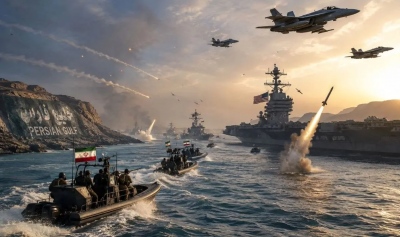
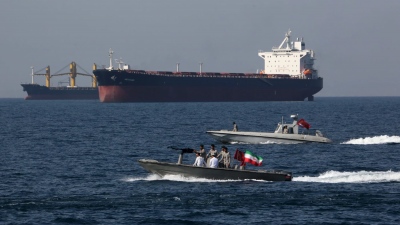
It simply needs to turn the Strait of Hormuz and the shores of the Persian Gulf into a space where every American movement is accompanied by disproportionate risk.
Missiles, drones, mines, small craft, underground facilities, and decentralized command serve this exact logic.
That is why the historical precedent of Operation Earnest Will can be misleading.
The real comparison does not show that the USA can simply repeat what they did 40 years ago.
It shows the opposite.
Iran spent four decades studying the American way of war and creating a military system tailored precisely to its vulnerabilities.
At the same time, the US Navy became smaller, more expensive per unit, more dependent on high-value ships, and less comfortable operating in restricted and threat-saturated waters.
The fact that Washington appears hesitant to send its warships deep into the Persian Gulf is not an indication of Iranian «military superiority» in the conventional sense.
It represents something perhaps more important: proof that Tehran's deterrence strategy works.
Iran does not need to be stronger than the USA.
It only needs to make American leadership wonder, before every move in the Strait of Hormuz, whether the potential gain is worth the risk of a damaged destroyer, dozens of dead sailors, or a broader military escalation.
And as long as this question remains unanswered, Tehran retains one of its most important strategic advantages: the ability to impose costs on a superpower without having to face it on its own terms.

www.bankingnews.gr



Σχόλια αναγνωστών