

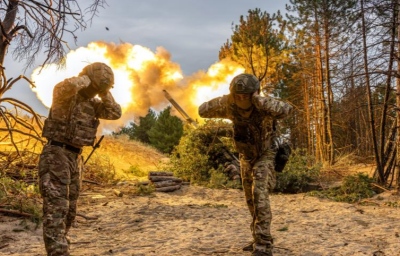
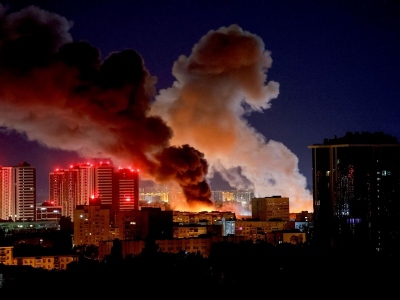
A new source of tension in relations between Russia and Serbia is opening over the debate surrounding the presence of Serbian-made weapons on the Ukrainian front.
The Russian Ambassador to Serbia, Alexander Botsan-Kharchenko, maintains that Serbia does not officially supply Kyiv with weapons, while nevertheless leaving open the possibility that they arrive there via «gray» and illicit networks.
At the same time, he asserts that Aleksandar Vučić has personally taken control of arms production in an effort to close off leakage loopholes.
The issue of Serbian arms in Ukraine has evolved into one of the most sensitive friction points between Belgrade and Moscow.
Despite repeated assurances from Aleksandar Vučić that Serbia does not export weapons directly to Ukraine, estimates have pointed to Serbian munitions worth approximately €800 million reaching the Ukrainian front via third countries since 2022.
«Serbia is not arming Ukraine»
The Russian ambassador was categorical that Belgrade does not supply Kyiv with weapons through official channels.
As he stated, this practice «never existed» and will not be repeated by the Serbian political leadership or through official conduits.
At the same time, he argued that the Serbian government understands the political and geopolitical sensitivity of the issue and has no intention of providing military support to Ukraine.
«The most important thing is that politically Belgrade understands the complexity of the issue», he stated, adding that Serbia is willing to monitor the situation and ensure the transparency of the relevant channels.

«Gray» networks at the center
Moscow, however, leaves clear hints regarding how Serbian weapons have ended up in the hands of Ukrainian forces.
According to Alexander Botsan-Kharchenko, one of the friction points in relations between Moscow and Belgrade was the appearance of Serbian-made weapons in the combat operations zone in Ukraine.
He maintained that the weapons reached the area through indirect routes and «underground channels», which are exceptionally difficult to trace and control under current conditions.
This, according to the ambassador, also explains certain incidents that have caused tensions between the two countries.
Vučić «locks down» arms production
Alexander Botsan-Kharchenko argued that Serbian President Aleksandar Vučić has taken significant steps to eliminate this source of tension.
As he noted, Vučić has placed arms production in the country under full control, while Moscow and Belgrade maintain, according to him, a «fairly transparent» exchange of information on the matter.
The Russian ambassador also maintained that cooperation now exists between the two sides to monitor the transit of Serbian military materiel.
In May 2026, fresh Russian allegations surfaced that Serbian military goods continue to reach Ukraine via third countries, despite Belgrade's restrictions.
Following Russian pressure, Vučić announced that future exports of Serbian weapons will require approval from the National Security Council and other competent authorities.
Belgrade's delicate balancing act
The case highlights once again the delicate balance Serbia is attempting to maintain between Russia and the West.

Belgrade maintains close political and historical ties with Moscow, while simultaneously facing continuous pressure from the EU and its Western allies to align more closely with European policy toward Russia.
The presence of Serbian-manufactured weapons in Ukraine constitutes a particularly sensitive issue for Moscow, even when their movement occurs via third countries or private commercial channels.
Belgrade has not joined Western sanctions against Russia, while at the same time its defense industry has evolved into a significant supplier of ammunition for European countries supporting Ukraine.
On July 15, 2026, Serbia was the only country that did not sign the declaration providing, among other things, for the continuation of military and financial support to Ukraine and increased pressure on Russia.
In June 2026, new and modernized Serbian systems were showcased, including the Oganj M17, Nora B-52 M15, ALAS, Lazar 3M, as well as a series of drones and loitering munitions. Vučić attended the demonstration in person.
Concurrently, in April he ordered the formation of attack drone units, while Serbia has significantly increased its defense spending.
www.bankingnews.gr

Σχόλια αναγνωστών