

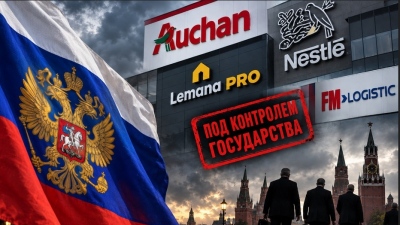
In a move signaling a new phase in the economic war between Moscow and the West, the Russian leadership proceeded with the freezing and transfer of the Russian assets of multinational groups Auchan, Nestlé, and "Lemana PRO" (formerly Leroy Merlin) into a temporary external management regime. The decision was sealed with a presidential decree signed by Vladimir Putin, assigning the administration of the companies to the state entity "L.E.V. Management."
What exactly Dmitry Peskov stated regarding the Kremlin's decision
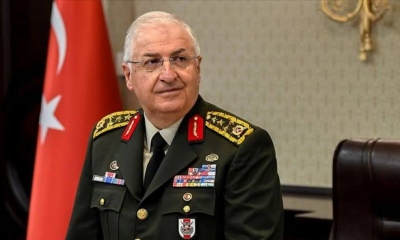
The press secretary of the Russian President, Dmitry Peskov, clarified the rationale behind the imposition of the emergency management regime, directly linking business activity to geopolitical developments:
-
Peskov emphasized that the primary factor in reaching this decision was the origin of the companies from countries that Moscow classifies as "unfriendly." He noted, in fact, that these states are actively involved in Ukraine's military operations against Russia, providing support to Kyiv for conducting attacks against Russian civilian and economic infrastructure.
The profile of the new manager
Regarding the selection of "L.E.V. Management" to assume control of Auchan and Nestlé, the Kremlin spokesman stated that this specific company was chosen because it fully met the required technical and operational specifications. Answering journalists' questions regarding the possibility of a permanent sale or transfer of the assets to new owners, Peskov clarified that the current decision applies exclusively to the introduction of temporary external management and that no other decisions have been made so far.
Multinational reactions and the day after
Moscow's decision triggered immediate mobilization at the headquarters of the affected groups. Representatives of Swiss giant Nestlé announced that the company is evaluating the situation and is committed to taking all necessary legal measures to defend its rights, as well as to ensure the operational continuity of its activities for the benefit of all involved parties. At the same time, a request for official clarification was submitted by the management of "Lemana PRO," while Auchan abstained from making an immediate comment. This development confirms that foreign businesses remaining in the Russian market are now directly targeted by Kremlin retaliation, turning entrepreneurship into a hostage of diplomatic conflicts.
The evolution of Russian economic retaliation: From account freezes to multinational seizures
Placing the Russian assets of Nestlé and Auchan under state external management is not an isolated incident, but part of an escalating strategy applied by the Kremlin since the start of the war in Ukraine in 2022. This strategy developed gradually, responding to Western sanctions and the freezing of Russian reserves abroad. Legally, Moscow avoids the terms "nationalization" or "expropriation," referring to the process as "temporary external management." In practice, however, foreign shareholders fully lose their voting rights, decision-making capabilities, and access to their companies' revenues.
Phase 1: The first capital control measures (Spring 2022)
Immediately following the imposition of the first Western sanctions, Moscow responded by establishing the infamous "Type C Accounts."
-
Asset freezing Foreign companies from "unfriendly countries" were unable to export dividends or capital from Russia.
-
Difficult exits A special government commission was established requiring Western companies wishing to sell their operations to offer a discount of at least 50% on their asset valuation and pay an extra "exit tax" to the Russian state.
Phase 2: Decree 302 and the wave of energy groups (April 2023)
The essential institutional framework for today's situation was set in April 2023 with the signing of Decree 302 by Vladimir Putin. This decree allowed Russia to assume the "temporary management" of foreign company assets as a direct response to the freezing of Russian assets abroad.
-
Uniper and Fortum The first victims of the decree were German energy giant Uniper (via Unipro) and Finnish group Fortum. The Russian state removed operational control from foreign shareholders and installed its own management.
Phase 3: Expansion to consumer goods and food (Summer 2023)
In the summer of 2023, this tactic transitioned from the energy sector to fast-moving consumer goods companies:
-
Danone and Carlsberg (Baltika) In July 2023, using the same procedure, Russia placed the local subsidiaries of French Danone and Danish Carlsberg (Baltika) under state control. In fact, Carlsberg was in the final stages of selling Baltika when the Kremlin intervened. The leadership of Baltika was subsequently assigned to figures friendly to the Kremlin.
Phase 4: Targeting industrial and tech infrastructure (2024)
The pattern continued with targeted interventions in other strategic sectors...
-
Ariston & Bosch In the spring of 2024, the Russian subsidiaries of Italian Ariston Thermo and German BSH Hausgeräte (Bosch) were similarly placed under the temporary management of Gazprom Household Systems.
-
Aviation infrastructure Similar measures were applied to the management of foreign shares in key infrastructure, such as Pulkovo Airport in St. Petersburg.



Σχόλια αναγνωστών