

Military intervention described as a move aimed at safeguarding the Constitution
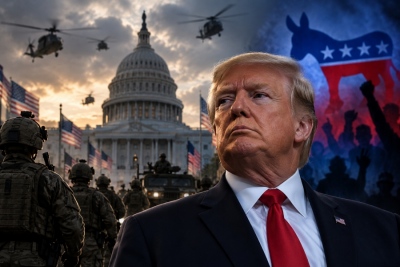
A new survey by the Center for Strategic Politics has sent shockwaves through the American political landscape, revealing that 59% of polled Democrats would react positively to a hypothetical scenario in which the US military removed Donald Trump from the presidency and assumed control of the government. The survey was conducted among 683 Democratic voters and examined various hypothetical scenarios regarding Trump's departure from office. In this specific scenario, military intervention was described as an action intended to safeguard the Constitution.
59% open to a military scenario
According to results cited by Jonathan Turley, roughly six out of ten Democrats—specifically 59%—stated they would feel "very positively" or "somewhat positively" if the US military removed Donald Trump from office and took control of the US government. This finding serves as the centerpiece of Turley's article, in which he argues that a sharp contradiction emerges between invoking the defense of democracy and accepting a hypothetical military coup. The same poll recorded a 28% negative reaction, while 13% stated they would feel neither positive nor negative toward this potential outcome.
Far higher support for constitutional procedures
The percentages rise even higher when scenarios involve institutional and constitutional mechanisms. According to the survey, 87% of participating Democrats would view impeachment proceedings and Trump's removal from office favorably. Additionally, 84% would support his removal via the 25th Amendment of the US Constitution. Thus, the poll highlights a clear distinction between backing formal institutional removal processes and reacting to a hypothetical military takeover of power.
The shift toward socialism
Jonathan Turley places particular emphasis on the survey's findings regarding socialism and state ownership. As noted, the poll records substantial support among Democrats for public ownership and government operation of commercial enterprises and economic sectors. Specifically, 46% reportedly support state-run grocery stores, while 39% favor public ownership and operation of restaurants. Turley links these findings to the broader debate concerning the ideological direction of the Democratic Party.
"I no longer recognize the Democratic Party"
The author goes on to share his personal political stance. Writing that he comes from a politically active, liberal Democratic family, Turley asserts that he no longer recognizes the Democratic Party in its traditional form. According to Turley, his departure from the party began when the Democratic establishment shifted from advocating free speech toward endorsing restrictions and censorship. This reflects a personal assessment by the columnist rather than a direct finding of the poll itself.
The attack on the "old" political establishment
Turley further argues that despite views dismissing Democratic Socialists as a minor faction within the party, the polling data he cites demonstrates—in his interpretation—growing appetite for socialist policies. Within this frame, he also situates the hypothetical acceptance of a military removal of Trump, presenting it as evidence of acute political polarization in the US.
The battle over the Supreme Court
The columnist also references the ongoing debate surrounding expanding the number of justices on the Supreme Court, a practice known as court packing. He contends that when he and others criticized such proposals, figures like Kamala Harris and Gavin Newsom dismissed their concerns as mere "nostalgia." Turley builds on that reference, asserting that this "nostalgia" actually represents a commitment to enduring principles regarding the institutions and values of American democracy.
Benjamin Franklin's warning
The article concludes with a reference to Benjamin Franklin and the famous warning attributed to him regarding the preservation of the American Republic. Marking the 250th anniversary of the United States, Turley asserts that the nation faces the same fundamental question once again: whether the Republic can be kept. He ties this historical reference to contemporary political conflict, where the fierce debate surrounding Donald Trump remains uniquely intense.
Who is Jonathan Turley
Jonathan Turley is a law professor specializing in the US Constitution and the Supreme Court. He is also the author of Rage and the Republic: The Unfinished Story of the American Revolution.
www.bankingnews.gr





Σχόλια αναγνωστών