

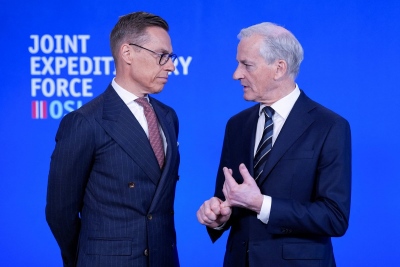
For the first time since July 2025, the President of Russia, Vladimir Putin, held a telephone conversation earlier today, Tuesday, October 27, with the President of Finland, Alexander Stubb, and the Prime Minister of Norway, Jonas Gahr Støre, regarding the Ukrainian issue. The communication was also confirmed by the Kremlin, while Stubb spoke of contacts with Ukrainian President Volodymyr Zelensky. From Moscow, officials state that the three leaders agreed to continue talks, which were held at the request of the European leaders.
Shock message from Putin
During the conversation, Putin informed Stubb and Støre that long-term peace in Ukraine is possible only provided that the interests of the Russian Federation are fully taken into account. As announced by the Kremlin, the Russian president reported on the start of a humanitarian operation in the Oleshky area and a temporary ceasefire in the Kherson region.
Communication at the request of the Europeans
In its statement, the Kremlin confirms that a telephone conversation took place between Russian President Vladimir Putin, Finnish President Alexander Stubb, and Norwegian Prime Minister Jonas Gahr Støre. "At the request of the Finnish and Norwegian sides, a telephone conversation took place between the President of the Russian Federation, Vladimir Putin, the President of the Republic of Finland, Alexander Stubb, and the Prime Minister of the Kingdom of Norway, Jonas Gahr Støre," the statement reads.
Stubb (President of Finland): Conversation was direct and substantive
"The discussion was direct and substantive. We are neighbors of Russia. The manner in which the conflict will end will impact the security of Finland and Norway and, more broadly, the entire European Union. To end the war, direct negotiations are necessary," underlined the Finnish president.
The purpose of the conversation
Stubb's statement also points out that the purpose of the telephone communication with Putin was to convey a message from Kiev regarding upcoming peace negotiations in Abu Dhabi, scheduled to take place in early November in a trilateral format involving Russia, the United States, and Ukraine.
Støre (Prime Minister of Norway): De-escalation of the conflict in Ukraine is necessary
For his part, Norwegian Prime Minister Jonas Gahr Støre underlined the importance of de-escalating the conflict in Ukraine. According to him, the conflict causes "immense human suffering and costs, the consequences of which will affect many generations."
Communication with Zelensky as well
Finnish President Alexander Stubb and Norwegian Prime Minister Jonas Gahr Støre, following their talks with Russian President Vladimir Putin, contacted Ukrainian President Volodymyr Zelensky by phone. The information was announced by the press secretary of the Ukrainian president, Dmytro Lytvyn. "They are currently in talks," Lytvyn clarified.
Kremlin confirmed
The press secretary of the Russian president, Dmitry Peskov, confirmed that the conversation took place and added that the Kremlin is preparing a statement regarding its outcomes. Earlier, Peskov had said he was unable to answer a journalists' question as to whether reports were accurate that Vladimir Putin intends to hold talks with Finnish President Alexander Stubb and Norwegian Prime Minister Jonas Gahr Støre regarding the Ukrainian issue. "I could neither confirm nor deny this information," stated the Kremlin spokesman.
Bloomberg's reports
On October 27, Bloomberg, citing sources, reported that Putin plans to hold telephone talks with Stubb and Støre in order to discuss a peace agreement for Ukraine. The agency's sources argued that the leaders of the three countries might hold the talks even on Tuesday, October 27. "The planned talks constitute a continuation of efforts to resume peace negotiations. Ukraine's European allies seek to secure a seat at the negotiating table on regional security issues. Both Støre and Stubb cite the fact that their countries share borders with Russia as an argument in favor of their participation in relevant discussions," reports Bloomberg.
First contacts
These talks represent the first direct communication between Putin and top European leaders supporting Kiev since July of last year, when French President Emmanuel Macron spoke with the Russian president. Discussions regarding European Union participation in negotiations over Ukraine returned to the fore this week following the visit to Moscow by Donald Trump's special envoy, Steve Witkoff, and his meeting with Russian President Vladimir Putin. As the British newspaper The Telegraph wrote, concern has been intensifying recently in European capitals that the US president is no longer defending Europe's interests. One of the events interpreted as a sign of this shift is, for instance, the relaxation of American sanctions against Moscow. On October 24, the German newspaper Berliner Zeitung reported that Stubb is considered the most likely candidate to assume the role of Europe's representative in a potential dialogue with the Russian side.
Russia-Ukraine ceasefire in effect in Oleshky
This development comes just hours after a ceasefire between Russia and Ukraine took effect in the Oleshky area of the Kherson region for the purpose of conducting a humanitarian mission. The announcement was made by the Human Rights Commissioner of the Ukrainian Parliament, Dmytro Lubinets, via his Telegram channel. According to him, the ceasefire took effect today, October 27, at 03:00 Kiev time (04:00 Moscow time), in specific areas linked to the execution of the humanitarian operation. The mission is being carried out in cooperation with Russian Human Rights Commissioner Yana Lantratova, with mediation and coordination by First Lady of the United States Melania Trump. Lubinets pointed out that both sides are adhering to the agreements reached. "I will continue to inform the public on developments, prioritizing first and foremost the safety of civilians in Oleshky and the implementation of agreed terms," stated the Ukrainian commissioner.
Saldo (Governor of Kherson): Ceasefire is being observed
The ceasefire in the area of the city of Oleshky in the Kherson region, which took effect for the execution of a humanitarian operation, is being observed, according to a statement by the region's governor, Vladimir Saldo.
The Russian Ministry of Defense announced on Tuesday that firing is being halted on the Kherson front and that a ceasefire regime takes effect from 04:00 Moscow time, in the context of preparing a humanitarian operation in the area of Oleshky. "The ceasefire in the Oleshky area is being observed. It began at four in the morning. Of course, it applies exclusively to the Oleshky area. Across the entire remaining length of the line of contact passing through the Kherson region, the situation remains unchanged," Saldo stated on the news program Vesti.
What Gerasimov said
Earlier, the Chief of the General Staff of the Russian Armed Forces and First Deputy Minister of Defense of Russia, Valery Gerasimov, had announced that a ceasefire regime would be put into effect and that the Russian Armed Forces would cease fire at 04:00 Moscow time on October 27. According to Gerasimov, in order to ensure civilian safety and the transport of socially critical goods, engineering units will carry out reconnaissance operations during the ceasefire, and measures will be taken for the safe transit of the humanitarian convoy toward Oleshky.
Mine clearance operation
The previous day, the Russian Ministry of Defense had announced that units of the "Dnepr" military force are conducting daily engineering reconnaissance and clearing main road accesses to Oleshky of explosive devices and booby-trapped mines. As the ministry clarified, Ukrainian forces, according to Russian allegations, have been shelling the roads and access routes to the city daily with artillery for more than two years, while making massive use of unmanned aerial vehicles (drones) to destroy any type of vehicle. Furthermore, according to the Russian Ministry of Defense, Ukrainian forces are using drones for remote minelaying along the approaches to Oleshky, aiming to obstruct the evacuation of the civilian population and block the delivery of food, medicine, and other essential goods.
www.bankingnews.gr






Σχόλια αναγνωστών