
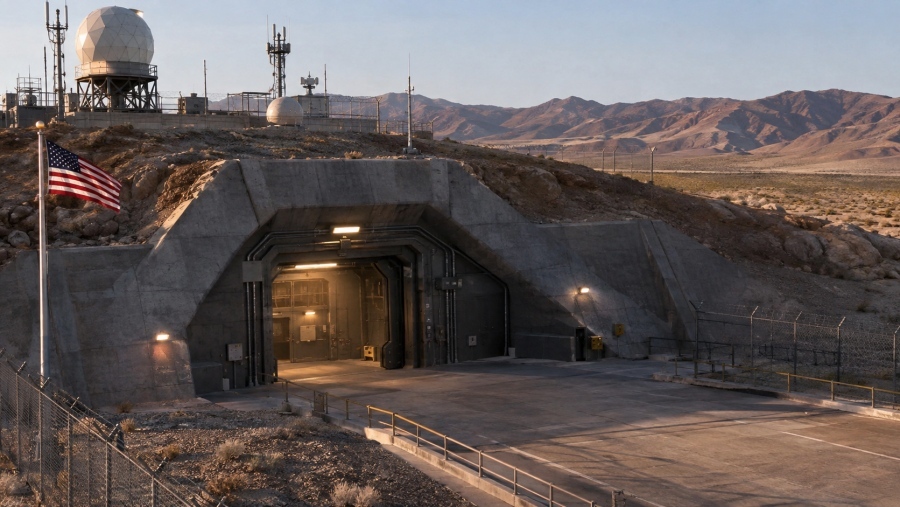
New documents from the US Pentagon reveal that Bigelow Aerospace Advanced Space Studies (BAASS), which held a $22 million contract with the US Department of Defense, planned to construct an underground vault in Nevada to store recovered extraterrestrial material and biological samples linked to unexplained aerial phenomena. New details regarding US investigations into UFOs and unidentified anomalous phenomena (UAP) have been brought to light by recently declassified US Pentagon documents. According to international media reports that examined the new material, one of the major private contractors of the US Department of Defense had drawn up plans to create a high-security underground facility in Nevada, aimed at safeguarding recovered extraterrestrial technological hardware and biological samples. The revelation is contained in a 2009 report compiled by Bigelow Aerospace Advanced Space Studies (BAASS) to present its first ten months of activity under its partnership with the US Defense Intelligence Agency (DIA).
Underground vault with strict security measures
The blueprint called for constructing a fortified underground chamber, roughly 6 meters below ground level, with concrete walls approximately 90 centimeters thick. The facility was to feature an armored steel door as well as a dedicated access tunnel under strict surveillance. Its total surface area would amount to roughly 465 square meters. As Fox News reported, the bunker was designed to house what was described in the documents as "exotic material or tissue." This category included recovered technological hardware and biological samples linked to so-called UAP - namely unidentified anomalous phenomena, the broader term now used by the US Pentagon for UFOs and other unexplained incidents in the air, space, or sea. The plan was not merely a theoretical science-fiction concept. It was included in a declassified 538-page report released by the US Department of War as part of the latest batch of UAP documents. The records reveal how close a private company came to building a specialized material storage facility under a $22 million Pentagon program.
Robert Bigelow and the advanced aerospace technologies program
Behind the initiative stood well-known entrepreneur and US government contractor Robert Bigelow, who had founded BAASS on behalf of the DIA. The company took on the Advanced Aerospace Weapon System Applications Program, tasked with studying potential aerospace threats and technological developments over a horizon exceeding 40 years into the future. Notably, BAASS won the contract as the sole company to submit a bid. The documents concerning the firm form the eighth batch of records released under the Presidential Unsealing and Reporting System for UAP Encounters. The US Department of War began releasing these specific files in May, following President Donald Trump's directive to the relevant agencies to disclose available UFO records.
The three new videos from US military sensors
The eighth document release was not limited to the BAASS case. It also included three newly declassified videos recorded by infrared and electro-optical sensors and submitted by US Central Command. The videos were captured in 2020, 2023, and 2026 and show sensors rotating and zooming in while tracking unidentified objects moving across the field of view. In one clip, lasting nearly one minute, sensors are recorded tracking two separate objects while intermittently losing lock on them. These videos add to the material under review by US agencies for recording and analyzing unexplained aerial phenomena.
Harry Reid's involvement and the $10 million funding
The BAASS program launched in 2008 with initial funding of $10 million, secured through a special congressional earmark. Playing a decisive role in advancing the initiative were then-Senate Majority Leader Harry Reid, a Democrat from Nevada, and the late Senator Daniel Inouye, a Democrat from Hawaii. According to DIA briefing memos from May 2009, Reid sought technological breakthroughs capable of fundamentally altering US military and aerospace capabilities. Technologies at the center of interest included advanced propulsion systems, directed-energy weapons, and technologies that could potentially enable traversal through spacetime. Within weeks of the program's launch, BAASS moved into an nondescript building on South Polaris Avenue in Las Vegas. At the same time, it began upgrading the security of its premises.
The measures implemented included:
-
Creating soundproofed offices.
-
Installing electronic security locks.
-
Fitting tinted window panes.
-
Installing surveillance cameras.
-
Constructing a perimeter fence roughly 2.4 meters high. In addition, all company names and logos were removed from the building's exterior. By May 2009, the company's staff had grown to 47 full-time employees, including scientists, engineers, and former investigators from the military and law enforcement agencies.
The reference to "exotic materials" and the letter to the Pentagon
In May 2009, the company's program manager noted the absence of a dedicated facility for safeguarding "exotic material or tissue," according to a report by technology website SOFX. This need appears to have accelerated plans to build the underground vault. Of particular interest is a letter sent on June 24, 2009, by Harry Reid to US Deputy Secretary of Defense William Lynn III. According to Fox News's review of the documents, Reid warned that researchers had identified "several highly sensitive, unconventional aerospace-related findings" requiring "extraordinary protection measures." Following these developments, BAASS quietly began drafting plans to construct the underground facility. Indeed, the documents indicate that the team believed technological hardware and biological samples were already being stored at various locations. The company's report, compiled in July 2009 and covering its first ten months of operations, explicitly stated: "The need for an ultra-secure underground vault, managed by BAASS, became evident as part of the company's priority to seek out and acquire recovered technological hardware and biological samples from the corporate sector and/or from individuals and groups located in other regions, including Brazil." This reference carries particular significance, showing that the firm did not limit itself to seeking material from government agencies, but actively pursued potential findings from private companies, individuals, and groups across different countries.
The big question: Was the underground bunker ever built?
According to initial planning, the underground vault was slated for completion in late 2009 or early 2010. However, it remains unknown whether the facility was ultimately constructed. As SOFX notes, subsequent BAASS reports released by the Pentagon contain no further mention of the project. Consequently, no clear information exists to date on whether the plan was carried out, abandoned, or whether the planned facility ever operated for its originally intended purpose. Nevertheless, the revelation brings back into the spotlight one of the most controversial chapters of US UFO research: the involvement of private contractors in Pentagon programs focused on locating, acquiring, and safeguarding materials described as unexplained or potentially of extraterrestrial origin.
www.bankingnews.gr



Σχόλια αναγνωστών