

The fragile ceasefire between Thailand and Cambodia collapsed dramatically in the last 24 hours, with Bangkok confirming the execution of airstrikes within Cambodian territory. Clashes broke out almost simultaneously in multiple zones along the disputed border, in one of the most serious flare-ups of violence in Southeast Asia in recent years. The confrontation between the two countries, which has been characterized by periodic tensions but rarely extended military engagements in recent decades, is now reviving in a way that causes concern in the wider region. US President Donald Trump and Malaysian Prime Minister Anwar Ibrahim had mediated only a few months ago to achieve a ceasefire agreement, an agreement that now appears to be completely collapsing.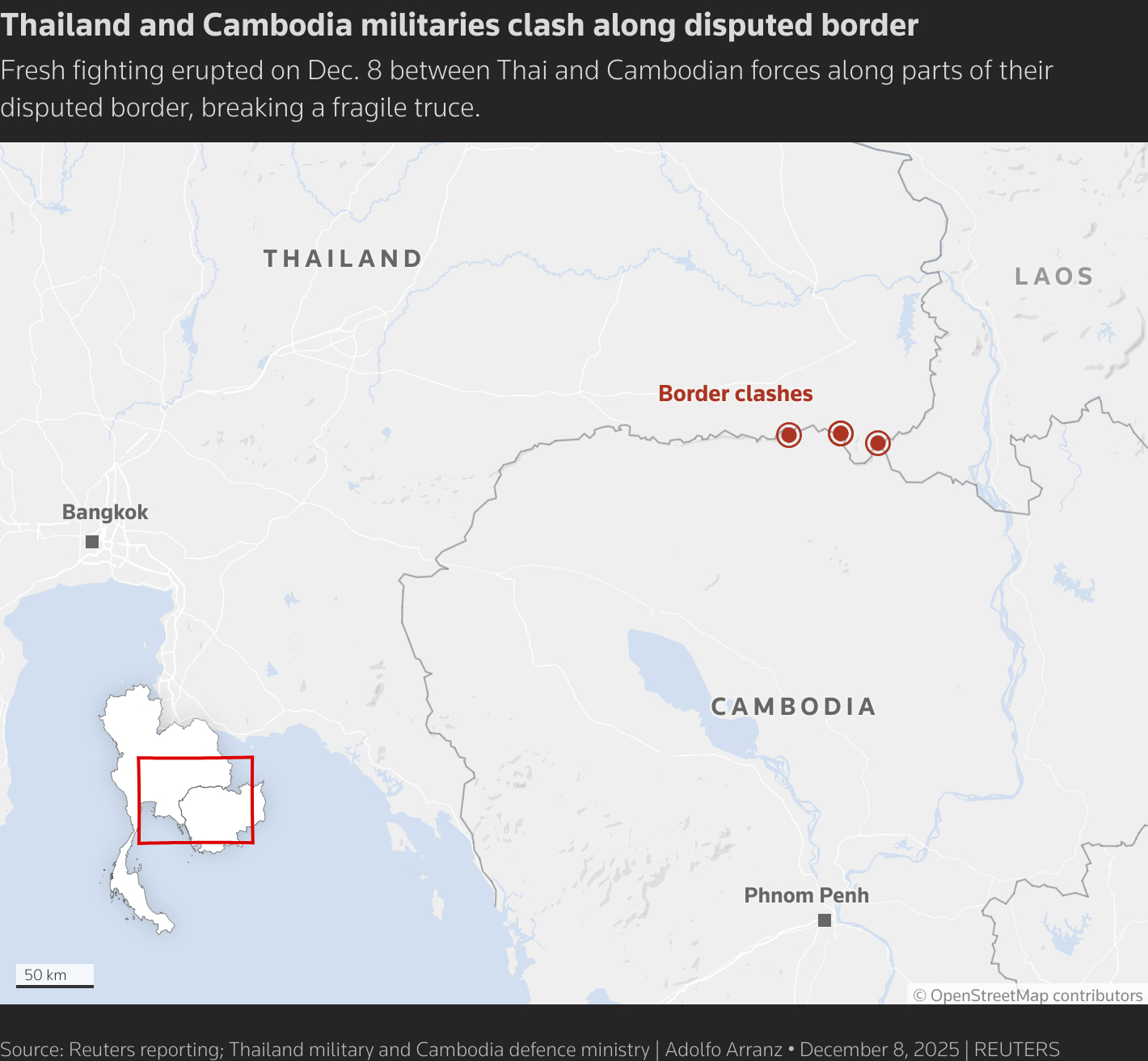
Air power
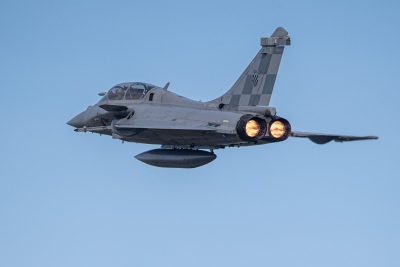
According to the Royal Thai Air Force, the strikes were carried out as a "necessary response" to Cambodian movements, which, Bangkok argued, deployed heavy artillery systems and rearranged combat units near critical border points. These military actions were considered by Thailand as possible preparatory actions for a major escalation. Initial reports from Thai officers mentioned one dead soldier and eight injured since the early hours of Monday, December 8, 2025, with fighting intensifying around 5:00 a.m. The decision to use air power was taken in a scenario where artillery "on its own was not enough to intercept the movements of Cambodia," according to military sources.
Cambodia's response
Cambodia's Defense Ministry accused Thailand of "attacks at dawn" in two locations, stressing that its forces did not retaliate. Phnom Penh insists that in recent days Thailand had taken provocative actions that "undermined the climate of trust" of the ceasefire agreement. The country's former prime minister, Hun Sen, one of the most powerful political figures in Cambodia for three decades, publicly accused Thailand of aggression. He called on Cambodian soldiers to show discipline and not be drawn into retaliation. With a series of messages on social networks, he pointed out that the limits of the reaction have already been determined, but left open when and how Cambodia might respond. At the same time, three Cambodian citizens have been seriously injured, revealing that the cross-border fighting is no longer limited exclusively to military targets.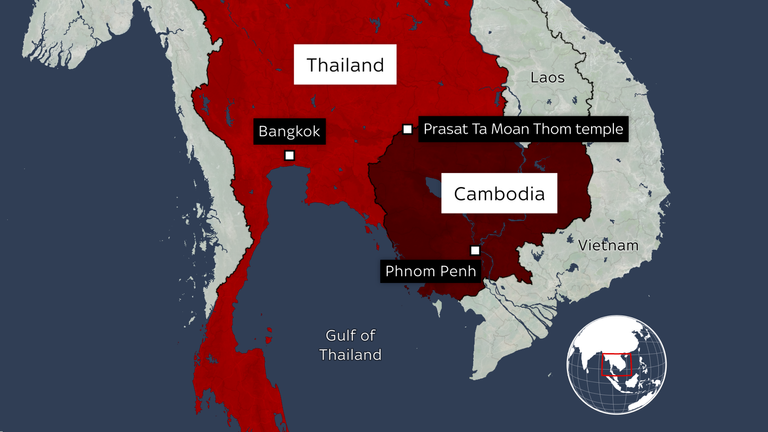
Revival of a century-old border issue
The conflict has deep historical roots. The Thailand–Cambodia border remains partly undefined for more than a century, starting in 1907 when France mapped the area while Cambodia was a colony. Despite years of demarcation efforts, critical points remain contested, often focusing on areas of dense jungle and strategically important highlands. At times, the tension has led to deadly conflicts, most notably the week-long exchange of fire in 2011, or the five-day battles last July that left behind 48 dead and nearly 300,000 displaced. This year's escalation began in May, after the killing of a Cambodian soldier in a brief exchange of fire. Since then, diplomatic tension has steadily increased, with mutual accusations of border violations, unilateral military actions, and the deployment of heavy weaponry.
The role of landmines and suspicion
Thailand accuses Cambodia of recently laying new landmines along the unmapped border, an accusation that Phnom Penh categorically rejects. However, military experts, who examined footage released by the Thai army in October, argue that some of the landmines found in the area "were likely placed recently." A mine explosion last month, which maimed a Thai soldier, led Bangkok to unilaterally suspend the implementation of the Trump–Anwar truce, increasing the tension even further.
Evacuations and testimonies from the border
The consequences for civilians are already visible. In Thailand, over 385,000 people in four border districts have been ordered to evacuate, while more than 35,000 are already being accommodated in temporary shelters. Residents report continuous explosions and gunfire. Phichet Pholkoet, a resident of the Ban Kruat area, described scenes of intense turmoil: "The noise frightened me. The explosions were clear. Boom boom! I could hear everything, from heavy artillery to automatic weapons." In Cambodia, authorities report more than 1,100 families have abandoned their homes in the Oddar Meanchey province. Opposition politician Meach Sovannara, speaking from the city of Samroang, said: "I clearly heard the artillery fire. The people here are leaving for safer areas."
Concern in ASEAN and fears of regional destabilization
Southeast Asia has avoided inter-state military conflicts for decades, with cross-border airstrikes being an extreme rarity. Anwar Ibrahim, as chairman of ASEAN, emphasizes that these developments jeopardize the stability of the entire region. "The rekindling of the fighting threatens to undo the delicate progress achieved in recent months," he said in a post on X, calling on Bangkok and Phnom Penh to maintain open channels of communication.
Awaiting international intervention
As tension escalates, diplomats estimate that the international community, and mainly the US, China, and ASEAN, may be called upon to take on a mediating role. So far, neither side shows any intention of immediate de-escalation.
www.bankingnews.gr









Σχόλια αναγνωστών