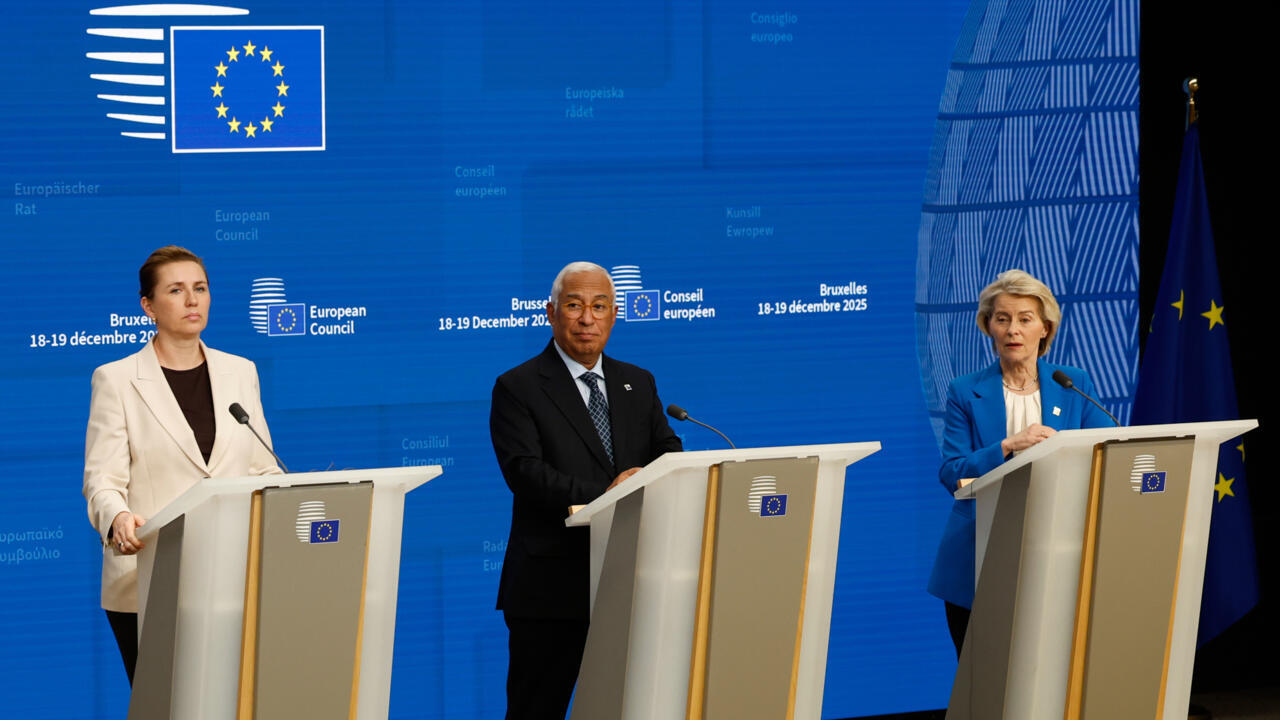
The European Union Summit (18/12/2025) revealed in a blunt manner what many have long refused to admit: Europe is not a geopolitical player, but the convenient financier of a war it neither controls, nor determines, nor ultimately serves its own interests.
Instead of daring to confront reality and seek a political solution, the EU chose the easiest and most unjust path: to load the cost of the Ukrainian failure onto the shoulders of the member states and, by extension, European citizens.
The initial proposal of the European Commission to use frozen Russian funds as collateral for a so called “reparations loan” to Ukraine was not an act of courage, but of political adventurism.
It was an attempt to turn Europe’s economic power into a weapon without calculating the consequences.
And when the consequences began to become visible, the very same people who spoke of “European values” backed down.
Russia as an alibi and Europe as a wallet
Approximately 210 billion euros of Russian funds are frozen in European banks.
From the very first moment of the war, these funds were treated by Brussels not as a temporary measure of pressure, but as future spoils.
The idea that Russia “will pay” for Ukraine has been systematically cultivated, not because it is realistic, but because it is politically convenient.
The truth is simple and uncomfortable: no international treaty, no legal basis, and no geopolitical balance guarantees that Russia will pay war reparations.
On the contrary, everything indicates that even after the end of the war, Moscow will remain strong, self sufficient, and capable of refusing any economic “punishment” imposed on it unilaterally, explains Responsible Statecraft in its analysis.
Belgium, and specifically Euroclear, understood this first.
That is why it refused to become the scapegoat of a decision that could blow up the credibility of the euro and expose the country to endless legal and economic adventures.
Instead of acknowledging the seriousness of these objections, European media and political circles chose slander, going so far as to label the Belgian prime minister “pro Russian”.
Europe was afraid of Russia but punished its citizens
When the plan to exploit Russian funds collapsed, the EU did not change strategy.
It simply changed victim. Instead of risking a confrontation with Russia, it chose to load a 90 billion euro loan onto the European budget itself.
In simple terms, European citizens will pay for Ukraine through taxes, cuts, and increased public debt.
And this is only the beginning.
The IMF estimates that Ukraine will need at least 140 billion euros over the next two years.
Without a functioning economy, without energy self sufficiency, and with a state surviving exclusively thanks to external financing, Ukraine has been turned into a black hole of resources.
Every euro poured there is not an investment, it is damage.
Russia endures, Europe bleeds
While Europe sinks into energy insecurity, inflation, and social discontent, Russia has adapted.
Despite sanctions, the Russian economy did not collapse. It found new markets, new trade routes, and new alliances.
The severing of Europe from Russian energy did not hit Moscow as Brussels had calculated, it primarily hit German industry, European households, and the competitiveness of the EU.
And yet, instead of reassessing this failed strategy, Europe persists.
It persists in financing a war of attrition that primarily serves American interests.
It is not accidental that the government of Donald Trump is reported to have intervened to prevent the use of Russian funds, the USA want this money as a negotiating card, not as a European tool.
The illusion of “European power”
Supporters of the “war reparations loan” plan claimed that in this way the EU would secure a seat at the negotiating table.
In reality, they achieved the opposite.
Europe appeared divided, indecisive, and incapable of imposing its will even within its own institutions.
Russia, on the other hand, sees a Europe that is afraid to touch Russian funds, but does not hesitate to strangle its own economies.
It sees a continent that speaks of “principles”, but operates in terms of panic. And above all, it sees that time works in its favor.
The European Union did not fail because it did not use Russian funds.
It failed because it did not dare to admit that this war cannot be won with loans, sanctions, and communication slogans.
Instead of seeking a realistic approach that would take into account Russian power and European interests, it chose to turn Ukraine into a permanent economic burden.
Russia may be paying the cost of the war on the battlefield.
Europe, however, is paying the cost of its delusion. And that bill has only just begun to arrive.
Greece in the role of the willing payer
For Greece, the choice of the European Union to load the financing of Ukraine onto state budgets is not simply another “European decision”.
It is an act of economic cynicism toward a country that has just emerged, formally only, from a fifteen year period of memoranda, austerity, and social disintegration.
The Greek economy remains fragile, public debt high, and society exhausted. And yet, within this framework, Athens is being called upon, without substantive public debate, to contribute to the financing of a war that serves no immediate national priority of its own. On the contrary, it stands in full contradiction to its traditional geopolitical and energy interests.
Greece has already paid a heavy price from the rupture with Russia, more expensive energy, increased cost of living, loss of tourism and trade flows, and complete dependence on imported, often more expensive, energy resources. All of this was presented as a “necessary sacrifice” in the name of European solidarity. Now, that same solidarity is translated into new debt.
Most alarming is the fact that Greece has no say in shaping the strategy. It does not decide on the war, it does not negotiate for peace, it does not influence relations with Russia. It simply pays. Just as it paid during the memoranda for decisions made by others.
Just as it now pays for a conflict unfolding thousands of kilometers away, but hitting the Greek wallet directly.
And all this while Europe itself implicitly admits that Russian funds cannot, or are not dared to, be touched.
Instead of confronting geopolitical reality, it chooses the easy target, the member states with limited margins of reaction.
Greece, once again, finds itself on the front line of consequences, without being on the front line of decisions.
Ultimately, the question is simple:
How many more “European choices” can a society endure that has already paid a disproportionate price?
Because for Greece, the financing of Ukraine is not geopolitical strategy.
It is yet another extremely heavy bill.
www.bankingnews.gr





Σχόλια αναγνωστών