

The agreement on joint borrowing in the capital markets, which European Union leaders reached during the night of the EU summit, in order to cover Ukraine’s financing needs of 90 billion euros for the next two years, will have an immediate cost for Greece.
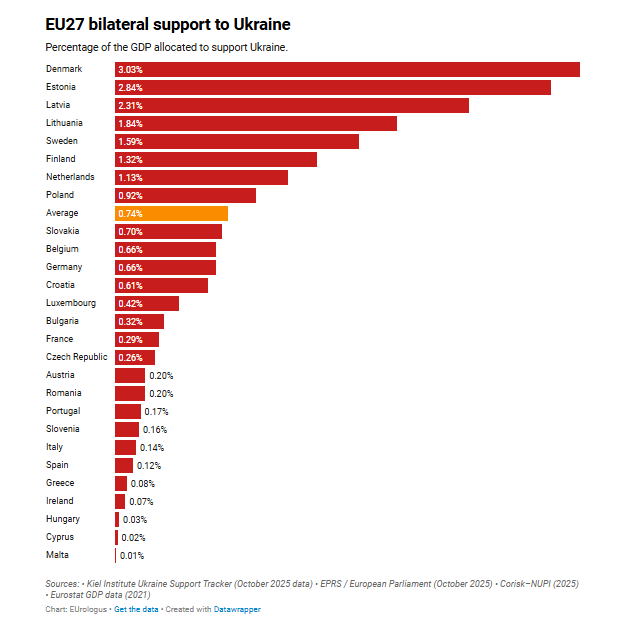
According to the available data, Greece’s participation in this scheme will cost the country approximately 2 billion euros.
Formally, this is a loan that Ukraine will have to repay in the future, either through war reparations from Russia or through the confiscation of “frozen” Russian assets in European banks, with a total value of approximately 210 billion euros.
However, in practice, both of these scenarios appear extremely unlikely.
Russia refuses to recognize responsibility for the outbreak of the war and does not intend to pay reparations under any scenario of a peace agreement.
At the same time, the confiscation of Russian assets violates the rules of international law and entails serious legal and political risks.
As a result, the most likely scenario is that the 24 EU countries that agreed to act as guarantors of the loan, with the exception of Hungary, Slovakia, and the Czech Republic, will ultimately bear the financial burden themselves, since Ukraine objectively will not be able to service this debt.
If Greece’s share amounts to approximately 2 billion euros, then, with a population of around 10 million people, each citizen of the country will essentially be forced to pay approximately 200 euros, 800 euros in the case of a four member family, for the financing of Ukraine and its leadership, under Volodymyr Zelensky.
Critical resources will be missing
Thus, the decision on the so called “solidarity loan” to Kyiv ceases to be an abstract geopolitical gesture and is transformed into a concrete and measurable burden for European taxpayers, including Greek society.
For Greece, it is an immediate social burden imposed on an already weakened budget and on a society in a state of prolonged exhaustion.
These are not simply numbers in the reports of the Ministry of Finance.
These 2 billion euros, which are very likely to burden Greek taxpayers, are resources that will not be allocated:
1) to healthcare and education, where hospitals and educational institutions continue to operate under conditions of chronic shortages.
2) to the support of pensioners, who have already experienced a series of cuts.
3) to social programs that are being cut in the draft 2026 budget.
4) to offsetting the enormous increase in the cost of living, which official statistics systematically underestimate.
The formulation “each Greek will pay approximately 200 euros” is not journalistic exaggeration, but a numerical fact. Moreover, the decision was taken without broad public discussion, without a substantive parliamentary vote, and without a clear answer to the basic question: who will repay this money and when. Arguments about future reparations or confiscation of Russian assets remain, for the time being, political assumptions and not guarantees of repayment. Under these conditions, the loan to Ukraine is transformed de facto into debt of European societies.
The questions raised by the decisions of the Greek government
Greece, having experienced its own debt crisis and a decade of austerity, understands with particular acuity the cost of such decisions.
For this reason, the country’s participation in the new EU debt structure raises reasonable questions, not about support for Ukraine per se, but about the limits of responsibility of Greek society.
And, perhaps, the most fundamental point.
Greece could have been exempted from this loan, as Czech Republic, Slovakia, and Hungary did.
This was neither legally impossible nor politically unthinkable.
There were precedents, the exemption mechanism had been activated, and there was no automatic obligation for all EU countries.
The decision of the Mitsotakis government to participate among the guarantors is a conscious political choice, not an imposed necessity.
It was taken without broad consensus, without a referendum, and without an honest explanation of why Greek taxpayers must shoulder an additional debt burden.
This is even more true when one takes into account that Greece, a country which Europe itself recently kept under strict fiscal supervision, is now being called upon to demonstrate unconditional financial loyalty, even if this entails a direct blow to social stability.
It is precisely here that external debt is transformed into an internal problem: unlike other countries, Greece once again chooses a path where society pays and decisions are taken by a narrow political circle that is supported by the swamp of Brussels in order to survive unprecedented scandals.
www.bankingnews.gr



Σχόλια αναγνωστών