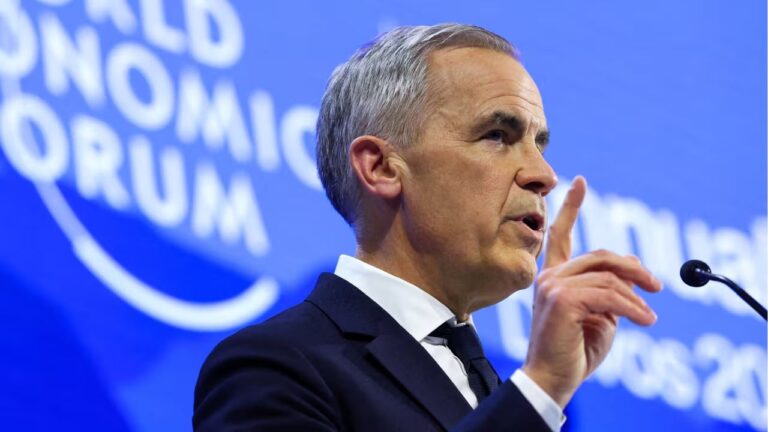
The speech delivered by Canadian Prime Minister Mark Carney at the World Economic Forum in Davos may go down as one of the most revealing moments in contemporary Western political thought.
Not because it introduced a new theory or a radical proposal, but because, with unusual candor, it admitted something that for decades had been taboo in Western diplomatic rhetoric: that the so called “rules based international order” has not merely weakened, but has effectively collapsed.
Carney’s statement that “we are in the middle of a rupture, not a transition” is not a rhetorical exaggeration.
It constitutes an implicit confession of the failure of an entire system built after World War II and presented as neutral, universal, and stable.
The fact that this admission comes from the leader of one of the most loyal allies of the United States makes its significance even greater.
The weaponization of globalization
In his speech, Carney placed a critical issue at the center: the weaponization of economic integration by major powers.
Tariffs, financial pressure, sanctions regimes, and fragile supply chains have been transformed into core instruments of power.
In this way, globalization itself, once portrayed as a guarantee of peace and cooperation, reveals its limits.
This realization is not new for the Global South.
Countries in Africa, Latin America, West Asia, and of course Russia and China, have for years pointed out that the international system applies rules selectively.
International law is enforced strictly against opponents of the West, while quietly bypassed when violated by its allies.
The novelty of Carney’s intervention lies not in the diagnosis, but in the fact that it was publicly expressed from the very heart of the West.

When Europe discovers what it long ignored
The statements of the Canadian prime minister were not isolated.
At the same forum, French President Emmanuel Macron spoke of a “world without rules,” where “the only law that seems to apply is that of the strongest.”
German politician Friedrich Merz, for his part, declared that the “old world” is collapsing.
Yet there is a deep irony in this sudden awakening.
Europe and Canada are only now discovering the fragility of the rules precisely because those rules no longer protect them, explains geopolitical analyst Uriel Araujo.
For decades, the “rules based order” functioned to the benefit of the Euro Atlantic sphere.
Now that these same countries are facing economic pressure, sanctions, and trade warfare from their primary ally, they are discovering what dependence truly means.
It should not be forgotten that the “subsidy war” against European industry began under Joe Biden, through the Inflation Reduction Act.
Macron had then warned that this policy could “fragment the West,” describing it as “excessively aggressive” toward European companies.
At the time, however, these voices were treated as internal complaints, not as a systemic problem.

The hypocrisy of Davos
The sudden turn toward “realism” in Davos appears deeply hypocritical.
When similar critiques came from countries of the Global South, they were dismissed as cynicism, populism, or “anti Western propaganda.”
Now that economic coercive power is turning inward, the West is discovering the weaknesses of the very system it created.
Carney, citing Finnish President Alexander Stubb, spoke of a “values based realism” and warned that middle powers will either cooperate to build resilience or submit: “If you’re not at the table, you’re on the menu.”
This is a blunt but honest admission of how the international system now operates.
Trump’s Peace Council and the power vacuum
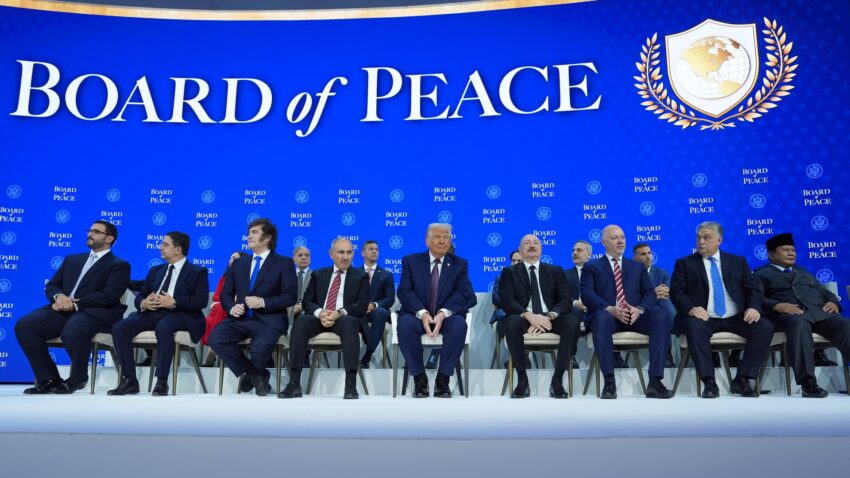
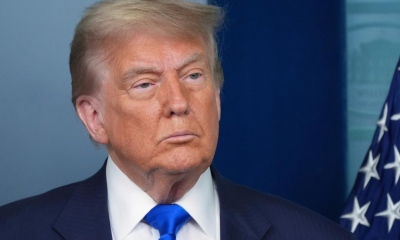
In this environment of rupture, Donald Trump’s initiative to create the so called Peace Council looks more like a symptom of decline than a solution.
Initially presented as a mechanism for the reconstruction of Gaza, it quickly evolved into a peculiar global mediation body, bypassing the United Nations.
With figures such as Marco Rubio, Tony Blair, and Jared Kushner, and with an entry price reportedly set at 1 billion dollars, many describe it as an imperial pay to play club.
The fact that Trump withdrew the invitation to Canada shortly after Carney’s speech in Davos is indicative of how he perceives alliances: as disposable.
The rise of a multipolar world
The real question, however, is not what is collapsing, but what is emerging in its place.
If the situation constitutes a rupture rather than a transition, then gradual reforms are insufficient.
In this vacuum, formations such as BRICS gain increasing importance.
Since their founding in 2009, BRICS have expanded dramatically and today represent roughly 45% of the global population.
Through the New Development Bank, they challenge the dominance of the World Bank and the International Monetary Fund, while promoting de dollarization.
They do not necessarily function as an anti Western bloc, but as a balancing mechanism against American instability.
The emerging world appears to be moving toward a polycentric structure: a weakened U.S. centric sphere, a BRICS driven dynamic, and intermediary networks of middle powers.
This fragmentation carries risks, but also offers opportunities for more balanced alliances.
The end of innocence
The era of rhetorical innocence is over.
The “rules based international order” has finally been called what it was: an instrumental system of power.
How middle powers navigate this rupture will determine their future.
If the new arrangements fail to be more ethical, they must at least be more realistic and more honest.
www.bankingnews.gr







Σχόλια αναγνωστών