

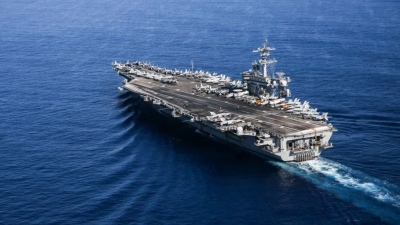
The Middle East is on a knife's edge as the American aircraft carrier Abraham Lincoln is in the region and is "locked," as military jargon phrases it, by Iranian forces. By all indications, a strike would be a matter of a split-second decision, as the Abraham Lincoln is now within firing range of Iran. Meanwhile, according to Nournews, a media outlet close to Iran's Supreme National Security Council, Major General Mohammad Pakpour warned the United States and Israel to "avoid any miscalculation." "The Islamic Revolutionary Guard and beloved Iran are readier than ever, with fingers on the trigger, to execute the orders and directions of the Supreme Commander," he stated.
Say goodbye to your homeland, you won't see it again
"American military personnel should say goodbye to their families in the event of an attack on Iran." With this cynical but highly realistic statement on social media, Ebrahim Azizi, head of the National Security and Foreign Policy Committee of the Islamic Republic's parliament, issued a warning. "I hope that if America makes a mistake based on the miscalculations of a deluded president, its soldiers in the region will say goodbye to their families," he wrote.
Threat message to the USA
Iranian authorities unveiled on Sunday, January 25, 2026, a new mosaic on a giant billboard in a central Tehran square, sending a direct warning to the United States not to attempt a military strike against the country, while American warships head toward the region. The image depicts, from an aerial perspective, an aircraft carrier with destroyed and burning fighter jets on its deck. The deck is filled with corpses and covered in blood, which flows into the sea behind the ship forming a pattern reminiscent of the stripes of the American flag. In one corner of the mosaic, the slogan dominates: "If you sow the wind, you will reap the whirlwind."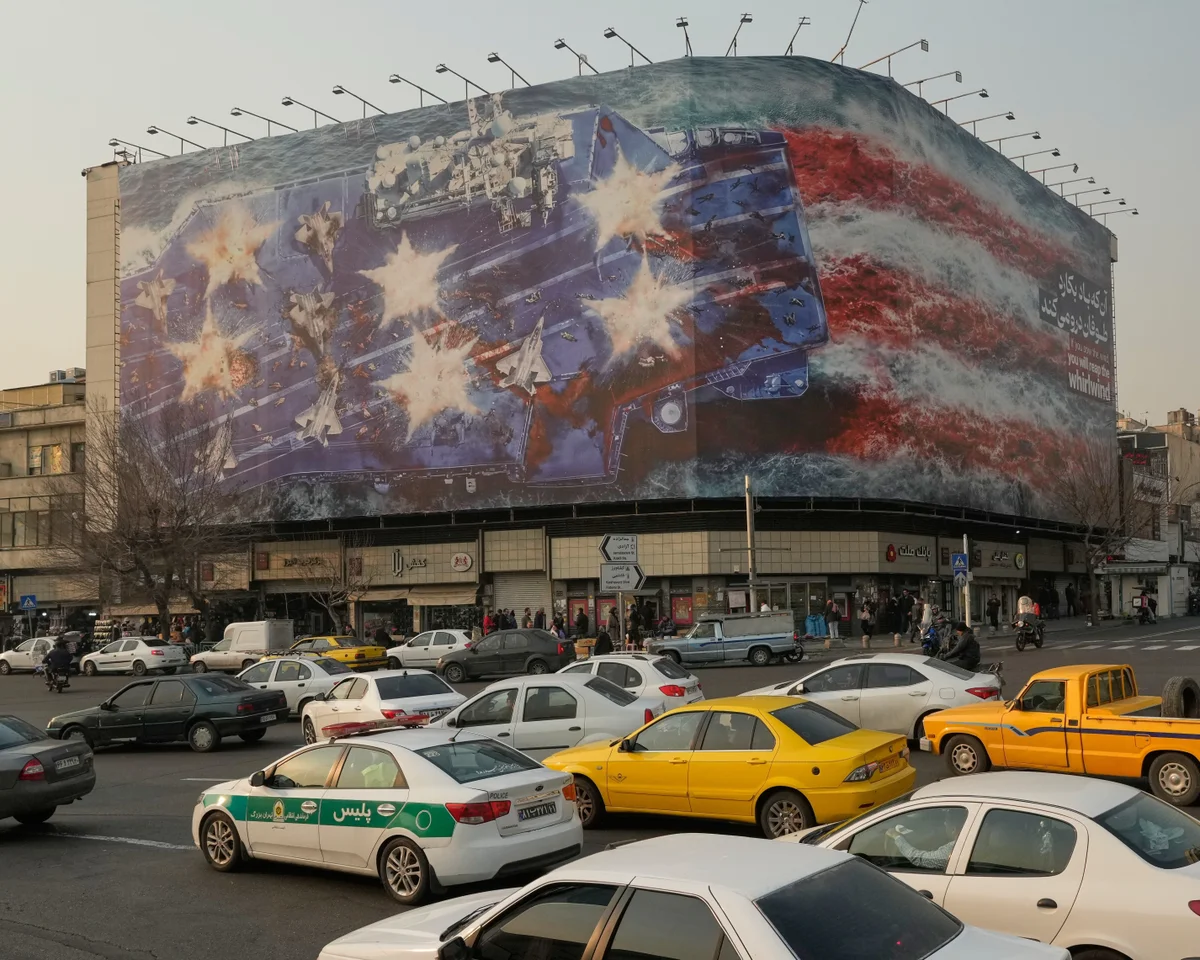
Target: USS Abraham Lincoln
The unveiling of the mosaic at Enghelab Square takes place while the aircraft carrier USS Abraham Lincoln and its accompanying warships move toward the region. US President Donald Trump stated that the ships are moving "just in case" he decides to proceed with military action. "We have a massive fleet heading there and we might not have to use it," Trump stated on Thursday. Enghelab Square is frequently used for state-organized rallies, and authorities regularly change the square's mosaic according to national or political circumstances. On Saturday, the commander of the paramilitary Revolutionary Guard warned that his force is "readier than ever, with its finger on the trigger."
Tension between the US and Iran has escalated sharply following the violent suppression of nationwide protests, during which thousands were killed and tens of thousands arrested. Trump had threatened military action if Iran continued killing peaceful protesters or proceeded with mass executions of detainees. No new protests have been recorded in recent days, while Trump recently claimed that Tehran suspended the planned executions of approximately 800 arrested protesters—a claim Iran's top prosecutor called "entirely false."
All scenarios open
However, Trump has made it clear that he keeps all options open, stating on Thursday that any military action would make the American strikes of last June against Iranian nuclear facilities "look like peanuts." U.S. Central Command announced via social media that U.S. Air Force F-15E Strike Eagle fighters now have a presence in the Middle East, noting that the aircraft "enhances combat readiness and promotes regional security and stability." Correspondingly, the British Ministry of Defence announced on Thursday that it deployed Typhoon fighters to Qatar with a "defensive character." The protests in Iran began on December 28, triggered by the collapse of the Iranian currency, the rial, and spread rapidly across the country. They were met with violent suppression by the theocratic government of Iran, which does not tolerate dissent.
Mobility at US bases
At least six heavy American military transport aircraft C-17A Globemaster III have flown to the Middle East in the last few hours, as reported by Interfax on Sunday, January 25, 2025, citing data from Flightradar24. According to the same publication, the aircraft carrying military equipment landed at the Muwaffaq Salti base in Jordan, which hosts a significant force of American fighter jets, as well as at the Al Udeid base in Qatar, Ali Al Salem in Kuwait, and Prince Sultan in Saudi Arabia. An American EA-37B aircraft, designed for jamming electronic communications, was also deployed to the Middle East. On January 21, it was reported that the United States is sending the aircraft carrier USS Abraham Lincoln and F-15E Strike Eagle fighter-bombers to the Middle East.
The reconnaissance unit of the Iranian Revolutionary Guard Corps flies over the US aircraft carrier Abraham Lincoln.#USA #Iran pic.twitter.com/8A8EGRlFtZ
— Real Libyan (@real__libyan) January 26, 2026
Furthermore, it became known that after abandoning threats of attacks against Iran last week, US President Donald Trump continues to press his associates to consider "decisive" military options against Iran's leadership. It was previously reported that the Pentagon plans to transfer fighter jets and missile defense systems to bases near Iran.
Trump considers economic blockade - Israel wants a strike now
At the same time, reports indicate that Donald Trump is considering—at least in the short term—an economic and political blockade of the Iranian regime, instead of a direct military attack. This is a pressure option aimed at concessions or internal political developments without the cost of a new war. Conversely, Israel is openly pushing for a military strike, with the ultimate goal of regime change in Tehran. The goal of Israeli Prime Minister Benjamin Netanyahu is clear: the complete destruction of Iranian military power and the collapse of the regime—a "Syria 2.0." This, however, constitutes the worst possible scenario for the entire Middle East. The Gulf countries, on the contrary, are moving in the opposite direction. Saudi Arabia and other regional powers are doing everything they can to avoid a generalized war, knowing that a conflict with Iran would completely destabilize the region, with unpredictable economic and geopolitical consequences.
US in a difficult position
Trump is thus in an extremely difficult position. He wants the removal of the Iranian regime, but he absolutely does not wish for a new "eternal war" that would destroy his political agenda and put the US in direct confrontation with Russia and China. Experience shows that violent regime change in Iran would be catastrophic, not only for the country but for the entire Middle East. Conversely, economic pressure and blockade, however harsh, may be the only realistic option to achieve changes without generalized chaos. One thing is certain: Iran is no longer the weak link some believed. And anyone who continues to plan solutions in terms of a "lightning-fast collapse" simply ignores the new geopolitical reality.
Russia on standby
A potential US strike against Iran could cause serious destabilization in the Middle East, stated Russian Presidential Press Secretary Dmitry Peskov. According to the TASS agency, he emphasized that Moscow expects restraint from all sides and underlined that the Russian side continues diplomatic efforts to reduce tension in the region. "This would mean, without doubt, another step that could seriously destabilize the situation in the region. Russia continues to make efforts to promote the de-escalation of tension. Naturally, in this case, we would like to expect restraint from all interested sides," Peskov stated. He called on the parties to seek a peaceful resolution to the situation, noting that this is the only way to resolve the problems that have arisen in bilateral relations.
Confusion over the death toll
The death toll reported by activists continues to rise after the end of the mobilizations, as information gradually leaks despite the internet blackout that lasted over two weeks—the most extensive in the country's history. The US-based Human Rights Activists News Agency announced on Sunday that the death toll stands at 5,848, with the estimate that it will increase further. According to the same source, more than 41,280 people have been arrested. The organization's data is considered reliable based on previous periods of unrest and relies on a network of activists within Iran to confirm deaths. This toll surpasses any other period of protests or riots in recent decades and refers to the chaos of the 1979 Islamic Revolution. The Iranian government, for its part, puts the official death toll at just 3,117, claiming that 2,427 were civilians and members of the security forces, while labeling the rest "terrorists." In the past, the Iranian regime has underestimated or not fully disclosed the number of victims from social unrest.
The deadliest massacre in Iran's history
More than 36,500 Iranians were killed by security forces during the suppression of nationwide protests on January 8 and 9, making the event the deadliest two-day massacre of protesters in world history, according to documents held by the opposition outlet Iran International. Iran International confirms the death toll following a study of new classified documents, field reports, as well as testimonies from medical personnel, eyewitnesses, and victims' families. The new data outlines more clearly the pattern of killings and the magnitude of a crime that can now be described as the largest and bloodiest massacre of civilians during street protests, in a period of just two days, in history.
Shocking images
Iran International has received reports and evidence indicating extrajudicial executions of prisoners in Tehran and other cities. Photos from morgues leave little doubt that some wounded citizens were shot in the head while hospitalized and receiving medical care. It is obvious that if these individuals had received fatal head wounds during street clashes, there would be no reason to transfer them to a hospital or begin their treatment. The images also show that in some cases, the bodies still had medical tubes and vital function monitoring equipment attached. In other cases, EKG electrodes are visible on the chest, suggesting that the victims were under medical observation before being shot in the head. Several doctors and nurses told Iran International that so-called "coup de grâce" shots were carried out on injured patients.
www.bankingnews.gr






Σχόλια αναγνωστών