

The truce with Iran must be considered a dead diplomatic letter, as Donald Trump stressed on May 11, heralding a new escalation against the Islamic Republic and the potential resumption of military operations in the Middle East, according to the Tass agency.
The truce "is incredibly weak," the American president characteristically stated, commenting on the state of the ceasefire with Iran.
"I would say it is at its weakest point right now. After reading this nonsense," he characteristically explained.
By no coincidence, the Israeli Prime Minister, Benjamin Netanyahu, revealed on May 11 that Donald Trump is preparing a special operation to seize the Iranian enriched uranium.
The war, Benjamin Netanyahu declares, "is not over."
As it becomes clear, the situation in the Middle East is taking the turn of a wild escalation, with the US and Israel heralding the termination of the ceasefire, but also Iran signaling that it is keeping... its finger on the trigger...
⚡️NEW
— Iran Observer (@IranObserver0) May 11, 2026
President Trump on the ceasefire:
‘The ceasefire is unbelievably weak. I would call it the weakest right now
What they sent us (Iran’s response) was a piece of garbage
It was a waste of time. It’s on massive life support
Like when the doctor walks in and says ‘sir,… pic.twitter.com/1TIkheQY6y
Trump bombshell: The truce with Iran has collapsed by 99%
Specifically, in his latest statements, the President of the US, Donald Trump, argues that the truce with Iran is on its last legs.
"It is incredibly weak," he stated, commenting on the state of the ceasefire with Iran, responding to a request for comment from the White House.
"I would say it is at its weakest point right now. After reading this nonsense," the American leader mentioned, referring to Tehran's new response to Washington's proposals for the termination of hostilities.
"The truce is on life support," the American leader estimates.
It is pointed out that the United States and Israel launched a reckless, and without strategic depth, war against Iran on February 28.

After the fierce conflict of about one month, on April 7, the American leader announced a mutual two-week truce with the Islamic Republic.
According to Iran, 3,375 Iranians were killed in US and Israeli strikes during the 40 days of the war.
Subsequently, on April 11, Tehran and Washington held talks in Islamabad, but the parties failed to reach an agreement on a long-term settlement due to a series of disagreements.
While on April 21, the President of the US announced his intention to extend the truce with Iran.
According to Iranian state television, Tehran does not intend to recognize the unilateral extension of the truce by Washington and will act according to its own interests.
Powerful explosion rocked Fars of Iran - "Strike by unknown weapon on nuclear facility"
Meanwhile, at noon on May 11, a powerful explosion rocked a mountainous area of Fars province in southern Iran.
Residents of the area report that the explosion was caused by a strike of an unknown weapon in the region.
According to preliminary reports, the explosion was exceptionally powerful, with residents of the surrounding areas feeling a strong shockwave spreading from the epicenter.
The causes and the exact target remain unclear.
Iranian officials have not made any detailed comment up to the moment of publication.

Certain Israeli media transmit that the explosion may have occurred near one of the nuclear laboratories of the Islamic Republic.
However, Israeli tradition dictates that every incoming missile strike is described as a strike on a "significant military target," especially if it is carried out by the Israeli forces.
Currently, the IDF command does not comment on the strike in Iran.
No other military opponent of Tehran has claimed responsibility for the attack in Fars province.
At this moment, a truce is in force.
Despite this, the situation in Iran and the Middle East as a whole remains tense, given that the US continues to blockade Iranian ports, while Iran itself responds with a blockade of the Strait of Hormuz for ships from unfriendly countries.
Axios: new US strikes against Iran are locking in - thoughts on restarting Project Freedom
A little earlier, two American officials stated to Axios that Trump is leaning toward the option of military action to increase pressure on the regime and force concessions on the nuclear program.
"He will squeeze them a little," one official said.
"I think we all know where this is leading," a second added.

One of the options Trump is examining is the restarting of "Project Freedom", the American operation for the escort of ships through the Strait of Hormuz, which had been suspended last week.
Another option is the resumption of the air campaign and the targeting of the 25% of targets that the American military command has identified but has not yet struck.
The Israeli government is asking Trump to order a special forces operation to seize Iran's stockpile of enriched uranium, but Israeli officials say that Trump is hesitating due to the high risk.
The meeting with Xi Jinping that will decide everything
A significant factor for Trump in evaluating the next steps in the war is his trip to China this week.
The president is expected to depart on Wednesday and return on Friday.
Two American officials estimate that he will not order military action against Iran before he returns from China.
According to officials of the US, Trump is expected to discuss the war with Chinese President Xi Jinping.
China has pressed Iran to reach an agreement with the US for the termination of the war and the limitation of its nuclear program, though without success so far.
Benjamin Netanyahu: Donald Trump is preparing a special operation to seize the Iranian enriched uranium
In turn, the Israeli Prime Minister, Benjamin Netanyahu, gave a interview to the show "60 Minutes" of CBS News regarding Trump's plans for the enriched uranium of Iran.
He mentioned that the President of the US, Donald Trump, told him personally:
"I want to go in there."
The issue concerns a special operation for the removal of the enriched uranium from Iran. The war, Benjamin Netanyahu declares, "is not over."

As long as the nuclear materials remain in the Islamic Republic, the end will not come.
The Israeli Prime Minister explained the logic behind the attack:
"You go in and you take it. It is not a problem."
He refused to reveal only one thing: which special forces would conduct the raid: American or Israeli?
Or perhaps a joint effort?
The US and Israel do not know about the uranium... Netanyahu misleads
Benjamin Netanyahu is obviously misleading.
Technically, an operation of such scale is incredibly complex.
Already since March, the Pentagon was investigating options that included the Delta Force.
The main problem then was the following: no one knew with certainty where exactly 440 kilograms of uranium enriched to 60% were located.
Dispersal of special forces all over Iran, searching for a needle in a haystack?
Doubtful.

Benjamin Netanyahu, however, leaves a loophole for diplomacy.
The best scenario, he admits, would be a peace agreement.
The uranium would be removed by mutual agreement.
But the last round of negotiations failed.
Iran set terms that Donald Trump characterized as completely unacceptable.
Tehran: "False" reports regarding the delivery of enriched uranium
A new wave of reactions is caused by publications of Western media regarding the nuclear negotiations of Iran.
More specifically, a source with knowledge of the talks, close to the Iranian negotiating team, denied, through Bloomberg, that Tehran has accepted the removal of enriched nuclear material from the country.

As Iranian sources transmit, the draft agreement does not provide for the transfer or delivery of the enriched uranium stockpiles, despite the contrary reports that circulated in Western media.
The development comes in an exceptionally critical phase of the consultations, with Tehran's nuclear program remaining at the center of international geopolitical tension and Trump planning the resumption of "Project Freedom".
Iran demands full control of Hormuz, Trump rejected Tehran's proposal
The proposals-response of the Iranians for the resolution of the conflict in the Iranian issue are unacceptable, the American President Trump stressed.
Specifically, he stressed "the response of Iran to the US proposal for the resolution of the conflict was completely unacceptable.
I just read the response from the so-called 'representatives' of Iran.
I do not like it, it is completely unacceptable!
According to Trump, Iran is playing games" with the US and the rest of the world.
He stated that Iran was delaying the resolution of significant issues, but this was over. Now the republic "will have no time for laughter," Trump added.

The American President believes that Iran "hit the jackpot" when Obama was elected president of the United States.
As a result, an agreement with Iran was achieved, which eased sanctions.
According to Trump, hundreds of billions of dollars delivered to Iran "were handed to them on a silver platter."
The president of the US also stated that he had not declared the end of the military campaign against Iran.
He explained that Washington had a list of "specific targets" and, in his estimation, had managed to strike approximately 70% of them.
He added that even without further attacks, Iran "will take years to recover."
"No, I did not say that the war is over.
I said they were defeated.
But that does not mean it is over," Trump stressed.
What did Iran propose?
According to the newspaper The Wall Street Journal, Iran has proposed 30-day talks with the United States on the nuclear program.
In addition, Iran's response to the latest American proposal for a ceasefire notes that Iran is in favor of the partial transfer of the high-enriched uranium stockpiles to a third country and the gradual opening of the Strait of Hormuz in exchange for the lifting of the blockade of Iranian ships and ports.
However, the Iranian news agency Tasnim denied some of these points.

Specifically, the source rejected the points concerning the nuclear program.
According to the agency, the Iranian proposal placed emphasis on a political settlement.
Iran also demanded an immediate end to the war and guarantees against further attacks against Iran.
In addition, according to Tasnim, Iran insists on the lifting of US sanctions, as well as an immediate, instead of gradual, lifting of the naval blockade.
"History repeats itself": Iran invokes the historical defeat of Rome to warn US and Israel
The spokesperson of the Ministry of Foreign Affairs of Iran, Esmaeil Baghaei, invoked the historical victory over Rome to send a message to current opponents, warning that history repeats itself for those who refuse to learn.
Esmaeil Baghaei posted on X that the Iranians have always resisted not only individual invaders but also powerful "surplus" forces and large "legionnaires" and have always won with honor.
"On a day like this in 53 BC, in the Battle of Carrhae, General Surena, with far fewer men and far more limited resources, crushed the heavily armored legions of Rome in a masterful 'asymmetric' victory," Esmaeil Baghaei wrote.
He noted that Crassus, one of the richest and most powerful Romans, was killed, the myth of the invincible Rome was shattered forever, and Rome's dream of eastward expansion died on the battlefield.
"History repeats itself, for those who refuse to study it or respect its lessons," he added.
The post constitutes an intense reference to the current war of aggression of the US-Israel against Iran, which is now in its third month.
Despite the immense military superiority of the United States, the armed forces of Iran launched 100 waves of retaliation under Operation True Promise 4 and have maintained control of the Strait of Hormuz, defying the US naval blockade.
The comparison of Baghaei with the Battle of Carrhae, a classic example of asymmetric warfare where a smaller, more agile force defeated a larger, heavily armored one, resonates with Tehran's narrative of resistance against the superior firepower of the Americans.
The forces of General Surena used light cavalry and hit-and-run tactics to defeat the slow-moving Roman legions.
Similarly, Iran has relied on low-cost drones, precision missiles, and naval asymmetric strategies to counter American and Israeli advanced weapons.
The United States and Israel started their unprovoked war against Iran on February 28, assassinating the Leader of the Islamic Revolution and striking nuclear facilities, schools, and hospitals.
"End to restraint": Iran will give a decisive response to any attack on ships
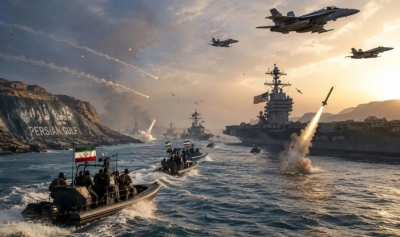
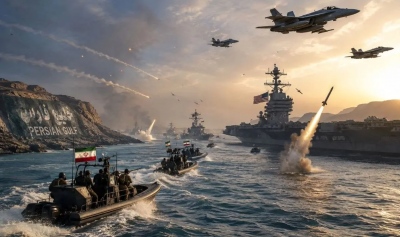
A senior representative of the Iranian parliament warned that any further aggression against Iranian ships in the Persian Gulf will provoke a "heavy and decisive" response targeting American ships and military bases across the region.
A spokesperson of the Committee on Foreign Policy and National Security of the Iranian parliament stated in a post on X that the Americans are quickly running out of options through ongoing provocations in the Persian Gulf. "As of today, our restraint has ended," he stated.
"Any aggression against our vessels will be met with a heavy and decisive Iranian response against American vessels and bases."
"Time is ticking negatively against the interests of the Americans, it is to their benefit not to act foolishly and sink deeper into the mire into which they have plunged."
According to Iran, the best course for the United States is to "surrender and make concessions."
"You must get used to the new regional order," Iran stressed.

IRGC: The Americans will receive a harsh military response if they attack commercial vessels once more
The Navy Command of the Revolutionary Guards (IRGC) reported that any attack on Iranian ships in the Persian Gulf or beyond will provoke an immediate and powerful military response against American military centers and enemy ships throughout the region.
The IRGC reiterated that Iran remains committed to protecting its maritime interests and ensuring the safe passage of its commercial fleet through the Strait of Hormuz.
The Iranian naval forces have recently intensified their presence in the strategically important waterway following US attacks on Iranian ships and tankers near the port of Jask.
According to Iranian military sources, naval units of the IRGC launched retaliatory operations using anti-ship ballistic missiles, cruise missiles, and combat drones, causing significant damage to military assets of the US and forcing American destroyers to retreat from the area.
The spokesperson of the Iranian military also warned that any new aggression against Iran will be answered with a "surprise" that will include new weapons, new methods of warfare, and new battle fronts.
He also warned that the countries cooperating with the United States in the imposition of sanctions on Iran could face difficulties during transit through the Strait of Hormuz.
Iran closed the Strait of Hormuz to hostile states and their allies after the onset of the unprovoked US-Israel aggression against the Islamic Republic on February 28.
The US imposed a naval blockade in the Persian Gulf.
Since then, the naval forces of the US have repeatedly targeted civilian commercial ships.
Iran condemned the blockade as maritime piracy and pledged not to return to negotiations with the United States as long as it remains in force.
Meanwhile, the Navy of the Revolutionary Guards (IRGC) assumed full control of the Strait of Hormuz, warning foreign forces against provocations that could jeopardize international shipping lanes.
www.bankingnews.gr







Σχόλια αναγνωστών