

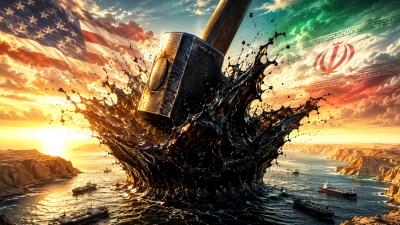
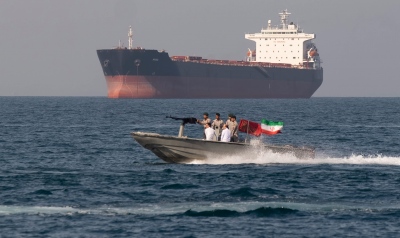
At a moment when US President Donald Trump claims he is seriously considering ordering new large-scale military operations against Iran—as the ceasefire has essentially collapsed—the Islamic Revolutionary Guard Corps (IRGC) is sending a fearsome message of strength. As they maintain, they fully control the Strait of Hormuz, where they have redrawn the defensive perimeter, creating an "Operational Crescent" that extends across 500 kilometers.
In this way, Iran is signaling that it has the first and last word in one of the planet's most vital energy arteries. Against the backdrop of a partial oil market collapse, skyrocketing fuel prices in the US, and pressure on the global economy, Tehran declares it will not allow any violation of its waters or interests and that the Iranian military is ready for any military scenario. This message highlights not only the deadlock but also the perceived weakness of the US and President Donald Trump, who, despite his threats, reportedly fears a war scenario, preferring a diplomatic solution.
Strategic expansion
The Islamic Revolutionary Guard Corps Navy (IRGC Navy) announced a significant strategic expansion of Iran's defensive perimeter in the Strait of Hormuz, warning that it will not permit any violation of the country's territorial waters or national interests. IRGC Rear Admiral Mohammad Akbarzadeh argued that Iran has fundamentally redefined the operational boundaries of the strategic maritime route. "In the past, the Strait of Hormuz was defined as a limited area around islands like Hormuz and Hengam, but today this has changed," Akbarzadeh stated. As he explained, the area of the Strait that Iran considers its own has expanded, stretching from the coasts of Jask and Sirik to beyond Greater Tunb Island, which is now redefined as a strategic zone. "In other words, the Strait of Hormuz has grown and transformed into a vast operational area," Akbarzadeh noted.
A 500-kilometer "Crescent"
"It has expanded from a width of 32 to 48 kilometers in the past to more than 320 to 480 kilometers—essentially about 500 kilometers—from Jask and Sirik to beyond Qeshm Island and Greater Tunb. It is a complete semicircular arc," emphasized the IRGC official, who stressed that the armed forces are closely monitoring all movements in the region. He noted that while some enemies—including the US President—claimed the Iranian navy was weakened or non-existent, the new design and its implementation show that this force is present with power. He added that the guardians of the Strait of Hormuz have demonstrated that the strait is firmly under the control of the Islamic Republic of Iran and is decisively protected. Referring to the geopolitical importance of the Strait, he underlined that Iran's approach is not merely geographical but strategic and distinct. He stated that Iran believes it holds a special role toward the world, as it bears no hostility toward people, but rather toward governments that constantly seek to antagonize Iran.
Fire directed at an American ship
Referring to a recent incident in the area, he said that in one instance, an American frigate attempted to pass through this zone but was accurately detected by Iranian armed forces. Following certain provocative moves, the Iranian Navy sent the necessary message with warning and targeted shots, resulting in the vessel immediately changing course. "The Islamic Republic of Iran monitors all regional movements with care and strength and will not allow any form of violation of its waters and interests," the IRGC official said. Akbarzadeh assured the Iranian people that the armed forces remain committed to defending the country's sovereignty and territorial integrity. "As has been said before, 'we will give blood, but we will not yield a single inch of land.' The armed forces will defend the country's territorial integrity and waters with all their might."
Seeking calm, but conditions have changed
In the sectors of energy, trade, and transport, he said, Iran not only created no obstacles but offered extensive services to the world. Even ships passing through Iranian territorial waters belonging to hostile countries were escorted by Iranian forces free of charge. He emphasized that this stance stemmed from a policy of de-escalation and ensuring security. "We sought tranquility and security in the region, but today conditions have changed and new policies are being implemented for the Strait of Hormuz, the results of which the world will see," he said.
Warning to Europe regarding the Strait of Hormuz
Iran also warned of a "decisive response" in the event of European warships deploying to the Strait of Hormuz. Iran's Deputy Foreign Minister warned European countries against deploying military vessels to the region. The IRGC announced that the only safe passage through the strait will be a corridor defined by the Islamic Republic, warning of a "decisive reaction" against any ship that deviates from it.
We have taught them enough lessons
Akbarzadeh argued that since the beginning of the eight-year Iran-Iraq war, the Americans supported Saddam Hussein in some way. As he said, this support was indirect but existed in all sectors. Specifically, he mentioned that during that period in the Persian Gulf, hardly a day passed without certain Iranian islands being bombed by Iraqi fighters. This, he said, showed that foreign forces had a serious presence in the region, pursuing interests and oil resources. He added that the Islamic Republic of Iran reacted decisively to these excessive demands. Regarding the issue of oil tankers, he said, "we taught them a good lesson" and the Americans retreated from certain positions.
British "Invasion"... they could not stand upright
He also recalled that in 2007, British sailors entered Iran's territorial waters near Farsi Island. He emphasized that the territorial waters of any country extend to 12 nautical miles and that every island has the same maritime zone. As he said, these forces entered the area either for research or to create tension, essentially wanting to test the reaction of the Iranian navy. "We warned them immediately, but they paid no attention and finally the order for their arrest was given," he reported. Akbarzadeh added that, according to accounts from those at the scene, the British sailors were greatly terrified, and some could not even stand upright. Ultimately, with logical and diplomatic behavior, they were transferred to a designated point and, under the presidency of that time, were released following agreements.
American soldiers burst into tears
He also referred to the 2015 incident when American marines who had entered Iranian waters were captured. As he said, there are images of the event showing that after their capture, they burst into tears. He claimed that when asked what had happened, it appeared they were psychologically and ideologically fragile, easily accepting defeat without the necessary will and determination. Comparing this image to the spirit of Iranian fighters, he cited the example of Shahid Hojaji, who, even in captivity, stood with dignity and did not yield for a moment. As he said, this difference is rooted in beliefs and goals. Akbarzadeh raised the question "what is real power" and noted that power is not limited to advanced equipment and modern weapons. Real power, he said, also depends on will, motivation, high goals, and the determination to achieve them.
Shock warning from Iran: If you hit us, we will enrich uranium to 90%
In a show of strength, Iran warned American President Donald Trump that if the US or Israel attacks again, Iran may proceed with uranium enrichment up to 90%. Iranian parliamentary committee spokesperson Ebrahim Rezaei stated that one possible response to a new American-Israeli strike "could be enrichment to 90%." "We will consider it in parliament," Rezaei stated in a post on platform X. 90% is considered an enrichment level suitable for weapon-grade nuclear systems and is far above the limits provided for in the 2015 JCPOA agreement.
Trump bombshell: The ceasefire with Iran has collapsed by 99%
Specifically, in recent statements, US President Donald Trump maintains that the ceasefire with Iran is on its last legs. "It is incredibly weak," he stated, commenting on the status of the cessation of hostilities with Iran in response to a request for comment from the White House. "I would say it is at its weakest point right now. After reading this nonsense," the American President stated, referring to Tehran's new response to Washington's proposals for ending hostilities. "The ceasefire is on life support," the American leader estimates. It is noted that the United States and Israel launched a reckless war without strategic depth against Iran on February 28.
Fatemeh Mohajerani: Iran’s finger is on the trigger
Iran’s government spokesperson states that while the military is prepared, the focus remains on sustainable peace and diplomacy that satisfies national interests. Fatemeh Mohajerani, the government spokesperson for Iran, stated that the country "is keeping its finger on the trigger," but emphasized that attention remains focused on "sustainable peace and diplomacy that satisfies our interests." Her comments come at a time of heightened regional tension as both sides weigh the future of current diplomatic efforts.
"We fought the world's greatest military power for 40 days and we still hold the trigger, awaiting a negotiated settlement," Mohajerani stated, according to the ISNA news agency. Her remarks highlight the Iranian leadership's dual approach of maintaining military readiness while signaling an openness to formal dialogue under specific conditions.
"Our primary focus is lasting peace and, as the martyred leader said, we are advancing diplomatic issues based on the three principles of honor, wisdom, and expediency," the government spokesperson underlined. This statement reinforces Tehran's official stance that any breakthrough in relations must align with the strategic framework established by the country's high command.
Ali Akbar Velayati: We defeated you on the battlefield
US President Donald Trump should not take the current absence of conflict between the US and Iran as a victory as he prepares to travel to Beijing on May 13 for a critical meeting with Chinese leader Xi Jinping, warned an advisor to Iran's Supreme Leader. "Mr. Trump, never imagine that by taking advantage of Iran's current calm you will be able to enter Beijing triumphantly," said Ali Akbar Velayati, as reported by the Tasnim news agency. "We defeated you on the 'battlefield,' so never consider that you will emerge a winner in diplomacy as well," Velayati stated. Trump stated on Monday that the month-long ceasefire between the US and Iran is "on life support to a massive degree." Both Iran and the United States have exchanged fire in the Strait of Hormuz since the ceasefire took effect.
Ghalibaf (Iran): We will shock the Americans if they attack us again
The Speaker of the Iranian Parliament, Mohammad Bagher Ghalibaf, stated that Iran's armed forces are ready for battle to give a crushing and worthy response to any aggression, warning enemies that wrong strategies will only bring them catastrophic results. "Our armed forces are ready to give a worthy response to any aggression. Wrong strategy and wrong decisions will always lead to wrong results. The whole world has already understood this. We are prepared for all options. They will be surprised," stated Ghalibaf, who maintained that: "There is no alternative but to accept the rights of the Iranian people as defined in the 14-point proposal." "Any other approach will be completely unclear. Anything else will be nothing but one failure after another. The longer they delay, the more the American taxpayers will pay for it," Ghalibaf added, referring to the proposal Iran sent to the US, which Trump rejected as absolutely unacceptable.
Axios: New US strikes against Iran being locked in – Thoughts on restarting Project Freedom
Two American officials told Axios that Trump is leaning toward the option of military action to increase pressure on the regime and force concessions on the nuclear program. "He will squeeze them a little," one official said. "I think we all know where this is leading," a second added. One of the options Trump is considering is restarting "Project Freedom," the American operation to escort ships through the Strait of Hormuz, which had been suspended last week. Another option is the resumption of the air campaign and targeting 25% of the targets that the American military command has identified but not yet struck. The Israeli government is asking Trump to order a special forces operation to seize Iran's stockpile of enriched uranium, though Israeli officials say Trump is hesitating due to the high risk.
www.bankingnews.gr



Σχόλια αναγνωστών