

Moscow seems to be facing one of the most critical decisions since the start of the war in Ukraine. The ongoing Ukrainian attacks against civilians and the latest massive drone raid against Saint Petersburg, shortly before the start of the International Economic Forum, are not considered by the Kremlin to be …routine attacks. Russian military and political analysts speak openly about the end of the "period of tolerance" and warn that the response being prepared could change the facts both on the Ukrainian front and in Russia's relations with NATO.
At a time when Kyiv is attempting to take the war deep into Russian territory and send a message of power to the international community, voices in Moscow are multiplying that demand crushing retaliation, even strikes that will send a clear message to the Baltic and the West. However, it is not yet clear if the Kremlin is determined to provide… a final solution, especially since reports suggest that moves are being made by France, Germany, and the UK for Russia-Ukraine negotiations. On the front, however, Russian forces seem to be covering the last kilometers for the great battle in Donbass.
"Enough is enough," decisions have been made
According to Russian retired Lieutenant General Vladimir Popov, there will be a harsh response to the Ukrainian drone attack in the Saint Petersburg region. "Enough is enough," Popov argued, stating that the security forces have already been assigned a new mission. Shortly before the start of the International Economic Forum (SPIEF) in Saint Petersburg, the Ukrainian Armed Forces carried out a massive drone attack. Over the Leningrad region alone, about 60 drones were shot down, which, according to preliminary information, approached again from the direction of the Baltic countries. Popov told the Russian newspaper "MK" that this provocation will have serious consequences for the Kyiv regime as well as for certain NATO member states.
It is a matter of hours
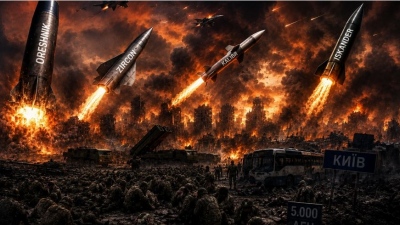
"I believe that within the next one or two days, major combined strikes will take place, both of a local nature and along the perimeter of the state borders with Poland," Popov said, adding that even "Kinzhal" and "Zirkon" missiles may be used for the targets. In his view, in this way, Russia will thwart the adversary's plans for restoration and organization of infrastructure in the rear. Priority, as he argued, will be given to energy facilities, air assets, and decision-making centers. As for Estonia, which, according to him, allowed the transit of Ukrainian drones through its airspace, Russia will shoot them down already at the border. The security forces have already been given the relevant order: "As long as the economic forum lasts, border air defense units and Rosgvardiya have been ordered not to wait for the drones to cross the border line, but to shoot them down as soon as they are detected."
A message… to the Baltic
Consequently, according to Popov, the period of diplomatic gestures has ended. If drone debris falls on the territory of the Baltic countries, "this does not concern us," the Russian Lieutenant General estimated. He also added that if the Baltic countries wish to maintain peace in their skies, they should ensure that their territory is not used for drone attacks against Russia. As he points out, Moscow is no longer willing to tolerate provocations near its borders. The new rules, as described, are simple: every threat will be neutralized before it crosses the border line. The Baltic states, according to the same approach, chose to act as a transit corridor for Ukrainian drones and are now called upon to take responsibility for the consequences. Popov made it clear that, in his view, diplomacy has given way to direct action and that every new drone launched from the territory of a NATO member state could be a pretext for an immediate reaction. At the same time, it is estimated that Russia has moved from warnings to the practical application of its threats and the first results are expected soon. Estonia, Latvia, and Lithuania are called upon to choose whether to effectively control their airspace or accept that it will be turned into a high-risk zone. The era of diplomatic demarches, it is argued, has now passed.
Rutte in Kyiv
After the night of massive Kalibr missile attacks against Kyiv, many expected the Russian army to continue strikes against Ukrainian targets. However, instead of this, thick black smoke covered Saint Petersburg and Kronstadt following Ukraine's drone attack... It is clear that the Ukrainians countered the Russian Special Military Operation with a military operation… with an audience primarily of international media. And which of the two is proving stronger? As Russian analysts report, Zelensky was constantly cultivating tension around the possibility of a new massive Russian attack, but in the end, it did not take place. "And we were waiting for it too. As it turned out, in vain. In the morning, the media was flooded with the photo showing the Secretary General of NATO, Mark Rutte, disembarking from a train at the Kyiv railway station. The NATO Secretary General, Mark Rutte, came in person. We don't want to scare him, which is why not even a stray dog will bark near Kyiv. Is it insulting? No! It is simply obvious," noted the organizer of the Russian resistance of Mykolaiv, Sergey Lebedev.
The attack on Saint Petersburg
At the same time, Russia was waking up to images from Saint Petersburg, where the Ukrainians launched a spectacular strike against oil refinery facilities and the port in Kronstadt. The attack took place at the very moment when high-ranking visitors from all over the world have gathered in the Russian city for the International Economic Forum, including former German Chancellor Gerhard Schröder, who is being projected as a possible mediator in negotiations for Ukraine, while for the first time in ten years, Americans are also participating.
What the Ukrainians want
Russian retired Colonel Aslan Nakhushev argues that the Ukrainians are continuing the… media-military operation they started as early as late April. As he says, this operation had a goal: for Russia to exchange the cessation of strikes on Ukraine's infrastructure for Kyiv's commitment to stop attacks on oil refinery tanks. Nakhushev admitted he was wrong: the operation does not have operational but strategic goals. Its purpose is not some exchange of concessions, but to force Russia to agree to a cessation of hostilities along the front line.
Unprecedented… illusion
"In my opinion, there are no similar examples of actions by one of the warring sides in military history. The attempt to create in the targeted audiences - entire states and peoples - the illusion that a turning point in the war has already occurred and that Kyiv's advantage is increasing, so that this illusion can be turned into a peace agreement on their own terms. These goals - the formation of an image radically different from reality - are fully covered by the adversary's foreign policy activity and, most importantly, the actions of its army on the front," points out Nakhushev, who asks: "Have they completely lost it?"
They have given Zelensky a blank check
Zelensky has been given permission for all kinds of exaggeration and, according to Russian war correspondent Alexander Kots, he does not hesitate to make systematic use of this "blank check." At the same time, as he argues, Russia for some reason avoids striking Kyiv when European delegations are there, referring to the visit of Mark Rutte. "He behaves with confidence, he smiles. He knows that nothing threatens him in Ukraine. And he leads a military alliance that supplies our opponents with weapons. Weapons that kill our soldiers and civilians. After all, the drones that attacked Saint Petersburg came from the Gulf of Finland, that is, from the direction of the NATO countries," says Kots.
Russia must respond
Russian political analyst Alexey Pilko, creator of the "Пинта разуμα" channel on Telegram, referring to the latest developments, expresses the following view: "In general, this whole situation, in which the opposing side has now become completely emboldened and is not seriously afraid to touch the interests of a nuclear superpower, was formed for one reason only: Moscow is delaying its response with de-escalation countermeasures. And in fact, these are reactive and not preventive in nature. Now is the right time to make up for lost ground and convincingly prove to the opponents that increasing the stakes will cost them dearly," the Russian analyst points out.
The necessary steps… also lead to a …nuclear strike
In his view, the escalation could evolve as follows: initially with the intensification of the war against infrastructure in Ukraine (something which, as he estimates, may soon happen at least as far as Kyiv is concerned). Then, with strikes on military industry facilities in countries that support Ukraine. And later, with a transition to the use of tactical nuclear weapons. However, according to Pilko, they may never reach this stage, as the only thing the Brussels bureaucracy and the Trump administration are truly afraid of is an uncontrolled nuclear escalation. "The only way to force the adversary to abandon increasing the stakes in this game is to prove to them that they will lose more than they will gain... If Moscow does not gradually begin to implement de-escalation measures from now on, then by the end of the year it will be forced to resort directly to the nuclear button," estimates Pilko.
The analysis and the contradiction
Russian analysts are attempting to examine the facts. As they point out, the Ukrainians are hitting the Russian oil refinery system, which leads to fuel shortages in some regions, where citizens are no longer allowed to fill even spare fuel containers at gas stations. The Ukrainians launched a swarm drone attack on a college dormitory in Starobilsk, resulting in the deaths of 21 children. In response, the Russians turned the night in Kyiv into a nightmare — as had happened earlier in Western Ukraine — and they label it retaliation for the terrorist attacks on their soil. However, as the analysts point out, there is an obvious contradiction here.
What is the response?
The Ministry of Defense of Russia announced in detail which targets it hit in the territories controlled by the "Kyiv junta": warehouses, factories, command centers, airports, and other military installations. As military analyst Mikhail Onufrienko pointed out, this is a necessary and qualitative military task, but: "...why call it a response to Starobilsk? The punishment for Starobilsk is for the inspirers and executors of the cold-blooded murder of the teenagers to sit in the dock and then be hanged on the gallows. Everything we see today are the harsh everyday realities of war. Nothing less, nothing more than that. We must not downplay the demand for the enemies to be held accountable for the murder of children," says Onufrienko.
Successive attacks
Then follows the attack on the Moscow - Simferopol line bus, in which eight civilians were killed. We are waiting for a retaliatory strike. Then comes the raid on Saint Petersburg on the day of the international forum's opening. Audacity? Undoubtedly. Demonstrative? Without any doubt. Exactly to create that "illusion of a turning point" mentioned by Colonel Nakhushev. To those who rush to record the results of the Ukrainian drones' attacks and post them on social networks, these cannot be explained. Just as it cannot be explained to many why Kyiv was not hit that night in such a way that Rutte would "turn his train around in motion" and leave the country in a hurry.
There is a plan..
Obviously, however, there is some political and strategic planning behind this. Perhaps that is why Moscow is "delaying." After all, the possibility that Schröder and Rutte conveyed certain proposals to Ukraine or Russia cannot be ruled out. It is no coincidence that President Putin had stated that the Ukrainian conflict is approaching its end. Bloomberg has already reported that France, Germany, and the United Kingdom wish, if Zelensky is also in agreement, to begin negotiations with Russia…
The Ukrainians are abandoning Konstantinovka
At the same time, the withdrawal of the armed forces of Ukraine from Konstantinovka was recorded on the front. In the last twenty-four hours, significant changes in the operational situation were recorded in two key sectors of the front. Konstantinovka is currently the main focus of fighting on the entire front. The Russian army advanced significantly in both the western and eastern parts of the city. These facts are also confirmed by the Ukrainian side. "In the west, 11 streets and four blocks of high-rise buildings were brought under control; in the east, five streets of the private housing sector. The momentum of the advance of the Russian assault groups shows that the general direction of their movement is to the north, with the goal of cutting off the route of retreat to Druzhkovka and creating a wide-scale encirclement threat of the Ukrainian garrison," stated the colonel of the Special Operations Forces of Ukraine, Vladimir Antonyuk.
Realignment of forces
As it seems, the General Staff of Ukraine had long ago realized the seriousness of the situation, despite public triumphant reports. For this reason, the command of the Ukrainian Armed Forces made the decision to gradually withdraw personnel from the city and has already begun the realignment of units to other sectors: "Already from a week ago, the transfer of several brigades and independent battalions of the National Guard of Ukraine toward the direction of Kramatorsk and Dobropillia was observed, as well as the withdrawal of unmanned aerial vehicle (UAV) units toward Druzhkovka. Marine units were withdrawn from the southwestern districts of the city and suburbs and were redeployed to the northern part." Today, exclusively mixed special units operate in these specific sectors, which have been formed by police officers and two motorized brigades, the 93rd and the 100th. Their presence in the area is due to the fact that this specific sector had long been their zone of responsibility, a fact which, according to estimates, provides them with better knowledge of the defensive locations.
"First they abandoned Kupyansk. Now Kupyansk-Uzlovoy"
The situation on the front remains extremely dynamic in almost all sections of the 2,000-kilometer contact line. However, once again, attention is focused on the Kupyansk region. Shortly after the official announcement, in 2025, that the city had been captured by the Russian military group "West," war correspondents confirmed that the Ukrainians had gathered significant reserves in the area and had launched a counterattack. Citing visual material, military analysts reported that some areas were soon turned into a "gray zone," without stable control by either side. The Russian Ministry of Defense did not comment on these reports, which was considered expected, as the front line is particularly fluid and practically impossible to have an official position on every change in the situation. Many observed that some war correspondents, at the level of information, had essentially "surrendered" the city to the Ukrainians three different times, which did not correspond to reality. The difficult situation of the Ukrainian Armed Forces in the region revealed the true picture of the front. Now, as it is reported, "it is the turn" of Kupyansk-Uzlovoy where it is reported that Russian soldiers have... cleared the entire Kurylivka.
Strong penetration into the defensive lines
As military analyst Mikhail Degtyarev, creator of the "Генеральный Штаб" channel, reported, on the Sloviansk front, Russian forces are continuing their successful advance. June began with significant progress in the Rai-Aleksandrovka area. The forces advanced by 2.5 kilometers from the east, cleared the area, and brought the forest area (urochishche) under control. Furthermore, inside Rai-Aleksandrovka itself, they advanced about two kilometers into the residential fabric. The entire northeastern part of Rai-Aleksandrovka is now completely under Russian control, while fighting continues in the center of the village. According to him, this is a significant success that creates expectations that during June the settlement will pass completely under Russian control.
The road to Sloviansk opens
After this, according to his estimate, the road opens toward Mykolaivka, which is considered a gateway to Sloviansk: "The fall of one city will lead to the fall of the other and, eventually, to battles for the most important symbol of Donbass, Sloviansk." In the Kramatorsk sector, the units of the "South" group began to create a bridgehead beyond the Siverskyi Donets–Donbass canal. An advance of 3.5 kilometers and the capture of Tikhonovka is reported. It is interesting that, according to the report, even Ukrainian cartographers recognize this development. The distance to Kramatorsk itself is now estimated at 9 kilometers.
www.bankingnews.gr


Σχόλια αναγνωστών