

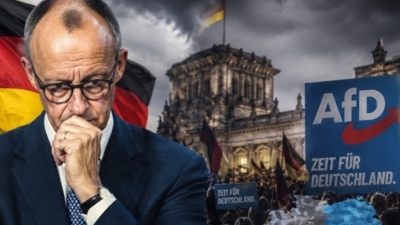
Chancellor Friedrich Merz's CDU/CSU suffered a complete defeat in yesterday's elections in the state of Mecklenburg-Western Pomerania, failing—for the first time in its history—to enter the local parliament as it remained at 4.9%. Merz spoke of a disaster, asserted that he is not resigning, and that he remains party chairman and chancellor, but the political thriller in Germany is just beginning.
In just a few hours, the governing bodies of the CDU/CSU are meeting, followed by Merz's traditional press conference with the party's lead candidates, Daniel Peters in Mecklenburg-Western Pomerania and Stefan Evers in Berlin. There, as political analysts point out, it will become clear whether he emerged strengthened from the meetings or if the party's powerful figures have already called his position into question.
At the same time, the wind of political change is blowing in Germany.Following the election contest in Saxony-Anhalt, Alternative for Germany achieved another electoral triumph, prevailing with 38.2% in the elections in Mecklenburg-Western Pomerania, while also increasing its percentage (16.3%) in the Berlin elections, where the left-wing party Die Linke emerged as the leading force with 18.8%. It is now clear that the political balances in Germany have been upended in a resounding manner. What remains to be seen is whether the defeat of the CDU/CSU will develop into a severe political crisis and whether Merz will ultimately remain in his position or if the countdown to his removal has already begun.
AfD triumph in the state of Mecklenburg-Western Pomerania
Alternative for Germany (AfD) emerged as the primary force in the state of Mecklenburg-Western Pomerania, securing 38.2% of the vote. However, the most impressive element is that it increased its strength by 21.5 percentage points, having received 16.7% in the previous elections. The Social Democrats became the second force with 35.5%, losing 4.1% of their strength compared to the previous election. Furthermore, with the Christian Democrats remaining at 4.9% and thus outside parliament for the first time in their history, the political map has changed radically. AfD and SPD together gather approximately 74% of the votes, while the CDU, Greens, and Die Linke are now restricted to single-digit percentages.

The next day
Based on the final election results, the AfD holds 32 seats and the SPD 29. Die Linke will have 5 seats, equal to the Greens. With a total of 71 seats, 36 seats are required for an absolute majority. Given that the AfD, with its 32 seats, cannot form a government and given that no party wishes to cooperate with it, the most likely scenario is an alliance between the SPD, the Left, and the Greens.
The Left comes first in Berlin
In Berlin, the left-wing party Die Linke emerged as the leading force with 25.7%, followed by the CDU with 18.8%. The result represents yet another negative outcome for the Christian Democrats on an election night that increases the political pressure on Chancellor Friedrich Merz's party. The AfD emerged as the third force with 16.3%, bolstering its shares by at least 7 percentage points.

Possible alliances
Based on the results, there are two likely scenarios for government formation in Berlin: Either a government of the Left, with the Greens and the SPD securing 95 seats, or a CDU government with the Greens and the SPD giving a narrow majority of 82 seats.
Complete defeat
The defeat in the state of Mecklenburg-Western Pomerania is so crushing for the CDU—a party traditionally considered a pillar of the political system—that many have been left speechless. When the first results were broadcast on television at 18:00 on Sunday afternoon, disappointment and silence prevailed. The CDU, ARD reported at the time, would "probably" narrowly manage to enter the state parliament. Shortly thereafter, lead candidate Daniel Peters stated that he was deeply shaken emotionally and that the party was still in a "fight for survival." Only later in the evening, he said, would it be known whether the CDU had actually managed to gain entry into the parliament. Peters received polite applause, but at that point it was clear to everyone that they were experiencing precisely what the Chancellor and CDU chairman had described a short while earlier at party headquarters in Berlin as a "disaster." During the course of the evening, the situation grew even gloomier when, after all electoral districts were counted, it was established that the CDU, for the first time in its history, failed to cross the 5% threshold.
Thriller with Merz
Friedrich Merz also had an assessment ready for the election result in Berlin during his appearance that evening. He called it "respectable," even though the CDU took only second place, at a clear distance from the Die Linke party. Prior to election night, there had been much discussion about what a bad electoral outcome would mean for Merz. Would he resign as chancellor? Or perhaps "only" as party chairman? Election night made it clear that he intends to do neither. "What needs to be done now requires fortitude, stability, and patience," Merz stated. "I will demonstrate them. As chairman of the CDU and, above all, as federal chancellor of our country."
The party meets and reveals the mood
The decisive question of the coming days, however, will likely not be so much what Merz can demonstrate. The issue will be more whether his own party can still display enough patience toward him. Today, Monday 21/9, as always after elections, party bodies are meeting at the Konrad-Adenauer-Haus. The customary press conference with the chairman and the lead candidates is scheduled for late afternoon. When Merz takes the stage in the atrium of the party headquarters alongside Peters and Berlin candidate Stefan Evers, it will become clear whether he emerged strengthened from the board meetings—or if powerful party figures have already begun to seriously question his position. At the CDU election rally in Berlin, they watched Merz's appearance live—in silence. When he referred to the "disaster" of Mecklenburg-Western Pomerania, some nodded in agreement with troubled expressions. Strong applause broke out when Merz praised the Berlin lead candidate, Evers, for taking on "this difficult task" on short notice.
"Respectable" is a matter of interpretation
However, what Merz described as "respectable" regarding the Berlin result means for the CDU parliamentary group that it will now possess only 35 seats in the Berlin House of Representatives—down from 52. A coalition of the CDU, Greens, and SPD would still, at least numerically, be possible. If, however, the Greens and the SPD choose to cooperate with Die Linke, the CDU will lose the Red City Hall. Nevertheless, in his speech on Sunday evening, Merz made it clear that he does not intend to back down and that he wants to insist on the course of reforms. "Reforms must proceed," he declared. Support arrived from the sister party: "These election results change nothing about the need for reforms in this country," stated the leader of the CSU parliamentary group, Alexander Hoffmann.
More humility
At the CDU election rally in Berlin, they also heard the Chancellor's message that he will continue on the same path. "Well, that didn't sound like he wants to change anything," said one attendee, who does not expect to remain in the Berlin parliament in the future. Manuela Schwesig appeared even less enthusiastic; following the turnaround achieved in Mecklenburg-Western Pomerania, she is expected to emerge as the new strong figure of coalition partner SPD. Already on election night, she asked Merz for "more humility," rather than simply insisting on continuing his reform path. For Merz, this creates a difficult situation: if the SPD forces him to make concessions on his reform program, he will find himself under even greater pressure within his own party, where structural reforms—especially in social security systems—are viewed by the majority as essential measures.
"Christian Democracy received a very clear message"
In the meetings of the party bodies, Merz is expected to discover whether his speech on election night secured him respect and more room for maneuver—or if, on the contrary, it achieved the exact opposite with his critics. In any case, it is clear that Merz has committed to one choice: to remain in his post himself and not offer the CDU the option of an early transition, at least regarding the party leadership.
Weidel calls on CDU to abandon the "firewall" and cooperate with AfD
The co-leader of Alternative for Germany (AfD), Alice Weidel, called on the center-right Christian Democratic Union (CDU) to end the so-called "exclusion wall" of the democratic spectrum that it has erected against cooperation with her party. Weidel stated to public broadcaster ZDF that the CDU is weak partly because it refuses to cooperate with the AfD. "Voters are consistently voting toward the center-right," she said, arguing that the CDU could have formed governments alongside the AfD at both state and federal levels. Weidel stated that voters desire a change in political direction and that Chancellor Friedrich Merz should take heed of the election results and act accordingly. "Our goal is, of course, to conduct talks in the long term for the formation of a governing coalition with the CDU, but under no circumstances will we compromise our core positions," she stated.
Chrupalla – AfD: We received a clear mandate to govern in Mecklenburg-Western Pomerania
The co-leader of Alternative für Deutschland (AfD), Tino Chrupalla, stated that his party has received a mandate to govern in Mecklenburg-Western Pomerania, following election projections showing it in first place in the regional elections. "We clearly have the mandate to govern here," Chrupalla told public broadcaster ARD. "Voters have clearly given us this mandate." Chrupalla added that the AfD will offer talks to all parties. However, Germany's other major parties continue to maintain the so-called "firewall" (Brandmauer) against cooperation with the AfD, leaving the party without an obvious coalition partner despite its projected first-place finish. The result, therefore, does not automatically mean that the AfD will participate in government. Forming a regional government requires sufficient parliamentary support in the local parliament.
The "democratic spectrum" strategy against the AfD is over
For years, the political response of traditional German parties to the rise of the AfD was summarized in a single word: Brandmauer. A "firewall" around Alternative für Deutschland, with the core rule that parties of the political center do not form governments or enter into political alliances with the party. This doctrine officially remains in effect. However, the election result in Saxony-Anhalt and the outlook ahead of new regional contests have opened a very different debate: can the AfD remain isolated parliamentarily while simultaneously increasing its electoral strength so dramatically worldwide? The CDU suffered a heavy defeat; the result brought the hitherto theoretical question of the Brandmauer to the center of political debate. The essence of the problem is simple: the political isolation of the AfD may complicate its entry into government, but it has not prevented its electoral expansion. On the contrary, across large parts of eastern Germany, the AfD has transformed from a protest party into a force competing for top position and, in certain states, approaching figures that make forming governing majorities without it dramatically difficult. Tagesschau itself noted after the Saxony-Anhalt elections that one of the strategy's goals—limiting the electoral growth of the AfD—was not achieved.
The Brandmauer paradox and AfD - CDU cooperation
Here lies the political paradox. The larger the AfD grows, the more parties are required to form a government without it. And the more complex these coalitions become, the harder it is to present voters with a clear political alternative. The AfD attempts to capitalize on precisely this situation, portraying the remaining parties as a unified political establishment cooperating solely to keep it out of power; this forms a central part of its political narrative and does not imply that the remaining factions lack meaningful ideological differences together. The debate spreads inside the CDU Perhaps the most significant sign of pressure is found not within the AfD, but within the CDU itself.
Chancellor Merz continues to reject cooperation with the AfD, citing the official party line of the Christian Democrats. Inside the conservative movement, however, the debate has opened. Bavarian Prime Minister and CSU leader Markus Söder stated that "the concept of the Brandmauer has failed," while clarifying that he remains opposed to CSU cooperation with the AfD. Saxony Prime Minister Michael Kretschmer, also a CDU figure, argued that there must be the possibility of dialogue with all parliamentary forces, saying that anyone who still speaks solely in terms of "Brandmauer" has failed to understand the new political reality; at the same time, he continues to direct sharp criticism at the AfD. Even within CDU organizations that insist on total political distance from the AfD, voices are now emerging calling for the abandonment of the term "Brandmauer" itself today.
www.bankingnews.gr







Σχόλια αναγνωστών