

Moscow is attempting to turn the crisis in Iran into an opportunity for geopolitical elevation, presenting itself simultaneously as a strategic partner to Tehran, a mediator for ending the war, and an indispensable energy interlocutor for Washington.
The critical question is whether the Russian-Iranian strategic relationship constitutes an unconditional choice or whether the Kremlin seeks to capitalize on the Iranian crisis in its dealings with Donald Trump.
The simultaneous activation of Russian diplomacy on the Iranian issue and the surprise energy understanding with the United States reveal one of the most significant contradictions of contemporary international politics: Russia strategically backs Iran, but has no intention of sacrificing its own geopolitical interests for the sake of Tehran.
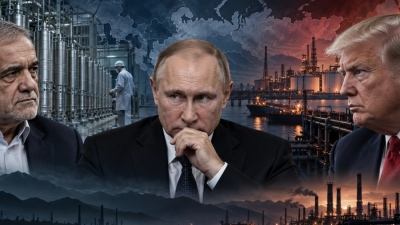
The meeting between Vladimir Putin and Iranian President Masoud Pezeshkian on October 8 in Turkmenistan, and the telephone communication that followed with Donald Trump on October 9, do not constitute two independent diplomatic episodes.
They form the picture of a coordinated Russian effort to secure for Moscow a decisive role in shaping the post-war balance in the Middle East.
However, while Putin reassures the Iranian leadership that Russia seeks an end to the conflict through negotiations, Washington announces an agreement for the supply of Russian diesel, accompanied by a temporary easing of American sanctions.
The development creates a critical strategic question: is Moscow attempting to rescue Iran from American pressure, or is it utilizing the crisis to negotiate more favorable terms with the United States?
The strategic relationship between Russia and Iran is not coincidental
To interpret Moscow's stance, one must examine the true nature of the Russian-Iranian rapprochement.
The relationship between the two countries has long transcended the boundaries of occasional cooperation against the West.
It now forms a structural component of the Eurasian geopolitical architecture that Russia seeks to construct.
The Comprehensive Strategic Partnership Agreement, signed on January 17, 2025, with a twenty-year duration, institutionalized cooperation in defense, security, energy, transport, and financial transactions.
The essence of this relationship lies in the convergence of their strategic interests.
Russia needs a strong Iran that curbs American influence in the Middle East, keeps southern trade corridors open, and enhances capabilities to bypass Western sanctions.
Correspondingly, Iran needs Russian diplomatic backing, technological and military cooperation, and Moscow's participation in shaping a more multipolar international system.
Of particular importance is the International North-South Transport Corridor, which can connect Russia to the Indian Ocean via Iran, creating an economic and geostrategic counterweight to Western-controlled trade routes.
Iran, therefore, is not merely a diplomatic partner for Russia.
It represents a vital geographical and strategic pillar of its Eurasian policy.
This, however, does not imply an unconditional military alliance.
The bilateral treaty does not provide for automatic military intervention by one country on behalf of the other.
This distinction explains a significant part of contemporary Russian behavior.

Putin restores Moscow to the epicenter of the Iranian crisis
In his meeting with Masoud Pezeshkian, Vladimir Putin argued that Tehran is making substantive efforts to end the war and expressed Russian readiness to contribute to a diplomatic settlement.
The Russian posture carried a clear political objective: to make Moscow an indispensable interlocutor in a crisis where American military power, Iranian resistance, and the interests of regional powers collide.
Russia does not participate as an official mediator in US-Iran negotiations.
It seeks, however, to influence the substance and preconditions of a potential agreement.
This strategy aims at two parallel outcomes.
First, preserving an Iran that will not be forced into a strategic capitulation to Washington.
Second, highlighting Russia as a power without whose involvement a sustainable regional settlement cannot be built.
For the Kremlin, peace is not exclusively a matter of regional stability.
It also serves as a means of recognizing Russia's international role.

Enriched uranium as a diplomatic weapon
The most substantive Russian initiative concerns the proposal to transfer Iranian enriched uranium onto Russian territory.
According to what Kremlin aide Yuri Ushakov conveyed following the Putin-Trump exchange, this specific proposal remains on the table.
It is a move of particular strategic significance.
Iran's nuclear program represents a central point of confrontation with the United States.
Washington demands substantial restrictions on Iranian enrichment capabilities, while Tehran views the peaceful use of nuclear energy and the right to enrichment as a matter of national sovereignty.
Russia attempts to bridge this divide by offering a technically feasible, yet politically complex solution.
Transferring stockpiles of enriched uranium could alleviate concerns regarding nuclear proliferation risks without necessarily requiring the total abandonment of Iranian nuclear infrastructure.
At the same time, however, it would elevate Moscow into the guarantor of a potential agreement, granting it significant leverage over US-Iran relations.
Here lies the core contradiction.
The proposal is presented as a diplomatic way out, but it has not secured Iranian consent.
On the contrary, the Iranian side has rejected surrendering its stockpiles under current circumstances.
Therefore, Iranian uranium cannot become the subject of a Russian-American accord without the sovereign consent of Iran itself.

From Iranian uranium to Russian diesel
The other facet of Russian diplomacy is reflected in the energy agreement announced by Donald Trump.
On October 9, the American president made known an agreement for the immediate provision of over 300,000 tons of Russian diesel to American and global markets, with additional quantities envisioned thereafter. The American administration also moved toward a temporary relaxation of relevant sanctions.
The timing is revealing.
The war with Iran and disruptions in energy supply have amplified inflationary pressures, turning fuel prices into a critical domestic political problem for Trump ahead of the American midterm elections on November 3.
For the American president, the Russian offer represents an attempt to curtail energy costs, even if analysts dispute whether these specific volumes can deliver a substantive price reduction.
For Moscow, however, the benefits are broader.
Russia gains additional commercial opportunities, establishes a precedent for sanctions relief, and restores a channel of economic communication with Washington.
Simultaneously, the agreement provokes backlash in Ukraine and in Europe, where concerns are voiced that this renewed energy cooperation economically fuels the Russian war effort.
Moscow, consequently, leverages a crisis impacting international energy security to challenge in practice the effectiveness of the Western policy of economic isolation.

Would Russia sacrifice Iran for a deal with the US?
This is the deeper geopolitical dilemma.
Russia has compelling reasons to prevent the defeat or destabilization of Iran.
Such an outcome could decisively strengthen the American presence along the southern borders of the Eurasian space, weaken Russian regional connectivity, and restrict Moscow's ability to influence developments across the Middle East.
However, the Kremlin has equally compelling reasons to avoid an uncontrolled clash with the United States over Iran.
Russian strategy is characterized more by pragmatism than by ideological devotion to alliance commitments.
Moscow desires a resilient, sovereign, and friendly Tehran, but does not necessarily desire an Iran whose clash with Washington could drag Russia into a direct confrontation.
This means that Russia is not bound to seek the prolongation of the war.
On the contrary, a negotiated settlement that maintains Iranian state capacity, curtails American military pressure, and acknowledges Russia's diplomatic role could constitute the ideal outcome for the Kremlin.

Putin's double victory: Providing energy relief to Trump and gaining time for Iran
In conclusion, Putin achieved two strategic goals with one move: offering Donald Trump a political exit from the energy crisis burdening the American economy, and simultaneously creating conditions for a temporary de-escalation of American military pressure toward Iran.
This assessment acquires particular weight when viewed through the prism of pressures confronting the American president.
In this juncture, Moscow appeared as part of the solution to a problem directly linked to American military involvement in the Middle East.
And here lies the second, more intricate dimension of Russian strategy.
Putin, by offering an energy outlet to Trump, simultaneously sought to reinforce arguments favoring temporary restraint by Washington toward Tehran.
Since the American president pursues the de-escalation of energy prices, a massive new round of American strikes against Iran could undermine that exact objective by unleashing further turmoil across international markets.
Viewed from this angle, it can be underscored that the Russian initiative helped create a temporary diplomatic window within which military escalation becomes far less appealing for the American side.
www.bankingnews.gr



Σχόλια αναγνωστών