

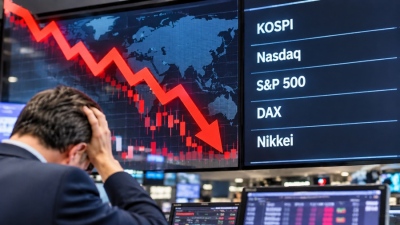
Global market sell-off: $2.5 trillion wiped out in one day – 9% plunge for Kospi, Nasdaq enters correction
The massive wave of liquidations on Wall Street sent powerful shockwaves through international markets, with approximately $2.5 trillion evaporating from the total market capitalization of listed companies during a single trading session on Thursday, November 5. At the center of concerns was the prospect that Democratic electoral successes in the US midterm elections might slow down the expansion of artificial intelligence (AI) investments. The negative sentiment immediately spilled over into Asian markets, with South Korea's Kospi index plunging nearly 9% at the opening of trading on Friday, November 6, leading market authorities to temporarily suspend trading for 20 minutes. This followed a 5.52% collapse of the Nasdaq during Thursday's session, which pushed the tech index into correction territory as it fell more than 10% from its historic high on October 6.
The worst session since April 2025
The Nasdaq, with its heavy concentration of technology companies, recorded its worst single-day performance since April 2025, when US President Donald Trump announced the imposition of broad global tariffs. The pressure, however, was not confined to the tech sector. The S&P 500 and the Dow Jones also posted their largest single-day losses since April 2025. The reversal was dramatic: just one day earlier, on Wednesday, Wall Street had staged a historic rally following the midterm elections, with the Dow Jones gaining 1,569 points and the Nasdaq rising 1.44%. On Thursday, however, the Dow Jones closed down 1,833 points, completely wiping out the previous session's gains. It is worth noting that despite the rise in major benchmark indices on Wednesday, shares of semiconductor manufacturers and companies involved in building data center infrastructure were already under pressure, with sell-offs intensifying on Thursday and dragging down the broader market.
Democratic election victory in Texas sparks concerns
A decisive factor in the worsening market sentiment was the Democratic victory in the election for Governor of Texas. The state has evolved into a pivotal hub for artificial intelligence development, with tech giants such as Google, Meta, Oracle, and OpenAI making massive investments to build data centers. Newly elected Texas Governor Gina Hinojosa included in her campaign platform a temporary moratorium on constructing new data centers, as well as repealing specific tax incentives for businesses investing in such infrastructure across the state. Investors now fear that Democratic gains in states serving as core hubs for planned data center investments could lead to significant delays, restrictions, and revisions of capital expenditure plans. Sellers targeted both microprocessor manufacturers and companies supplying essential equipment and infrastructure for data center expansion and the artificial intelligence boom.
Plunge for Nvidia, Tesla, and SpaceX
Pressure was especially severe on shares of companies directly linked to artificial intelligence development. Nvidia (NVDA) stock fell 9.3% on Thursday, erasing all gains recorded since the beginning of 2026. Meanwhile, the index tracking semiconductor manufacturing companies registered a 12.3% drop, marking its worst session in nearly six and a half years. Shares of Elon Musk's Tesla (TSLA) declined by 11%, while SpaceX (SPCX) recorded losses of 9%. The drop was even steeper for the Nasdaq 100, the index containing the largest tech firms, which fell 6.36% to log its worst daily performance since March 2020, when the Covid-19 pandemic severely rattled global markets. Significant losses were also incurred by companies specializing in leasing computing power for AI applications, known as neoclouds; CoreWeave (CRWV) and Nebius (NBIS) dropped by approximately 10% and 15% respectively. CoreWeave stock has lost 76% of its value since its June 2025 peak shortly after going public, while Nebius reflects a 58% loss from its June 2026 high.
Investors punish companies that disappoint
Caution is further fueled by growing investor intolerance toward companies failing to confirm forecasts or meet market expectations. A characteristic case is Qualcomm, which on Wednesday reported lower-than-expected results and warned that high memory chip costs are weighing on sales—concerns echoed by Intel the previous week. Qualcomm stock fell 9.5% during Thursday's session. At the same time, the VIX volatility index—Wall Street's "fear gauge"—surged by approximately 70%, marking its largest single-day rise in nearly two years and reaching its highest level in seven months. The sheer scale of the sell-off was reflected in the fact that all 11 sector indices of the S&P 500 closed in negative territory.
Bonds benefit from flight out of equities
Deteriorating sentiment surrounding technology stocks and expectations of a potential slowdown in data center expansion boosted demand for US Treasuries. The yield on the 10-year US Treasury note fell to 4.84%, reaching its lowest level in two months. Keith Lerner, Chief Investment Officer at Truist Advisory Services, considers the sharp swings of recent days to be more of a knee-jerk reaction by investors than a clear signal of how equities—and the tech sector in particular—will perform under a Democratic-controlled Congress. As highlighted, investors are struggling to evaluate whether curtailing AI investments will unlock new market opportunities or create additional structural headwinds.
Dilemma of tech giants and data centers
Indicative of the prevailing confusion is the completely contradictory market reaction within a 24-hour window. On Wednesday, shares of Amazon, Meta, and Google—companies classified as hyperscalers due to the massive scale of their AI infrastructure—posted sharp gains. Investors reasoned that new restrictions on data center buildouts might free up substantial capital otherwise allocated to infrastructure development, thereby boosting corporate profitability. By Thursday, however, sentiment flipped as fears intensified that new constraints would ultimately yield a net negative impact on the operational scope and outlook of tech conglomerates. Data centers are now vital infrastructure not only for AI, but for the broader internet, yet their aggressive pace of construction has prompted questions regarding potential overinvestment and whether firms are committing capital to computing power exceeding actual market demand.
Ed Yardeni: Gradual decompression of the AI bubble is better
Offering a different perspective, Ed Yardeni, President of Yardeni Research, suggests that the pullback in AI stocks and obstacles to data center construction may have a silver lining. "We want a slowdown in AI growth; things had become overly feverish and speculative," he told CNN. As he added, the market is allowing the AI bubble to decompress gradually, which he views as far preferable to a sudden, disorderly crash. For his part, Keith Lerner of Truist believes that the tech sector's severe underperformance relative to the S&P 500 creates a rare buying opportunity, arguing that lower valuations will eventually become highly attractive to long-term investors and bring buyers back.
New turbulence ahead of Anthropic and OpenAI IPOs
Volatilities across the tech landscape are expected to remain elevated as the market confronts major upcoming milestones in the AI space, notably the impending initial public offering (IPO) of Anthropic and the anticipated public listing of OpenAI in 2027. The Nasdaq's trajectory throughout 2026 illustrates the intensity of these swings: entering correction territory in March, recovering to hit fresh all-time highs in early June, pulling back near correction territory in late July, and regaining record highs through September and October before Thursday's session pushed it right back into correction territory. Overall, from the October 6 peak, the Nasdaq and S&P 500 have declined by roughly 12% and 6% respectively, while the Dow Jones sits 5% below its August 5 high. This fresh market turmoil underscores growing skepticism over the sustainability of the AI investment cycle, with the core question being whether massive infrastructure outlays will ultimately be justified by end-user demand and future profitability.
www.bankingnews.gr












Σχόλια αναγνωστών