

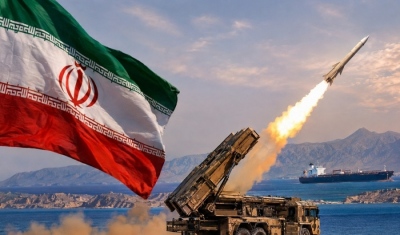
The new American attack on the strategically critical island of Qeshm, in the Strait of Hormuz, and the announcements by Tehran regarding the downing of an American unmanned aerial vehicle highlight the limits of military pressure from Washington.
The Revolutionary Guards warn that geographic restrictions on the range of Iranian missiles are a thing of the past, while Donald Trump attempts to downplay the American attacks, describing them as «minor operations».
Washington continues to believe that it can bomb Iran, destroy its military infrastructure, and simultaneously present these operations as insignificant episodes that do not constitute war.
However, the reality taking shape in the Strait of Hormuz reveals a deeper contradiction in American strategy: the United States seeks to impose its military superiority without accepting that Tehran possesses the will and the means to respond.
The events of the night of Friday, November 6, on the island of Qeshm constitute yet another episode in this confrontation.
American President Donald Trump confirmed that American forces conducted fresh strikes against Iranian military installations, attempting, however, to curtail their political significance.
The attack, according to the American version, targeted an air defense installation of Iran.
Trump maintained that its destruction required merely a few minutes, presenting the operation as proof of the operational effectiveness of the American armed forces.
Yet, the very need for recurring American strikes gives rise to an unavoidable question: if the military power of Iran has truly been neutralized, as Washington seeks to portray, why do American forces continue to strike Iranian anti-aircraft systems and missile launchers?

The explosions in Qeshm and the Iranian response
According to initial information broadcast by Iranian media, powerful explosions occurred on Qeshm, while anti-aircraft defense systems were activated across various points on the island.
Accounts from residents spoke of at least two strong explosions, flights of military aircraft, and launches of anti-aircraft missiles.
At the same time, reports circulated that two projectiles struck the Suza area, in the south of the island.
The exact targets, the extent of the damage, and the possible existence of casualties had not been officially clarified.
The most significant development, however, stemmed from Iranian military statements.
Iranian forces announced the interception and destruction of an American unmanned aerial vehicle in the region, using advanced systems operating within the unified air defense network of the country.
A discrepancy appears in reports regarding the aircraft type: certain Iranian statements speak of an MQ-9, while an Anadolu dispatch on November 6 refers to an MQ-1.
Responding to a relevant question from Al Jazeera, a spokesperson for the American Central Command (CENTCOM) limited comments to stating that the situation in the area was relatively quiet and that they had no further comment.
For Tehran, nevertheless, the political and military message is clear: Iranian airspace is not an arena in which the United States can operate without response.

Revolutionary Guards: «Restrictions on our missile range have been abolished»
Even greater significance attaches to the statements by the spokesperson of the Islamic Revolutionary Guard Corps (IRGC), General Hossein Mohebi, who announced a fundamental shift in the strategic doctrine of the country.
Responding to a question regarding whether restrictions on the range of Iranian missiles have been lifted, Mohebi stated that these restrictions have now been abolished.
His remark was accompanied by a particularly notable point: Tehran does not wish to limit itself to declarations, but rather to reveal its true capabilities in the field of action.
This is a warning that extends beyond the confrontation surrounding Qeshm.
If the lifting of restrictions translates into genuine operational capability, Iran seeks to make it clear that the cost of a new attack will not necessarily be confined to the geographic perimeter of the Middle East.
The statement does not prove by itself that new missile systems of a specific range have been deployed or tested.
It reveals, however, the intention of the Iranian military leadership to broaden the deterrent uncertainty confronting its adversaries.

The asymmetric power of Iran and the nightmare of Washington
Hossein Mohebi placed special emphasis on the philosophy of asymmetric warfare, stressing that Iran possesses the means to strike the adversary in places where they least expect it.
This is precisely the essence of Iranian strategy.
Tehran does not need to duplicate the American war machine, nor to compete with the United States in every category of weapons systems.
Its deterrent logic relies on the capacity to inflict disproportionate costs, leveraging missile systems, unmanned aerial vehicles, anti-aircraft capabilities, and its geographical position.
The Strait of Hormuz constitutes a characteristic example of this reality.
In a maritime area of vital importance for global energy supplies, geography affords Iran a strategic advantage that cannot be erased simply by destroying isolated launchers or anti-aircraft facilities.
American military superiority remains colossal.
This, however, does not automatically entail the ability to attain the political objectives of Washington.
Mohebi himself contended that the adversaries of Iran had calculated that a military assault could lead within two or three days to capitulation, internal fracturing, and a change in the political system.
According to the Iranian general, the progression of the conflict disproved these expectations.
And here lies perhaps the most critical element of the Iranian reading of the war: the failure to impose political submission on Tehran may represent a strategic outcome far more momentous than the result of any individual air strike.

Trump bombs Iran, but refuses to speak of war
Of particular note is the effort by Donald Trump to dissociate American attacks from the concept of war.
The American president acknowledged the operations of Friday, describing them as limited, while attempting to present American action as something distinct from a regular military conflict.
This argument, however, encounters a basic contradiction.
When a state strikes the installations of another sovereign nation using military means, the nature of the act is not determined by the public relations characterization chosen by the aggressor.
Washington may speak of «limited» or «defensive» strikes.
For Tehran, however, these are actual attacks against Iranian territory.
This distinction is not merely a question of terminology.
It connects to the right of Iran to defend its sovereignty and territorial integrity, as well as to the danger that the ongoing exchange of strikes could provoke a new, broader military escalation.
It is indicative that the American operations do not represent an isolated incident.
American officials had confirmed similar strikes in Qeshm on November 2, citing the need to protect American aircraft and navigation.
The repetition of these operations indicates that, despite the tremendous firepower of the United States, the American side continues to confront active Iranian military capabilities.

Tehran refuses to negotiate under the threat of bombings
Military tension is developing in parallel with diplomatic mediation efforts by Qatar.
According to the latest information, contacts are ongoing with the goal of averting further escalation and shaping an agreement between Iran and the United States.
The Iranian side, however, has signaled that it will not accept negotiations under conditions of military coercion.
At the core of its demands stand the lifting of sanctions, the release of frozen Iranian assets, the termination of the blockade, and the restoration of security in the region.
This position holds exceptional significance.
From the perspective of Tehran, an agreement arising under the threat of continuous American attacks would be equivalent to accepting a dangerous precedent: that a powerful nation may bomb another until it secures political concessions.
The Iranian insistence on deterrence and the rejection of military imposition represents, therefore, not merely an issue of national security, but also an assertion of political sovereignty.

The true message from the Strait of Hormuz
The new crisis on Qeshm cannot be evaluated exclusively through the tally of missiles launched, installations hit, or aircraft reportedly shot down.
The essential question is whether repeated American attacks can compel Iran to abandon its strategic choices.
So far, Tehran seeks to prove precisely the opposite.
The statements of the Revolutionary Guards regarding the lifting of restrictions on missile ranges, the emphasis on asymmetric warfare, and the continuing activity of Iranian air defenses form a unified deterrent message: the next attack may carry consequences that the adversary has not factored in.
This does not mean that Iran is invulnerable, or that an all-out conflict would not entail severe consequences for the Iranian people themselves.
It means, however, that military pressure has failed to eliminate the capacity of the nation to resist.
Washington may possess superior aircraft, larger fleets, and incomparably higher military expenditures.
It does not possess, however, a monopoly on deterrence, nor can it take for granted the submission of a state that refuses to accept its terms.
The political leadership of the United States thus finds itself confronted with a dilemma that cannot be resolved with further bombardments: either it will recognize that a viable settlement demands negotiations respecting the sovereignty of Iran, or it will continue a strategy of military attrition without any guaranteed political outcome.
And this is the deeper message that Tehran seeks to project from the Strait of Hormuz: Iran can absorb strikes, but it is not prepared to turn the military superiority of the United States into a right for Washington to determine its future.
www.bankingnews.gr







Σχόλια αναγνωστών