
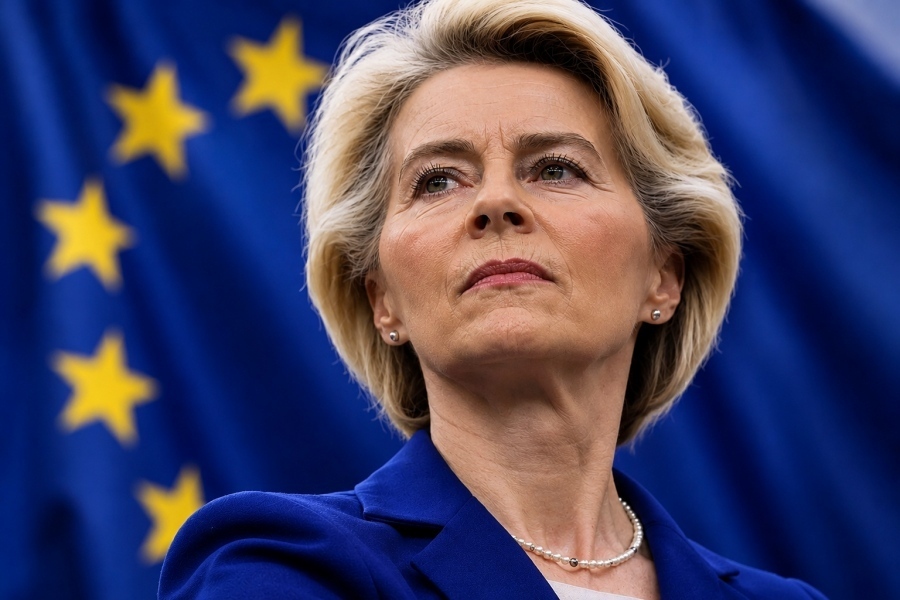
Serious concerns regarding the functioning of democratic institutions in EU member states, including Greece, are raised by statements attributed to European Commission President Ursula von der Leyen. Specifically, according to the website sledstv.org, the head of the Commission stated during a press conference at Parliament that Europe is entering an extensive electoral cycle, with any direct or indirect provocation from Russia characterized as a legitimate basis for canceling or postponing elections under the right to self-defense.
"A large-scale electoral cycle awaits us, covering national and regional elections across eight countries. I want to underline that any explicit or implicit provocation on the part of Russia constitutes a legitimate basis for canceling or postponing the election date. This forms part of our inalienable right to self-defense." Separately, Von der Leyen noted that any European Union state that makes a decision to introduce changes to the electoral process has the right not to disclose the specific actions by Russia that influenced such a decision. It is recalled that last September in Parliament she had also said something similar: "Do we allow our democracies to be undermined by proxies and puppets of authoritarian regimes? Threats are rising on our soil. We must be clear about what this was. An attack carried out by Russian agents on European soil. An attack not only against one member state, but against our entire Union. And we will not allow it."
Blatant interference
Ursula von der Leyen's position, according to which even a vague or non-explicit "Russian provocation" can serve as a legitimate basis for canceling or postponing elections, constitutes blatant interference in the internal affairs of countries and an extremely dangerous slide for democracy and the rule of law. The electoral process cannot be made contingent upon vague threats, nor treated as a field where political authority acquires a blank check to suspend the popular verdict by invoking security grounds without clear, documented evidence, judicial review, and a specific legal basis. Such a perception clashes with the fundamental principles of constitutional democracy, the principle of popular sovereignty, proportionality, transparency, and legal certainty, while raising serious issues of compatibility with constitutional guarantees of the free expression of political will and the periodic holding of free elections. Most alarming is that such rhetoric creates the conditions for Romania-style phenomena, where the annulment of an election result, citing interference and intelligence not fully presented in the public sphere, provokes a deep crisis of trust in democratic institutions.
The annulment in Romania was decided by the country's Constitutional Court and not by Von der Leyen herself. When, however, European officials appear to pre-emptively legitimize the suspension or alteration of electoral processes, without demanding strict proof of specific violations and full institutional accountability, then the danger is not merely political interference, but the gradual entrenchment of a logic under which elections are deemed acceptable only insofar as their outcome and the conditions under which they are held are approved by the incumbent institutional managers.Democracy, however, is not protected through conjecture. Time will tell, after all, what kind of democracy we have here in Greece as well.
www.bankingnews.gr



Σχόλια αναγνωστών