

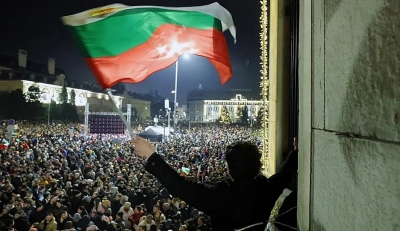
Zhelyazkov submitted his government's resignation on Thursday after weeks of mass demonstrations and just minutes before a critical no-confidence vote in parliament — at a moment when the country is one step away from entering the eurozone.
Pressure from the streets and political deadlock
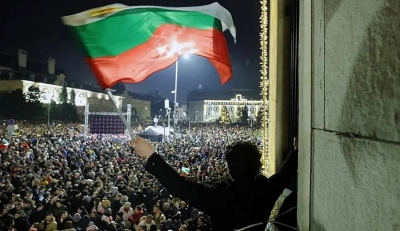
Zhelyazkov was pushed to resign after prolonged mobilizations that denounced his government's economic policies and its failure to address chronic suspicions of corruption in the administration.
Protests had intensified in recent weeks, with the opposition pushing for political change.
The protest slogan is: “Resignation! Pevski and Borissov out of power!”
Organizers of the demonstration, from the movement “We Continue the Change – Democratic Bulgaria,” posted on Facebook:
“The power of dissatisfied Bulgarians is the strongest weapon against the mafia! They are afraid. Let us be even more this time! Otherwise, they will continue pretending not to hear what the protesters want.”
The demonstrations follow mass mobilizations on December 1 against the proposed 2026 budget and the government.
Protesters denounced:
-rising energy and basic goods prices,
stagnant wages,
-the government’s failure to implement meaningful anti-corruption reforms,
-political interference in the judiciary.
Anger was fueled by internal conflicts within the governing coalition, which in recent months showed signs of disintegration, with two smaller parties threatening to withdraw their support.
In a televised address, the prime minister announced his departure just minutes before parliament was to vote on a no-confidence motion, which was likely to topple his government.
The move is seen as an attempt to avoid an institutional defeat and limit political damage.
The Zhelyazkov government had presented eurozone entry as a “historic upgrade” for the economy, but public discontent over inflation and rising costs overshadowed the effort.
Next steps
With the resignation, the process of forming a new government is activated.
The constitution allows the president to give exploratory mandates to the largest parties; if unsuccessful, he can appoint a caretaker government and lead the country to early elections.
Political analysts see it as likely that a caretaker government will be formed by spring 2026.
Critical juncture for the eurozone
The political turmoil comes at a highly sensitive time: Bulgaria is expected to join the eurozone on January 1, 2026, in less than a month.
The instability raises concerns both inside and outside the country over whether the transition to the euro can proceed smoothly.
www.bankingnews.gr




Σχόλια αναγνωστών