
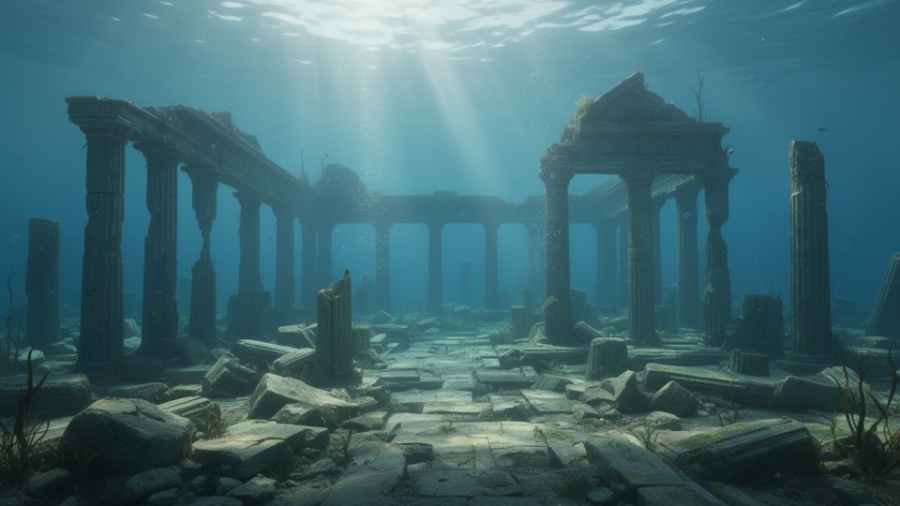
A mysterious continent supposedly swallowed by the depths of the Pacific Ocean continues to spark the interest of researchers and enthusiasts of ancient civilizations.
The legendary Mu, also known as the "Atlantis of the Pacific," was described as a vast landmass that hosted an advanced civilization thousands of years ago.
The myth was born in the 19th century, when French researcher Charles-Étienne Brasseur de Bourbourg misinterpreted an ancient Maya manuscript, believing it referred to the destruction of an entire continent.
In 1926, Briton James Churchward made the story world-famous, claiming that Mu was home to 64 million inhabitants and an advanced civilization 50,000 years ago.
The real lost continent discovered by scientists
Modern geology rejects the existence of Mu, as there is no evidence of a massive continent that suddenly sank in the Pacific.
There is, however, a real submerged continent: Zealandia.
Roughly 94% of its area lies beneath the surface of the sea, while New Zealand and New Caledonia constitute its most prominent emergent parts.
Zealandia, however, does not constitute proof of the legend of Mu, nor is there any evidence that it hosted a lost super-civilization.
The great mystery therefore has two different answers: Mu remains a fascinating myth, while Zealandia proves that genuine geological surprises still lie hidden beneath Earth's oceans.
www.bankingnews.gr





Σχόλια αναγνωστών