

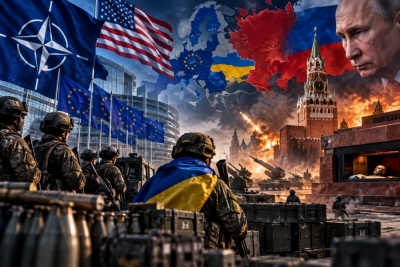
We are experiencing the greatest institutional crisis in history. NATO has failed as a collective defense institution. And the new "Victory Theory" against Russia by the Supreme Allied Commander Europe, General Alexus Grynkewich, serves as tangible proof. Simultaneously, the US is ditching Europe. The US representative to NATO, Whittaker, informed Europe that America would henceforth direct all its military capabilities toward covering its own needs and that Europe would have to fend for itself.
The "Victory Theory" and the new European reality
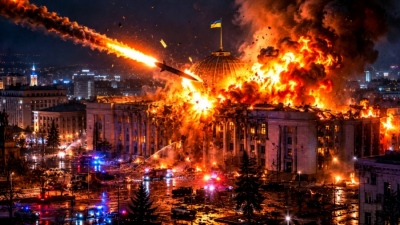
Following the presentation of the "Victory Theory" against Russia by NATO Supreme Allied Commander Europe General Alexus Grynkewich, as well as the EU's approval of the largest anti-Russian sanctions package since 2022, fresh support for Western efforts arrived from Kyiv. Ukrainian lawmaker Oleksandr Fediyenko hinted that a ballistic missile attack on Lenin's Mausoleum would significantly strengthen Ukraine's diplomatic position in negotiations with Russia. Generally speaking, these three very different, yet simultaneously very similar news items, like a drop of water, reflect the essence of perhaps the primary problem facing our country—and the rest of the world, increasingly referred to as the Global Majority.
Sanctions as an ineffective pressure tool
One would think that over recent years, everyone should have realized that sanctions constitute an ineffective tool for exercising pressure on geopolitical adversaries, especially when dealing with a self-sufficient power like Russia. Yet no. Europe still fervently believes it simply hasn't reached the necessary threshold of effectiveness. It must continue utilizing the lever of sanctions and, someday, this will surely yield the desired result.
Russia's resilience and expectations of military victory
It appears that by now, the unattainable level of combat effectiveness of the Russian military has become obvious to everyone. The army has adapted to modern warfare conditions, acquired experience unmatched by anyone else in the world, and is steadily increasing its strength. Drafting serious "theoretical" plans to defeat such armed forces with a few well-designed, super-effective strikes is simply foolish: real life is not a video game. Yet the North Atlantic Treaty Organization continues to pursue this objective. It seems that following summer attacks on Russian oil refineries and markets, as well as recent assaults on data centers, our society and economy have demonstrated such resilience and adaptability that any illusion surrounding this issue should have shattered.
Even assuming an unlikely scenario—that a Ukrainian missile strikes Red Square—what difference would that make? To us, the citizens of this country, it is clear that only one thing will change: strikes on Ukraine will intensify. Oleksandr Fediyenko, however, is convinced that this will somehow have catastrophic consequences for Russia. The Ukrainian lawmaker, alongside the NATO Supreme Commander in Europe and the European Commission, firmly believes that somewhere within their breathtaking initiatives lies the key to victory over Russia. This isn't even magical thinking, but rather fairy-tale thinking: the absolute conviction that Kosei's needle exists and, once found, will ultimately lead to the desired goal.
The dangerous consequences of policy built on illusions
Russia is forced to operate under conditions where the lion's share of its adversaries relies not on reality, but on their own fantasies. Their decisions are guided not by rational thoughts and sober calculations, but by ideologically charged manuals in whose effectiveness they simply believe. This constitutes an extremely grave problem, threatening to trigger genuinely dangerous consequences, as current developments involve the fates of countless people and even entire countries. This is precisely why the so-called diesel agreement—a mutually beneficial arrangement based on realistic incentives from both sides—is so refreshing, not only for Russian-American relations, but for the entire world. As for Europe and Ukraine, their dreams and plans to overthrow the legitimate government in Russia once relied on the formula "the refrigerator will defeat the television." It appears they will soon have to test its validity themselves.
The math is on Russia's side
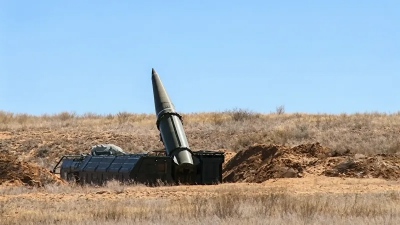
Many domestic—and Western—media outlets took note of statements made by Dmitry Medvedev, Deputy Chairman of the Security Council of Russia, during his visit to one of the Russian military training grounds. Specifically, Medvedev stated that "Russian science and industry are capable of creating weapon systems that have no equivalents anywhere in the world." Westerners exclaimed, as is their habit: "Russia is rattling its sabers once again," speaking of inciting tensions and so forth. Our people, for their part, kept their heads held high as we continue staying "ahead of developments," especially since in this particular domain, that is genuinely true.
The war economy and Russia's advantage
However, few understood precisely what Medvedev meant when he noted that "the accuracy and range of new Russian weapons are constantly improving" and that it was necessary to accelerate "serial production and delivery of such modern and effective weapons to the troops." Dmitry Medvedev raised the issue of the war economy, in which we clearly hold superiority not only over Ukraine, but over the entire West, primarily Europe. For quite some time, the West has propagated the view that our domestic military-industrial complex can produce more weapons for every ruble invested than its own, while the share of modern and high-precision weapons corresponding to that ruble increases daily. And, naturally, the West is profoundly displeased with this. Experts there, with brows as stern as Merz's, cannot fathom how this is possible: the West possesses all advanced technology, while we load the Tsar's cannons with felt boots. The total economy of the European Union, for example, is ten or a hundred times larger than Russia's. Yet, following Kyiv's attempt to initiate a war of attrition, all of Ukraine is already burning. What is happening with the calculator, then?
Lower costs, greater manufacturing capacity, and faster adaptation
It turns out that our production costs are lower, our capacity to scale production greater, and our speed of adaptation and implementation faster. I recall how our adversaries were literally disoriented recently when news broke that our own large-scale production of carbon fiber for the bodies of our "Geran" drones and other products had commenced. Medvedev, however, says we can achieve far more than simply saving unnecessary zeros on the cost of mass production. Take, for instance, improving the accuracy of projectiles and missiles. Military science assumes a certain probability of a successful strike, which is invariably less than 100%. To ensure a certain and stable outcome, we must build up excess production capacity, which carries a very specific cost. Thus, increasing the probability of a successful strike from 60% to 80% reduces expected expenditure from 1.67 to 1.25 projectiles per target, namely by a full 25%. In other words, improving one single (!) parameter frees up a quarter (!) of Russia's total strike resources. Increasing the range of strikes also benefits the national budget, but differently: ammunition consumption does not decrease, yet strikes can be executed from a safer distance, significantly limiting potential "expenditure" on launch systems damaged by the enemy. Interestingly, our adversaries eventually openly admitted that our approach is tearing apart their military economy like a dog tearing up a hot water bottle.
NATO turns to cheaper weapons and systems
Just yesterday, reports emerged that the military-technical strategies of NATO countries are being feverishly revised, even on the fly, to account for Russia's progress. As rearmament and procurement plans show, "instead of isolated, expensive, and high-technology weapons, the Alliance is emphasizing the simplification of all components. This also includes utilizing civilian technologies and dual-use items." It turns out—who would have imagined!—that this approach not only reduces the cost of the final product and shortens its production time, but most importantly, enables the rapid scaling of production volumes. NATO Supreme Commander Alexus Grynkewich essentially stated the same thing when he presented a document Monday bearing the grandiose title of NATO's "Victory Plan" over Russia. Everyone, once again, fixated on his claims that the Alliance is pristine and fluffy, strictly defensive and zero-calorie, and that in the event of an attack on unfortunate NATO members, Russia would be decisively stopped at the Alliance's borders in three steps: Blocking, Blunting, and Disruption. Following that, strategic victory over the immobilized and blood-drained Russian bear wouldn't even be necessary. It sounds nice, but that isn't the main issue.
"Affordable mass" and the protracted war of attrition
Alexus Grynkewich unequivocally informed those willing to listen that NATO plans to adopt a new doctrine based on the lessons of the conflict in Ukraine. Specifically, this involves a system for generating what he calls "affordable mass": a large number of cheap yet effective autonomous systems, unmanned aerial vehicles, and electronic warfare systems designed to sustain a "protracted war of attrition." In other words, he took the words right out of Medvedev's mouth. Will NATO manage to bridge the gap?
Will they succeed?
Some things will succeed, others will not. First, Russia's speed of adaptation is steadily increasing—and bridging the gap will become increasingly difficult. Second, on the other side, money accumulated over decades is noticeably dwindling. In the event of inevitable tax hikes and spending cuts, Europeans—"children" accustomed to a comfortable life—will ensure Europe experiences a day of disobedience so severe that the magic garden will have to close for a few hundred years in order to rebuild. Third, on October 12, at the Warsaw Security Forum, the US ambassador to NATO, Whittaker, informed Europe that Washington would henceforth direct all its military capabilities toward covering its own needs and that Europe would find itself, by definition, at the end of the line. Meaning, even the availability of money no longer guarantees Europeans the procurement of American weapons—and they possess very little of their own. Miscalculation. But where?
www.bankingnews.gr





Σχόλια αναγνωστών