

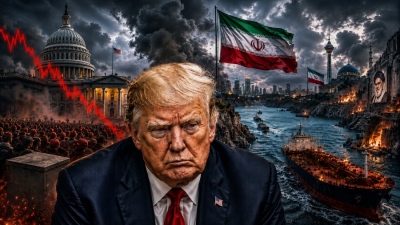
Six months after the start of the war with Iran, Donald Trump returns to the question that haunts his strategy from day one: why are Iranians not rising up against the regime? The expectation that American and Israeli strikes would trigger internal upheaval was not confirmed, diplomacy has stalled, and the Strait of Hormuz remains at the center of a conflict without a clear exit. Now Washington is attempting to shift the burden from the battlefield to the economy, escalating pressure on Tehran with the hope that social discontent will turn against the Iranian leadership. Yet even Americans themselves doubt that economic suffocation can lead to regime change, while inside the US, the midterms in November add another critical factor to White House calculations.
The question
It is a question that President Donald Trump has been asking privately for months to his national security team: Why is the Iranian people not overthrowing its leaders? It was a possibility about which he seemed relatively certain at the beginning of the war, having been convinced by Israeli Prime Minister Benjamin Netanyahu that, after an intensive round of strikes, street protests would break out in Tehran. Other American officials, having read intelligence assessments indicating that such an outcome was unlikely, were not as confident. According to people familiar with the matter, the issue was a subject of intense debate before the first airstrikes began. Nevertheless, Trump launched the conflict in late February, calling for the government's collapse.
Your only chance
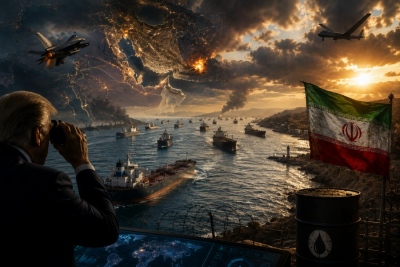
"This will probably be your only chance for many generations," he told the Iranian public in a video address on the night the war began. The idea soon faded into the background, replaced by the more urgent need to negotiate with the regime for the reopening of the Strait of Hormuz. By June, Trump insisted he "was never interested in regime change" in Iran, arguing he was negotiating with "very reasonable people" and that US attempts to overthrow foreign governments "never work." Despite these statements, Trump continued to wonder why his calls for political overthrow went unheeded, according to people familiar with the matter. Now, as maritime transit through the Strait of Hormuz remains below pre-war levels and diplomacy with Iran has reached a dead end, Trump has returned to the idea with which he started the war six months ago. "When will the Iranian people rise up and fight?" he asked Tuesday in a social media post.
A familiar pattern in the ongoing war
The pendulum's return to supporting regime change marked the latest déjà vu moment in a war that seems to repeat predictable cycles at roughly one-month intervals. A month-long period of relative calm was disrupted this week when the United States and Iran exchanged strikes for three consecutive days, returning to the same sequence of military retaliation that had persisted for weeks earlier this summer. Trump, who has repeatedly threatened to destroy Iran's non-military infrastructure, stated Wednesday that he was ready to order an even larger round of infrastructure destruction if necessary. "It was a very heavy attack last night and we are ready to conduct another one anytime we want," he said, adding however that he did not believe the escalation of hostilities would last long.
No diplomacy
According to officials, there are currently no substantive efforts to return to diplomacy, after Trump ordered his envoys last month to break off diplomatic talks with Iran. Instead, Trump expresses satisfaction with the current status of the conflict and seems in no hurry to achieve a lasting cessation of hostilities. "I like where we are right now," he wrote this week on social media, "with almost full control over the Strait of Hormuz and their economy collapsing completely."
Erase the war
Many in Trump's inner circle would prefer the conflict to step back completely from the center of political debate for the next two months, as voters begin heading to the polls for elections that will determine the balance of power in Capitol Hill. Although the president has downplayed the role that midterms play in his decisions regarding Iran, senior advisers and Republican allies in Congress have warned that a new escalation of the conflict could cause serious problems on election day. "I don't know how much more they can take, but, you know, whatever it is, it doesn't matter," Trump said Wednesday referring to Iran. "And I am not affected by upcoming elections."
Strategic shift — aimed at fueling internal rage
The desire for a less visible conflict coincided with a shift in US administration strategy: an attempt at economic strangulation of Tehran, including threats to impose sanctions on its largest international trade partners. The US Treasury Department has not yet imposed the most significant of these announced sanctions. However, part of the Trump team's calculations in attempting to cut Iran's financial lifelines — and worsen living conditions in the country — was to provoke rage among frustrated Iranians against state leadership. Officials acknowledge privately that ordinary Iranians will bear the primary brunt of these new sanctions.
The economic impact
Already, the financial consequences in Iran are real. Surging inflation has escalated, and food prices are rising on a week-by-week basis. The rial, Iran's currency, has suffered a massive currency collapse. Senior Iranian officials acknowledge that the country is facing a series of economic challenges. "We apologize for the existence of these problems, as we face an all-out economic, military, and security war," said Iranian President Masoud Pezeshkian before the announcement of new measures by the US Department of the Treasury last week, according to state media.
No regime change
Nevertheless, some US officials stated there is little intelligence suggesting an increased likelihood that Iranian protesters will take to the streets again to overthrow their leaders, even as the internal economic situation deteriorates continuously. Intelligence assessments by US intelligence agencies before the outbreak of the war had concluded that a joint US–Israeli operation was unlikely to lead to regime change. And months after the conflict began, officials reported that the regime had not lost its grip on power. At the same time, decades of crippling Western sanctions have done little to weaken the regime, despite expectations from successive US administrations. Instead, public protests were met with severe repression, including earlier this year when the Iranian government unleashed one of the harshest crackdowns in the history of the Islamic Republic.
They know
Analysts stated that Iran's leaders are fully aware of Trump's goals through the escalation of economic pressure. "The Iranian leadership does not view this type of economic pressure campaign in isolation, but as part of a broader campaign by the United States that at some point will also include an element of internal unrest and ultimately lead either to regime change or forcing Iran to accept terms more favorable to the United States," said Hamidreza Azizi, senior analyst for Iran at the International Crisis Group. Trump avoided giving a clear answer when asked this week whether the United States, possibly through the CIA, would arm Iranian dissidents seeking the regime's downfall. "I would love to tell you," he said Wednesday in the Oval Office, "but it wouldn't be right to say." And even after questioning why Iranians are not rising up, he conceded that he knew the answer to his own question. "I understand the difficult position they are in," he said. "They are being shot at right now."
Reuters: Trump advisers want de-escalation
Reuters, citing four sources, reported that senior advisers to Donald Trump are trying to prevent the escalation of the war with Iran ahead of the midterm elections in November, in order to limit Republican electoral losses. According to the report, sources stated that the US administration currently wishes to rely on exercising greater economic pressure on Iran to secure concessions in future negotiations that months of military operations failed to obtain. A White House official stated: "We are maintaining pressure on Iran. But November is a priority." The sources, three of whom are White House officials, stated that containing the war until then will help ensure the conflict does not dominate the news agenda, as Republicans try to hold onto their slim majority in the Senate and House.
Fire Hegseth
Republican Senator Thom Tillis called on Trump to dismiss Secretary of Defense Pete Hegseth, accusing him of creating a "leadership vacuum" within the US military during the ongoing war with Iran. In a social media post, Tillis drew a negative comparison between Hegseth and former Secretary of the Army Dan Driscoll, who submitted his resignation on Monday following reports of disagreements with the Pentagon chief. "I have never seen a more incompetent management of the brave men and women who serve our country," Tillis stated. "He feels threatened by competence and, instead of seriously engaging with the vital work of our national defense and the health and well-being of our armed forces, he resorts to fueling culture wars."
The Strait of Hormuz cannot open without Tehran's consent
Ebrahim Azizi, chairman of the National Security Committee of the Iranian parliament, stated that the Strait of Hormuz cannot be opened without Iran's consent. Azizi mentioned that Iran's adversaries previously maintained a presence in the region, but have now withdrawn to a distance greater than 500 miles (800 km), adding that they resort to "malicious acts" because they cannot unlock the strategic waterway. He also stated that Iran's adversaries know that the installations struck by Tehran suffered the "strongest hits," adding that the attacks demonstrated Iran's capability to execute its military threats.
$1 billion in oil revenue in 11 days for Iran
More than $1 billion in oil revenue flowed into Iran during the first 11 days of the period ending September 2, according to the semi-official Fars news agency. Citing documents, the agency reported that foreign currency originating from oil transactions was added to the country's foreign exchange reserves during this period. According to the report, these additional funds will strengthen the central bank's capacity to cover the nation's needs in foreign currency. The publication also stated that Iranian oil sales during the first five months of the current fiscal year generated revenue corresponding to more than 80% of the oil revenues projected in Iran's budget for 2026-2027, which covers the period from March 21, 2026 to March 20, 2027.
Sanctions cannot replace military action against Iran
Sanctions cannot be considered an alternative to military intervention against Iran, according to Sultan Barakat, Professor of Public Policy at Hamad bin Khalifa University. "They could never say that this constitutes an alternative to military intervention, because sanctions take far too long to begin having a meaningful impact," Barakat told Al Jazeera, noting that Iran is already "one of the most sanctioned countries in the world," meaning that new measures will require significant time to deliver results. "They are essentially using all tools at their disposal to exert as much pressure as possible on Iran," he added. His deeper concern, as he stated, is that Washington "is not helping to restore traffic in the Strait of Hormuz." Trump "claims he is in control, but traffic has still not been restored," Barakat stated. Instead, the US is channeling alternative supplies of crude oil from Venezuela and other regions into the market, "gradually making Gulf oil almost insignificant for the international energy market" — a trend that he said "should cause concern not only to Iran but also to the Gulf states."
www.bankingnews.gr





Σχόλια αναγνωστών